
Transforming Scrap Metal into 3D-Printable Resources: DARPA’s “Rubble to Rockets” Initiative at WPI
The landscape of additive manufacturing is continuously evolving, driven by groundbreaking initiatives from organizations like the Defense Advanced Research Projects Agency (DARPA). Following recent explorations into DARPA’s efforts to predict the lifespan of 3D-printed components, the agency continues to push innovation forward with significant new investments. On June 4th, the Worcester Polytechnic Institute (WPI) proudly announced a substantial $6.3 million grant from DARPA, earmarked for a revolutionary project. This ambitious endeavor, aptly titled “Rubble to Rockets,” aims to establish a comprehensive framework for transforming scrap metal and mixed alloys into viable 3D-printable material. The core objective of this initiative is to enable the on-demand production of critical components in even the most challenging and resource-constrained environments, ranging from active battlefields to urgent search-and-rescue operations. This project promises to redefine supply chain logistics for essential manufacturing, offering unprecedented flexibility and resilience.
At the heart of the “Rubble to Rockets” project lies the innovative application of machine learning and artificial intelligence (AI). The dedicated team at WPI will leverage advanced AI algorithms to meticulously identify and characterize various scrap materials, including complex mixed alloys. Understanding how these diverse materials react and bond together under specific conditions is paramount before they are melted and subsequently mixed for 3D printing. 3D printing, particularly with metals, demands an exceptionally precise understanding of material properties. Traditionally, this process necessitates carefully controlled, pristine materials and extensive, repetitive testing to ensure component integrity and performance. However, such ideal conditions are rarely available in dynamic, high-stakes scenarios like those encountered in the field or during emergency response situations. The integration of AI aims to circumvent these limitations by rapidly assessing and predicting material behavior, thereby streamlining an otherwise time-consuming and resource-intensive process.
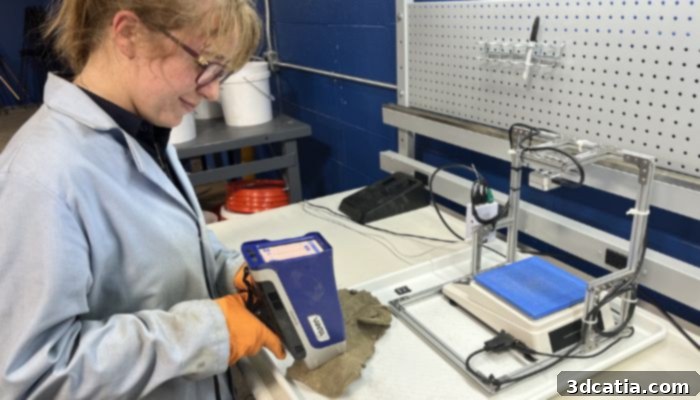
VALIS team member evaluating metal (Credit: VALIS)
The researchers will utilize sophisticated AI models, specifically developed by a WPI PhD student, to accurately predict the behavior of a given material based on its various chemical compositions and structural properties. This predictive capability is a game-changer, as it significantly streamlines the material characterization process. By accelerating the understanding of unknown or mixed material properties, the framework will enable faster production cycles without compromising the critical attributes of durability, strength, or structural integrity—factors that are non-negotiable for high-performance components. This approach not only enhances efficiency but also broadens the scope of materials that can be effectively utilized in additive manufacturing, moving beyond conventional limitations and opening new avenues for sustainable and responsive production.
Associate Professor Danielle Cote, a distinguished Professor of Mechanical and Materials Engineering and the lead researcher for the “Rubble to Rockets” project, highlighted the profound importance of this work. She stated, “This work is crucial, as it allows us to build high-quality components from unknown source materials with new confidence. Our goal is not just to build a single solution, but to create a framework that guides future innovations. By improving our predictions and understanding of material performance, we can pave the way for new advancements in additive manufacturing from diverse and unpredictable sources.” Professor Cote’s vision underscores a shift towards a more adaptive and resilient manufacturing paradigm. By developing a robust framework rather than a singular application, WPI and DARPA are laying the groundwork for a future where resource scarcity is less of a barrier to critical production, fostering innovation that transcends current limitations and promotes a circular economy within advanced manufacturing.
From Rubble to Rockets… And Beyond: Revolutionizing On-Demand Manufacturing
To rigorously validate and refine their pioneering framework, the WPI team will undertake a critical proof-of-concept demonstration: the design and fabrication of a sounding rocket. This test vehicle, constructed from mixed metals derived from scrap materials, will serve as a crucial benchmark for evaluating the structural integrity and performance of components produced through this innovative process. The successful flight of such a rocket would not only demonstrate the viability of the “Rubble to Rockets” concept but also inspire immense confidence in its broader applicability. However, the true potential of this technology extends far beyond this initial test. Its implications are transformative for a multitude of industries where reliable materials are critical but traditional supply chains are often fragile or inaccessible.
Consider sectors like energy and transportation, where the ability to rapidly produce or repair components using available resources could be a game-changer. Imagine a scenario aboard a submarine, an aircraft carrier, or within a remote disaster relief zone, where vital parts fail, and resupply is weeks away. With the WPI framework, these environments could potentially transform local scrap into functional components, drastically reducing downtime and improving operational readiness. This capability holds particular promise for defense applications, where localized manufacturing can enhance tactical advantages and minimize logistical vulnerabilities. Furthermore, in humanitarian efforts, the ability to rapidly produce essential tools or parts from reclaimed materials could accelerate recovery operations and save lives. The WPI framework directly addresses several key challenges that have long hampered the widespread adoption of such localized manufacturing: namely, ensuring consistent material performance from heterogeneous sources, minimizing the physical footprint and complexity of necessary equipment, and achieving unparalleled accuracy in predictive models for material behavior. By tackling these issues head-on, this groundbreaking approach simultaneously supports urgent emergency response needs and contributes to the long-term demands for sustainable, adaptable, and resilient manufacturing worldwide.
The success of this ambitious project is a testament to strong collaborative efforts. Beyond Associate Professor Cote’s leadership, the WPI team includes Assistant Research Professor Kyle Tsaknopoulos, along with a diverse group of talented PhD, master’s, and undergraduate students, all contributing their expertise to various facets of the research. This academic prowess is further amplified by strategic partnerships with several key subcontractors. These collaborators bring specialized knowledge and capabilities essential for turning the “Rubble to Rockets” vision into reality. Among them are two innovative WPI-led companies, highlighting the institution’s commitment to fostering entrepreneurial solutions directly from its research. Industry giant Siemens also plays a crucial role, likely contributing advanced manufacturing expertise and technological infrastructure. Additionally, two businesses hailing from California are vital to the project’s success: Nightshade Corporation specializes in the critical step of converting heterogeneous scrap metal into usable powder, a fundamental requirement for most metal 3D printing processes. The other Californian partner, Citrine Informatics, is a leader in materials AI and machine learning, providing the crucial algorithms and computational power needed to predict and optimize material behavior. Furthermore, VALIS, one of the WPI-led companies, is actively engaged in the recycling aspects of the project, focusing on maximizing the recovery and utility of valuable materials. This multifaceted collaboration ensures a holistic approach, covering everything from material sourcing and preparation to advanced AI modeling and final component production.

Scrap metal being melted along with in-melt analysis (Photo credit: VALIS)
Emily Molstad, co-founder and CEO of VALIS Insights, a key grant subcontractor, articulated the foundational ethos behind their involvement. She remarked, “VALIS was founded on the mission of delivering enabling technology to maximize the recovery of valuable materials for future generations. We see the recycling industry becoming increasingly vertically integrated as raw material producers and manufacturers aim to secure a reliable supply of scrap material and increase recycled content to drive down costs. The technology being developed through this program will unlock new levels of upcycling capabilities not only in remote, resource-restricted locations, but across the recycling value chain with the potential to strengthen domestic manufacturing capabilities.” Molstad’s insights underscore the broader economic and environmental implications of the “Rubble to Rockets” project. By developing sophisticated upcycling technologies, the initiative is poised to create a more resilient, localized, and sustainable manufacturing ecosystem. This vertical integration within the recycling and manufacturing sectors promises to reduce dependence on virgin raw materials, lower production costs, and significantly bolster domestic supply chains, contributing to national security and economic stability in an increasingly unpredictable world.
The “Rubble to Rockets” project is slated for completion in November 2027. Until then, the scientific community, defense sector, and additive manufacturing enthusiasts will eagerly anticipate updates on this pioneering research. This initiative by DARPA and WPI represents a pivotal step towards a future where manufacturing is no longer constrained by geography or resource availability, but empowered by ingenuity and the transformative potential of artificial intelligence and advanced materials science.
What are your thoughts on the groundbreaking “Rubble to Rockets” project and its potential to revolutionize manufacturing from scrap? Share your insights in a comment below or connect with us on our LinkedIn or Facebook pages! Plus, don’t miss out on the latest advancements in 3D printing – sign up for our free weekly Newsletter to receive top news directly in your inbox. You can also explore all our video content on our YouTube channel. For more in-depth coverage of 3D printing news across the aerospace and defense sectors, be sure to visit our dedicated page HERE.
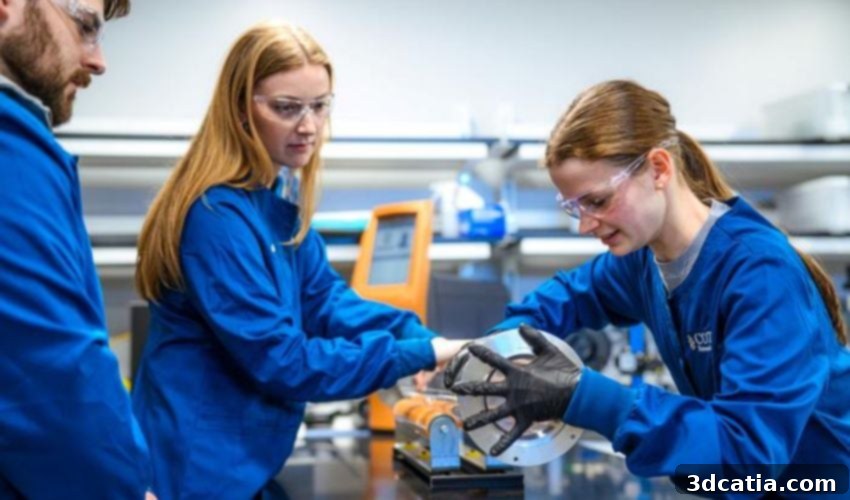
*Cover Photo: WPI student researchers in the advanced manufacturing lab. Credits: WPI