

Unlocking Nature’s Engineering: How 3D Printing Revolutionizes Shark Intestine Research for Advanced Fluid Control
Additive manufacturing, commonly known as 3D printing, is increasingly establishing itself as an indispensable tool for groundbreaking research discoveries within laboratories and university teams worldwide. Its unique capabilities enable scientists to investigate elements and intricate details that traditional methods simply cannot replicate or analyze without causing damage. A compelling illustration of this was the recent study of an ancient Egyptian mummy. Thanks to advanced 3D scanning and printing technologies, researchers were able to study the delicate artifacts and remains without any physical disturbance, creating exact replicas for in-depth analysis. This innovative approach primarily stems from the ability to accurately 3D scan an object, generate a precise digital twin, and subsequently reproduce it through 3D printing. This paradigm shift in research methodology continues to push the boundaries of scientific understanding, exemplified by a team of researchers at the University of Washington, led by physicist Ido Levin. They have harnessed 3D technologies to conduct an unprecedented investigation into the complex workings of the shark’s intestine, with the ambitious goal of mimicking its remarkable efficiency in a diverse range of engineering applications. These applications span from the development of highly efficient helical tubes to the creation of innovative “soft robots” – resilient, nature-inspired machines designed to perform tasks in environments where rigid robotics might fail.
Unveiling the Enigma of Shark Digestion
Despite the common perception that we understand much about the natural world, the specifics of what sharks eat and, more significantly, how their intricate intestines function have remained largely a mystery to scientists for decades. This knowledge gap began to close with a pivotal breakthrough in 2021. A collaborative team of researchers from California State University Dominguez Hills, the University of Washington, and the University of California published groundbreaking findings, accompanied by the first detailed images of shark intestines. To achieve this, the researchers employed a sophisticated 3D scanner to meticulously analyze the intestines of dogfish shark specimens, which had been carefully preserved at the Natural History Museum in Los Angeles. This non-invasive scanning process allowed them to generate high-resolution 3D images and digital models, providing an unprecedented view into the internal structure of these fascinating organs without causing any damage to the historical specimens. This initial step was crucial, laying the foundation for further biomimetic research by providing the detailed anatomical data required for accurate replication and study.
The Hydrodynamic Secrets of the Shark Intestine
The results derived from these initial 3D scans were truly extraordinary, leading to a profound understanding of how these unique spiral-shaped organs function. Scientists discovered that the intricate helical structure of the shark’s intestine plays a vital role in slowing the movement of food and efficiently directing it downward through the digestive tract. This process relies not only on peristalsis – the rhythmic contraction of the smooth muscles of the intestines – but also significantly on gravity. In essence, the intestines operate in a manner remarkably similar to the valve patented by the ingenious inventor Nikola Tesla in 1920. Tesla’s valve, known for its ability to allow fluid to flow in one direction while impeding flow in the opposite direction without any moving parts, finds a striking biological analogue in the shark’s digestive system. Further investigations through recent studies have revealed another critical characteristic: these structures also exhibit asymmetrical flows. This asymmetry is not merely a byproduct of their shape but a designed feature that actively promotes efficient flow along the digestive pathway, predominantly from the front (anterior) to the back (posterior). It’s this complex interplay of structure, gravity, peristalsis, and asymmetric flow that makes the shark intestine an incredibly efficient biological pump. Recognizing the immense potential of these characteristics, the team at the University of Washington embarked on a mission to leverage these natural engineering principles to design and create vastly improved helical tubes and fluid control systems for various industrial and scientific applications.
3D Printing to Create These Shark Intestine-Inspired Devices
The ambitious study by the University of Washington team, led by physicist Ido Levin, culminated in significant results, which were publicly shared in February 2023. Their innovative approach involved the meticulous 3D printing of high-fidelity replicas of shark intestines. This enabled them to precisely study the underlying physics and fluid dynamics that govern their astonishing efficiency. Specifically, the team utilized additive manufacturing to create simplified, yet biomimetic, models of the helical shark intestines. These models were carefully designed to capture the essential geometric and structural features responsible for the intestine’s unique flow control properties. By precisely measuring the flow of various fluids through these intricate 3D-printed structures, and critically, by testing flow in both forward and reverse directions, the researchers were able to accurately extract and characterize their fundamental hydrodynamic properties. This process allowed them to quantify the efficiency of the spiral valves and understand how they direct fluid movement. Furthermore, the study pushed the boundaries by printing these structures using softer, more flexible materials. This allowed researchers to investigate the intricate interaction between the deformation of the tube walls and the fluid flow rate, mimicking the natural elasticity and contractility of biological tissues. The ability to vary material properties through 3D printing provided an unparalleled opportunity to explore how material compliance affects flow dynamics, opening new avenues for designing adaptable and responsive fluidic systems.
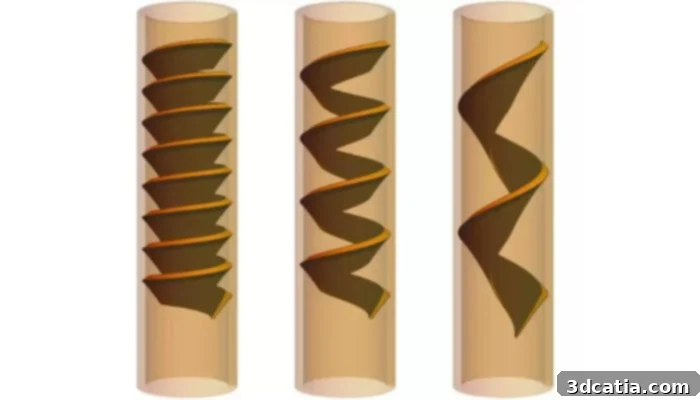
Photo Credits: Ido Levin/ University of Washington
Broadening Horizons: Applications of Shark-Inspired Fluid Control
The profound results yielded by this research are of immense importance, promising to revolutionize the design and engineering of various systems that demand precise control over fluid flow and pumping mechanisms. The ability to manipulate and control fluid direction and flow rates with such efficiency, inspired by natural biological systems, holds significant potential across a vast spectrum of engineering applications. Imagine the transformation in industrial piping, where more efficient, clog-resistant designs could lead to substantial energy savings and reduced maintenance. In the burgeoning field of microfluidic devices, often used in diagnostics and chemical analysis, these shark-inspired designs could enable unprecedented levels of precision and control over minute fluid volumes. For soft robotics, which are increasingly sought after for delicate tasks and human-robot interaction, incorporating flexible, efficient internal pumping systems could lead to more agile and biologically realistic movements. Furthermore, the implications extend critically to medical implants, where devices requiring controlled fluid delivery or waste removal could be designed to be far more effective and harmonious with the human body. This breakthrough therefore promises to be incredibly useful across numerous vital industries, including the food processing sector, where hygienic and efficient transport of liquids is paramount; the medical field, for drug delivery systems and artificial organs; the pharmaceutical industry, for precise handling of sensitive compounds; and the energy sector, for applications ranging from oil and gas transport to advanced cooling systems. The foundational understanding gained from this biomimetic research, made possible by advanced 3D printing, positions us at the cusp of a new era of fluid dynamics engineering. For those interested in delving deeper into the specifics of this groundbreaking research, the full study can be accessed in its publication HERE.
What are your thoughts on this fascinating application of additive manufacturing and biomimicry? We encourage you to share your insights and comments below, or engage with us on our LinkedIn, Facebook, and Twitter pages! Don’t miss out on the latest advancements and news in the 3D printing world; be sure to sign up for our free weekly Newsletter here, delivering the most relevant updates straight to your inbox. You can also explore all our informative and engaging videos on our dedicated YouTube channel, where we showcase the transformative power of 3D technologies.
*Cover photo: A detailed CT scan image illustrating the complex spiral intestine of the Pacific spiny dogfish shark (Squalus suckleyi). The anterior portion of the intestine is visible on the left, while the posterior end is on the right, highlighting its remarkable helical structure (photo credits: Samantha Leigh/California State University Dominguez Hills). This image vividly captures the natural inspiration behind the University of Washington’s pioneering research into fluid dynamics and biomimicry.