
The Featherweight Future: Exploring Graphene Aerogel, the World’s Lightest 3D Printed Structure
In the realm of advanced materials, innovation continually pushes the boundaries of what is possible. Graphene, a remarkable form of carbon, has long captured the imagination of scientists and engineers due to its unparalleled strength-to-weight ratio and exceptional electrical and thermal conductivity. While its individual properties are groundbreaking, the true magic often lies in how materials are combined and processed to unlock new capabilities. This is precisely what a team of pioneering engineers achieved, taking graphene’s inherent lightness and strength to an unprecedented level through cutting-edge 3D printing techniques. By integrating graphene with aerogel, they engineered a composite material so extraordinarily light yet robust that it earned recognition from the Guinness Book of World Records as the lightest 3D printed structure ever created.
Graphene itself is a marvel – a single layer of carbon atoms arranged in a hexagonal lattice. It is considered the strongest material known to man, approximately 200 times stronger than steel by weight, while also being incredibly lightweight and flexible. Its discovery garnered a Nobel Prize in Physics in 2010, ushering in a new era of material science. When harnessed in 3D printing, graphene offers the potential to create components that are not only durable but also significantly reduce overall mass, which is critical for applications ranging from aerospace to medical implants. However, achieving structures that fully leverage graphene’s potential, especially in complex, porous forms, presented significant challenges that required ingenious solutions.
Aerogel, the other half of this revolutionary composite, is often dubbed “frozen smoke” due to its ethereal appearance and incredibly low density. It is a synthetic porous ultralight material derived from a gel, in which the liquid component has been replaced with gas. This process results in a solid with extremely low density and low thermal conductivity. Aerogels are known for their exceptional thermal insulation properties, making them valuable in scenarios where heat transfer needs to be minimized. The porous structure of aerogel provides an expansive internal surface area, which contributes to its unique properties. Combining a material known for its lightness and insulative qualities with one renowned for its strength and conductivity offered a tantalizing prospect: a composite that could defy conventional material limitations.
The theoretical synergy between graphene and aerogel is compelling. Imagine a material that integrates the structural integrity and conductivity of graphene within the ultralight, highly porous framework of an aerogel. This combination promised a material with not only extreme lightness and strength but also potentially enhanced electrical, thermal, and mechanical properties. Indeed, the conceptualized graphene aerogel would represent a significant leap forward in materials engineering. Previous attempts by various researchers had managed to print using graphene aerogel, but these structures were typically limited to simple cylindrical or cubic forms. While impressive, these basic geometries restricted the material’s potential applications, particularly where intricate shapes or specific functional designs were required for handling and integration.
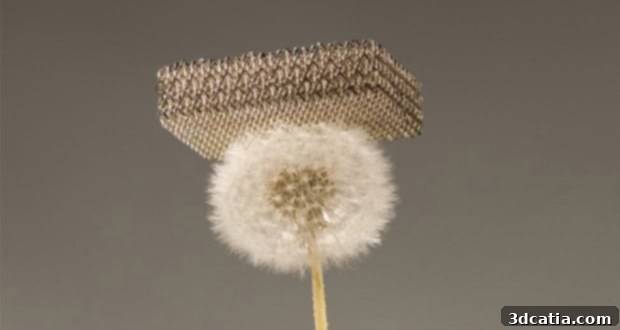
The breakthrough came from a dedicated team of three Chinese professors: Chi Zhou, Dong Lin, and Qiangqiang Zhang. Their innovative approach allowed them to overcome the limitations of previous methods, enabling the creation of graphene aerogel in much more complex and versatile forms. Their meticulously engineered structure weighs an astonishingly low 0.5 milligrams per cubic centimeter, making it lighter than air if scaled up, and significantly lighter than any other 3D printed structure before it. This featherlight material stands as a testament to the power of meticulous research and development, showcasing what can be achieved when brilliant minds converge on challenging material science problems. To put its incredible lightness into perspective, when a sample of this 3D printed graphene aerogel was gently placed on the delicate petals of a flower or a piece of cotton, it remained perfectly suspended without causing the slightest deformation or falling off, demonstrating its almost imperceptible weight coupled with remarkable structural integrity.

Researcher Chi Zhou with the 3D printer that was used to create the graphene aerogel
Professor Dong Lin underscored the profound implications of their creation, stating, “Graphene is a revolutionary material, and it makes sense that its aerogel form would be just as important. Our 3D printed graphene aerogel has important properties that give the material many applications for better electronics, batteries, or semiconductors.” This statement highlights the critical role of this novel material, not just as a record-holder, but as a foundational component for next-generation technologies. The ability to precisely control the internal architecture of this composite means that its electrical and mechanical characteristics can be tailored to specific performance requirements, opening up a vast array of possibilities across multiple industries.
The method developed by the researchers for creating this extraordinary graphene aerogel is both innovative and meticulous. They utilized a specialized two-nozzle inkjet printer, a common technology adapted for this delicate task. Instead of traditional inks, these nozzles precisely deposited droplets of graphene oxide and water onto a plate maintained at an extremely low temperature of -20°C. This sub-zero environment was crucial, as it caused the water in the droplets to freeze instantly upon contact. The result was a 3D printed ice structure, intricately interwoven with graphene. This controlled freezing process was key to enabling the graphene to retain its desired shape and maintain the structural integrity necessary for the aerogel’s final form. The ice acted as a temporary scaffold, holding the graphene in its intended configuration during the initial stages of printing.
Once the 3D printing of the graphene-infused ice structure was complete, the subsequent step involved transforming this frozen composite into the porous aerogel. The researchers carefully transferred the 3D printed material into a freeze dryer. This sophisticated equipment subjects the material to a high vacuum and low temperature, a process known as lyophilization or freeze-drying. Under these conditions, the frozen water (ice) sublimates directly into vapor, bypassing the liquid phase entirely. This critical step ensures that the delicate graphene network is not subjected to the surface tension forces that would occur during conventional drying, which could cause the fragile structure to collapse. The removal of ice through sublimation leaves behind an incredibly porous, lightweight, and robust 3D graphene aerogel. One of the most remarkable outcomes of this process is that the resulting graphene aerogel is able to retain its complex, intricate shape even at room temperature, demonstrating its inherent stability and structural resilience, a significant achievement for such a lightweight material.
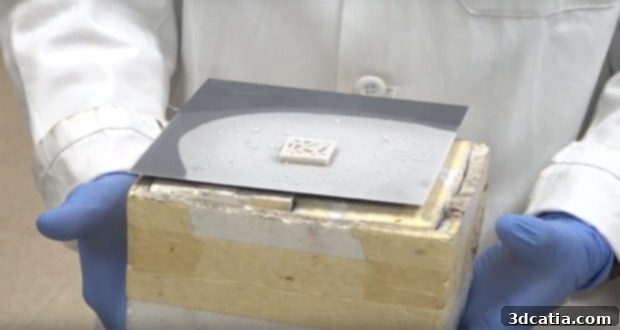
A sample of the frozen 3D graphene aerogel
The precision offered by this 3D printing method is a cornerstone of its success and future potential. As Professor Lin further elaborated, “With this 3D printing method, we can control the shape of the graphene aerogel and ideally we can control the electric and mechanical properties for the aerogels, too.” This level of control is paramount for tailoring materials to specific applications. The ability to dictate not just the macro-scale shape but also the micro-scale porosity and density means that engineers can design graphene aerogel structures with optimized strength for load-bearing applications, specific conductivity for electronics, or enhanced surface area for catalytic processes. This bespoke approach to material design unlocks a new era of functional materials, moving beyond generic forms to highly customized solutions.
While the three researchers humbly stated that they did not expect to win a world record, their groundbreaking work undeniably showcases the full, transformative potential of graphene aerogel. This scientific achievement is more than just a novelty; it represents a significant leap forward in materials science and manufacturing. The implications for various industries are vast and profound. Imagine flexible batteries that can be bent, twisted, or integrated seamlessly into wearable electronics or smart textiles, offering significantly longer life and faster charging times due to the high surface area and conductivity of graphene aerogel. Picture next-generation semiconductors that are not only lighter and more efficient but also more robust and capable of operating in extreme environments, thanks to the inherent properties of this composite material.
Beyond electronics and energy storage, the applications of 3D printed graphene aerogel could extend to thermal insulation for aerospace components, where every gram saved is critical, or for high-performance building materials that offer superior energy efficiency. Its high porosity and surface area could also make it an excellent candidate for environmental remediation, such as absorbing pollutants from water or air, or for advanced catalyst supports in chemical reactions. Furthermore, in the biomedical field, its biocompatibility and structural integrity could lead to innovations in tissue engineering scaffolds or novel drug delivery systems. The research by Professors Zhou, Lin, and Zhang has laid a robust foundation for these future innovations, igniting new avenues for exploration and development in the world of advanced materials.
The future, illuminated by their research, promises an exciting era where flexible batteries and highly efficient semiconductors might become commonplace, leveraging the unique characteristics of graphene aerogel. This material is not merely an improvement on existing technologies; it represents a paradigm shift in how we conceive and produce materials with extraordinary properties. The ability to precisely engineer such a light yet strong, conductive, and adaptable material via 3D printing signifies a new frontier in additive manufacturing, moving us closer to a future where materials are perfectly designed to meet the demands of advanced technological systems. Their work inspires further research into nanostructured materials and the limitless possibilities they hold for a sustainable and technologically advanced world.
To delve deeper into the fascinating process and witness this incredible material in action, we invite you to check out the video below:
What are your thoughts on the groundbreaking potential of graphene aerogel? We would love to hear from you! Share your insights and comments below, or join the conversation on our Facebook and Twitter pages! And to stay informed about all the latest advancements and news in the dynamic world of 3D printing, don’t forget to sign up for our free weekly Newsletter, delivered straight to your inbox!