
Revolutionizing Wildlife Protection: How 3D Printed Shark Fins Combat Illegal Trade
In a significant stride for wildlife conservation, additive manufacturing is once again proving to be an indispensable tool. TRAFFIC, a leading non-governmental organization (NGO) dedicated to combating the illegal wildlife trade, has announced a groundbreaking initiative: the deployment of the world’s first-ever 3D printed shark fin replicas. These hyper-realistic models are designed to equip customs officials and enforcement officers with an unprecedented tool to identify and seize illegally smuggled protected shark species. The global demand for shark fins continues to escalate, driving numerous shark populations to the brink of extinction through rampant smuggling and unsustainable overfishing. With TRAFFIC’s innovative approach, officials can now freely download high-fidelity 3D scans from the organization’s website, enabling them to produce their own accurate replicas. These replicas serve as invaluable training aids and identification tools, significantly bolstering efforts to distinguish between legal and illicit shark fin consignments and, ultimately, helping to stem the tide of illegal trade.
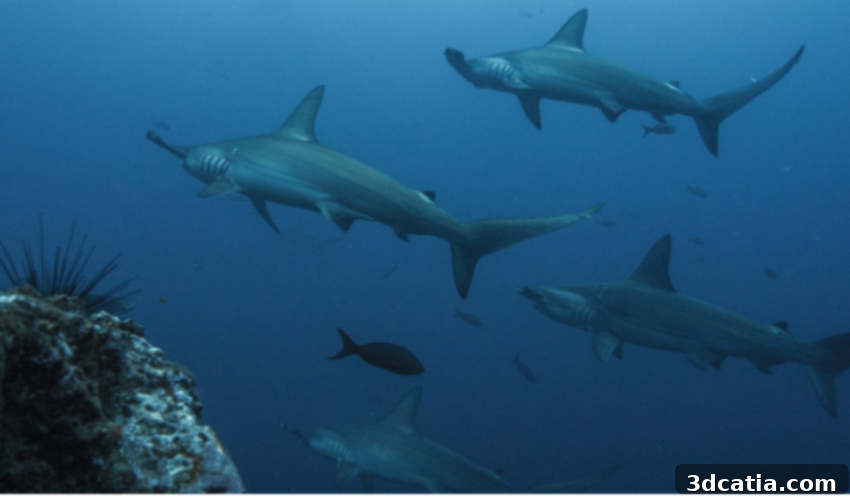
The scale of the illegal shark fin trade is staggering, with global estimates suggesting that between 26 and 73 million sharks are traded annually. Experts believe these figures might even be conservative, underscoring the immense pressure on shark populations. Beyond illicit trade, widespread overfishing further exacerbates the crisis, leading to severe negative consequences for marine biomes and a dramatic decline in marine biodiversity across the globe. The World Wildlife Fund (WWF) highlights that a combination of these factors, coupled with general ocean degradation, has rendered numerous shark species endangered or vulnerable. Prominent examples include the Oceanic Whitetip, porbeagle, and three distinct hammerhead species, all facing critical threats. Recognizing their extreme vulnerability and frequent appearance in illegal trade, TRAFFIC meticulously selected these species, among others, for inclusion in their comprehensive library of scanned shark fins, ensuring the replicas address the most pressing conservation needs.
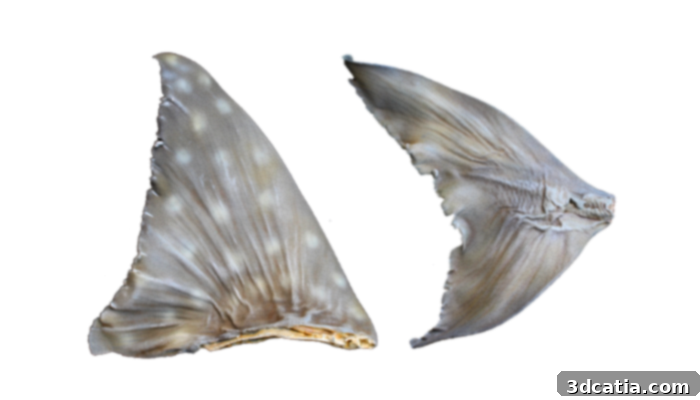
3D printed and painted Bowmouth Guitarfish fins (photo credits: TRAFFIC)
Addressing a Critical Gap: Why 3D Printed Replicas Are Essential
TRAFFIC initiated this groundbreaking program to tackle a significant challenge faced by law enforcement: the inherent difficulty in accurately identifying dried shark fin species by visual inspection alone. This task is particularly daunting without specialized training, which is often scarce or insufficient for many customs and law enforcement agencies globally. Furthermore, these critical organizations, vital in the fight against wildlife trafficking, frequently operate under considerable constraints, including inadequate staffing and limited access to essential equipment and advanced identification tools. Traditional identification guides, while useful, often fall short when dealing with the nuanced characteristics of dried fins, which can vary significantly in appearance due to processing, age, and damage.
In this context, 3D printed replicas emerge as a transformative solution. They offer a cost-effective, easily accessible, and user-friendly identification tool that dramatically enhances the capabilities of enforcement personnel. Markus Burgener, a TRAFFIC fisheries trade expert, eloquently articulated the anticipated impact: “These replica fins are expected to significantly improve the accuracy of active inspection, identification, and seizure of illegal shark fin consignments. They will help empower law enforcement officials the world over to more effectively disrupt the illegal trade in shark fins, which is causing significant detriment to our oceans.” This initiative represents a paradigm shift, moving beyond conventional methods to provide tangible, hands-on training and reference materials that are critical for effective interception of illegal goods. The ability to handle and compare physical replicas to suspected illicit fins greatly reduces identification errors and boosts confidence among officers, making their efforts more impactful.
The Technology Behind the Replicas: Precision 3D Printing for Conservation
To achieve the ultra-realistic fidelity required for effective identification, TRAFFIC specifically recommends employing Selective Laser Sintering (SLS) 3D printing technology coupled with nylon material. This particular combination is crucial because it allows the replicas to exhibit a distinctively rough, sandpaper-like texture that closely mimics the tactile qualities of actual dried shark fins. The choice of SLS is paramount; unlike other 3D printing methods, SLS produces parts with excellent mechanical properties and a porous, slightly granular surface finish. This surface characteristic is not only realistic but also provides superior paint adhesion, a critical factor for accurately replicating the intricate patterns and colorations of various shark species.
While professional SLS machines represent a significant investment and may not be readily available to every organization, TRAFFIC has addressed this potential barrier. Organizations lacking in-house SLS capabilities can easily send the provided 3D files to specialized 3D printing service providers. These service bureaus possess the advanced equipment and expertise to produce the necessary parts to TRAFFIC’s exacting specifications. Nylon, as the material of choice, offers several compelling advantages. Beyond its unique texture, it boasts an excellent strength-to-weight ratio, ensuring the replicas are durable enough for repeated handling and training exercises without being overly heavy. Crucially, its inherent properties allow for robust paint adhesion, a feature often problematic with other smoother 3D printing materials, which can resist paint or lead to chipping. This ensures that the highly detailed markings and colorations, essential for species identification, remain intact and accurate over time.
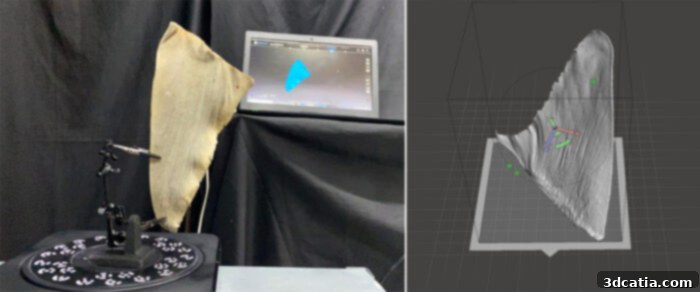
The scan and the completed replica shark fin (photo credits: TRAFFIC)
Accuracy, Collaboration, and Global Impact
A cornerstone of this project’s success lies in the meticulous attention to detail regarding distinctive markings and coloration – features that are absolutely crucial for accurate species identification. The development of these highly precise digital renderings was a collaborative effort, benefiting from the invaluable support of the South African Department of Forestry, Fisheries and Environment, alongside the expertise of renowned American shark expert Debra Abercrombie. This inter-agency and expert collaboration ensured that the 3D scans are as scientifically accurate and biologically representative as possible. The fidelity of these scans is paramount, guaranteeing that the resulting 3D printed replicas serve as truly reliable and effective tools in the global fight to halt the illegal shark fin trade and protect vulnerable marine life.
The accessibility of this innovative solution is a key factor in its potential widespread impact. The complete suite of 3D scan files, encompassing 22 distinct fins from 11 different shark species, along with detailed printing and painting instructions, is generously provided for free on the TRAFFIC website. This open-source approach empowers law enforcement agencies and conservation organizations worldwide to immediately benefit from this technology. The efficacy of these replica fins has already been rigorously tested by law enforcement officials in South Africa. Their findings unequivocally demonstrated that using the 3D printed fins significantly enhanced their ability to identify shark fins with greater confidence and ease compared to traditional identification guides. This practical validation underscores the tangible benefits of the program.
Should these highly accurate 3D scans and replicas become more widely adopted and utilized, they hold the immense potential to revolutionize officer training and education. By providing a standardized, repeatable, and highly realistic training aid, even more officials can be thoroughly educated in the nuanced, distinctive characteristics of various shark fins. This increased proficiency will lead to more rapid and accurate identification of fins from endangered species, enabling faster intervention and seizure of illegal shipments. Ultimately, this initiative by TRAFFIC, powered by 3D printing technology, represents a powerful weapon in the ongoing battle against wildlife crime, fostering a future where marine biodiversity is better protected. You can find out more and access the resources on TRAFFIC’s website HERE.
Beyond Shark Fins: The Broader Impact of 3D Printing in Wildlife Conservation
The application of 3D printing in creating realistic shark fin replicas is a testament to the versatility and transformative potential of additive manufacturing in wildlife conservation. This innovative use case joins a growing list of successful implementations where 3D printing is making a tangible difference in protecting endangered species and fragile ecosystems. For instance, 3D printing has been instrumental in creating custom-fit prosthetics for injured animals, from beaks for birds to shells for tortoises, allowing them to regain mobility and lead healthier lives. This personalized approach to animal welfare would be cost-prohibitive and impractical with traditional manufacturing methods.
Furthermore, 3D printing plays a crucial role in habitat restoration, particularly for marine environments. Projects involving 3D printed coral reefs, often made from specialized ceramic or stone-like materials, provide new substrates for coral polyps to attach and grow, helping to regenerate damaged reef ecosystems. These artificial structures are designed to mimic natural coral formations, providing shelter and breeding grounds for a diverse array of marine life. In the fight against poaching, 3D printed models are used for educational purposes, teaching anti-poaching units about animal anatomy or creating realistic mock-ups of illegal wildlife products for training detection dogs and customs officers, similar to the shark fin initiative.
The technology also contributes significantly to research and education. Scientists use 3D printing to create accurate anatomical models of rare or extinct species, facilitating detailed study and understanding without disturbing delicate specimens. These models are also invaluable educational tools in museums and classrooms, raising public awareness about biodiversity and the threats faced by wildlife. The ability to quickly and affordably produce highly detailed, customized objects positions 3D printing as a cornerstone technology for future conservation efforts, extending its reach from direct animal aid to ecosystem restoration and empowering enforcement agencies with cutting-edge tools. The TRAFFIC shark fin project is a prime example of how this technology can be leveraged to address specific, urgent conservation challenges with precision and global scalability.
What are your thoughts on this pioneering use of 3D printing to create the first-ever 3D printed replica shark fins for conservation? We invite you to share your insights in a comment below or connect with us on ourFacebook,Twitter, andLinkedIn pages! Don’t miss out on the latest advancements in additive manufacturing – sign up for our free weeklyNewsletter here, delivering the most current 3D printing news straight to your inbox!