
Unlocking Affordable VR Immersion: How LucidVR’s 3D Printed Haptic Gloves Revolutionize Virtual Reality
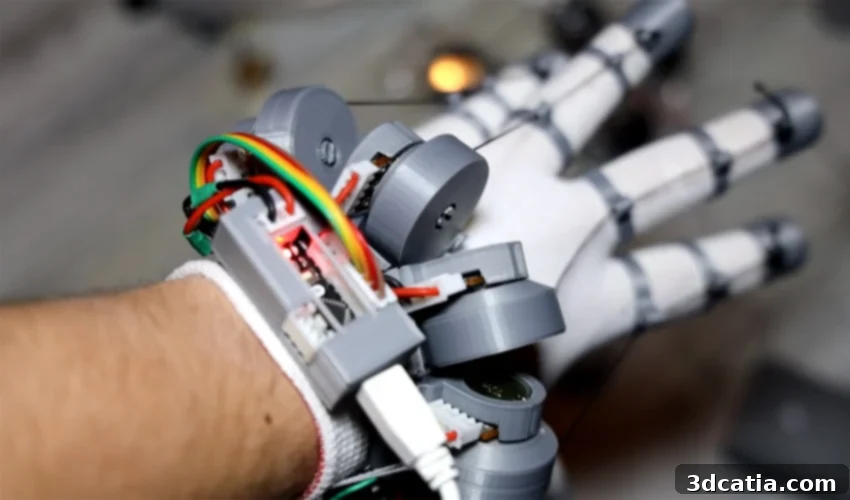
The world of virtual reality promises unparalleled immersion, a digital realm where boundaries blur and digital experiences feel almost tangible. However, achieving true immersion, particularly through realistic tactile feedback, has long been a costly endeavor. Enter Lucas VRTech, a visionary young YouTuber whose ingenuity during lockdown led to the creation of LucidVR – a groundbreaking pair of 3D printed VR gloves. Conceived as a personal project to simply keep himself busy, Lucas had no idea that his innovative design would capture the imagination of over 200,000 followers and ignite a passion for accessible VR technology. LucidVR stands as a testament to the power of open-source innovation, demonstrating that high-fidelity virtual reality experiences can be within reach for anyone with the right tools and a creative spirit.
At the heart of Lucas’s project was a profound desire to democratize haptic VR gloves. These advanced accessories are designed to bridge the gap between digital interaction and physical sensation, allowing users to experience the virtual world with an unprecedented level of realism. Imagine reaching out to grasp a virtual object and feeling its shape, texture, and weight, or experiencing the subtle touch of a virtual surface. Such tactile feedback is crucial for achieving total immersion, transforming passive viewing into active engagement. Yet, the barrier to entry for this technology has traditionally been its exorbitant price tag, often placing it out of reach for enthusiasts and independent developers. Commercial haptic solutions, while impressive, are typically aimed at enterprise applications or niche professional markets due to their high development and manufacturing costs.
Lucas VRTech identified this critical accessibility gap and set out to provide an alternative. As he articulates on his project site, “Currently, most VR Haptic Glove products out there are extremely expensive and are targeted for commercial use. In starting this project, I wanted to create a budget, but still well-functioning VR Haptic Glove that’s cheap and easy for people to get their hands on.” This mission statement perfectly encapsulates the spirit of LucidVR: delivering high-quality virtual reality haptics without the prohibitive cost. By embracing a do-it-yourself (DIY) approach and leveraging readily available technology, Lucas has carved a path for enthusiasts to build their own immersive VR solutions, fostering a more inclusive and innovative VR ecosystem.
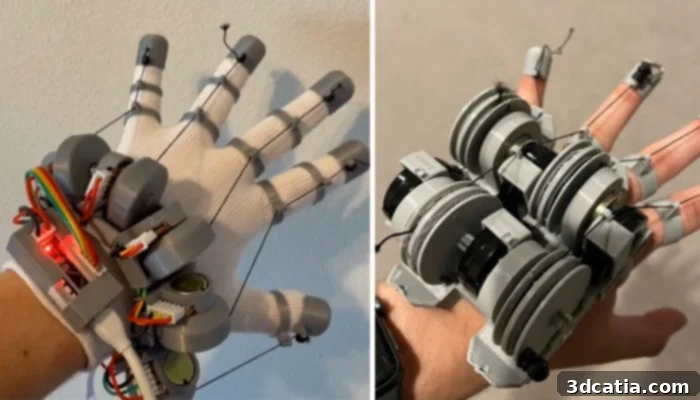
LucidVR’s different prototypes illustrating the project’s evolution (photo credits: Lucas VRTech)
3D Printing: The Cornerstone of LucidVR’s Affordable Innovation
The feasibility of the LucidVR project hinges largely on one pivotal technology: FDM (Fused Deposition Modeling) 3D printing. Lucas VRTech ingeniously turned to this additive manufacturing method to rapidly design, iterate, and produce his prototypes. FDM 3D printing, a process where a thermoplastic filament is heated and extruded layer by layer to build a three-dimensional object, proved to be the ideal choice due to its accessibility, cost-effectiveness, and flexibility. It allowed Lucas to quickly transform his digital designs into physical components, testing various iterations and refining his ideas with remarkable efficiency. This rapid prototyping capability is essential for any ambitious hardware project, enabling quick adjustments and improvements without the significant financial outlay typically associated with traditional manufacturing processes.
Currently, the LucidVR gloves are in their third significant iteration, a testament to the continuous development and refinement made possible by 3D printing. These iterations have brought the gloves to a point where they reliably allow the wearer to track their individual finger movements within virtual reality environments, completely eliminating the need for cumbersome or expensive dedicated VR controllers for hand presence. While the current version excels at accurate finger tracking, Lucas’s future plans include integrating advanced haptic feedback, a feature that promises to elevate immersion even further by allowing users to truly “feel” their virtual interactions. This phased development approach, facilitated by iterative 3D printing, ensures that the project remains focused on delivering core functionality while progressively adding more complex features.
Perhaps the most compelling aspect of the LucidVR project is its incredibly low manufacturing cost. Lucas proudly states that producing a single glove costs him an astonishing $11. This figure encompasses the cost of the 3D printer filament and all the necessary electronic components. Such an unprecedented low cost shatters the traditional paradigm of expensive VR hardware, making high-fidelity virtual reality accessible to a much broader audience. Of course, users will need access to a desktop 3D printer to fabricate the plastic components. However, this is no longer a significant hurdle, as the market is now flooded with a wide array of affordable 3D printer models, making this technology more widespread and economical than ever before. This convergence of accessible 3D printing and open-source design is what truly empowers the LucidVR revolution.
The Open-Source Advantage: Empowering the VR Community
Beyond the innovative use of 3D printing, the philosophical core of LucidVR lies in its commitment to being entirely open-source. Lucas VRTech has generously published all comprehensive manufacturing instructions, along with the essential STL files required for 3D printing the components. This open-source approach means that anyone with a 3D printer and a willingness to learn can replicate, modify, and even improve upon the LucidVR design. The published documentation includes a detailed list of all necessary parts to purchase, such as five specialized tensioners per hand. These tensioners are essentially types of resistors meticulously designed to measure the traction of strings that correspond to and control finger movements. Each glove also necessitates an Arduino microcontroller, the brains of the operation, which integrates with several 3D printed parts.
The project involves printing six distinct types of parts, including the tensioner housings and caps, all crucial for the glove’s functionality. Lucas emphasizes that virtually any FDM 3D printer should be capable of producing these components, making the project highly accessible even for hobbyists with entry-level machines. For optimal print quality and performance, he specifically recommends using a 0.4 mm nozzle diameter, a standard size found on most desktop FDM printers. Furthermore, Lucas goes the extra mile by providing detailed guidance on the optimal orientation of parts on the print bed. This seemingly minor detail is incredibly important for ensuring structural integrity, minimizing support material, and optimizing the overall printing process, showcasing the thoughtfulness embedded within the open-source instructions. This level of detail empowers even novice makers to successfully embark on building their own LucidVR gloves, fostering a true spirit of DIY innovation within the VR community.
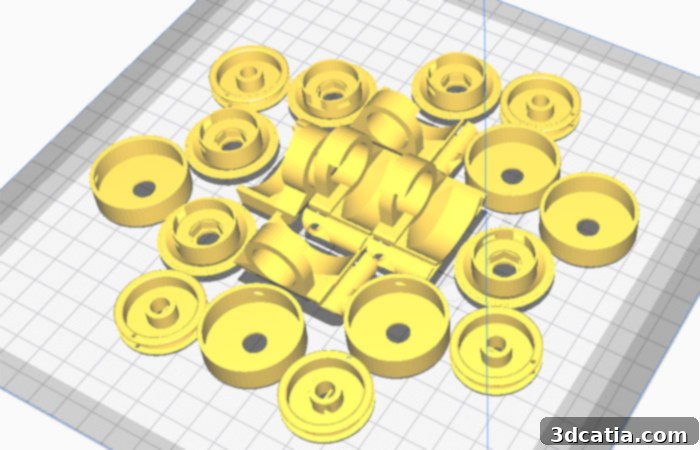
Detailed printing instructions are openly available online, fostering community participation (photo credits: Lucas VRTech)
Current Capabilities, Future Innovations, and Broad Compatibility
The LucidVR gloves, in their current iteration, offer impressive compatibility with a wide range of PCVR headsets via SteamVR, a popular platform for virtual reality content. Lucas has personally verified their functionality on various systems, including successful testing with the classic Oculus Rift CV1, demonstrating the project’s broad applicability across different VR ecosystems. This compatibility ensures that users can integrate these affordable 3D printed gloves into their existing VR setups without significant technical hurdles, making the barrier to entry even lower. The ability to utilize the gloves with established VR platforms enhances their appeal and practical utility for a diverse audience of VR enthusiasts.
Looking ahead, Lucas VRTech is not resting on his laurels; he is already actively developing his fourth prototype. The primary objective for this next iteration is the full integration of haptic feedback. This critical enhancement will be a game-changer, moving beyond mere finger tracking to allow users to genuinely “feel” their virtual surroundings. Imagine reaching out to a virtual button and feeling a subtle click, or picking up a digital item and sensing its weight and texture. This level of tactile realism profoundly deepens immersion, making virtual interactions feel more natural, intuitive, and believable. The goal is to enable users to truly perceive what they touch, grasp, and manipulate within the virtual environment, pushing the boundaries of what is possible with accessible VR hardware. This continuous pursuit of innovation underscores Lucas’s dedication to his project and his vision for the future of virtual reality.
The LucidVR project is more than just a pair of gloves; it represents a burgeoning movement towards open-source, accessible virtual reality. Lucas VRTech’s initiative demonstrates that with creativity, readily available technology, and a commitment to community sharing, groundbreaking innovations can emerge from unexpected places. His work is inspiring a new generation of makers and enthusiasts to engage with VR hardware in a hands-on, DIY fashion, ultimately accelerating the development and adoption of truly immersive virtual experiences for everyone. We extend our best wishes to Lucas in his ongoing technological journey and eagerly anticipate the evolution of LucidVR. You can explore all the detailed manufacturing and printing instructions, join the community, and track the project’s progress HERE.
What are your thoughts on these innovative 3D printed VR gloves and their potential to transform virtual reality accessibility? We’d love to hear from you! Share your comments below or engage with us on our LinkedIn, Facebook, and Twitter pages. To stay informed about the latest advancements in 3D printing and related technologies, sign up for our free weekly Newsletter here, delivered straight to your inbox! You can also find an extensive collection of our videos and project insights on our dedicated YouTube channel.