
Standardizing Macro-Scale 2PP 3D Printing: A Breakthrough in Material Testing for Industrial Adoption
The landscape of additive manufacturing is continuously evolving, driven by innovative technologies that push the boundaries of precision and complexity. Among these advancements, two-photon polymerization (2PP) stands out as a highly sophisticated 3D printing method. Renowned for its unparalleled ability to create intricate structures with sub-micrometer resolution, 2PP has traditionally found its niche in highly specialized applications. It excels in fields requiring exceptional detail, such as micro-optics, micromechanics, and biomedical devices, where the ability to fabricate ultra-fine features is critical. This high-precision capability makes 2PP particularly attractive for both advanced research and an expanding array of industrial applications, including high-volume production scenarios that demand rigorous quality control.
However, for any cutting-edge manufacturing process to transition from laboratory curiosity to widespread industrial adoption, robust and standardized material testing is absolutely essential. This becomes even more crucial for a technology like 2PP, which operates at the forefront of precision engineering. The establishment of standardized testing protocols ensures consistency, reliability, and safety across all produced parts. Without such standards, certifying the quality and performance of 2PP 3D printed components, especially for critical applications, remains a significant hurdle. Therefore, achieving comprehensive and recognized methods for evaluating the mechanical properties of 2PP printed parts is not just beneficial, but a fundamental prerequisite for its industrial scalability and broader market acceptance.
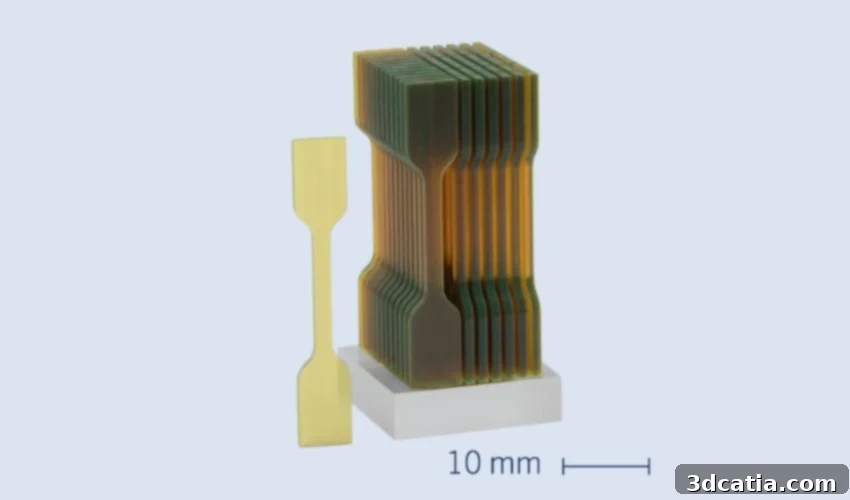
In a monumental stride towards this goal, a groundbreaking multinational collaboration has successfully standardized the material testing of macro-scale 2PP 3D-printed parts. This pioneering study involved an impressive consortium of leading research institutions and industry experts: researchers from the renowned Vienna University of Technology (TU Wien), the prestigious California Institute of Technology (Caltech), and RWTH Aachen University, alongside material specialists from UpNano GmbH. For the first time, this collaborative effort has enabled the standardized testing of macro-scale specimens, such as 35 mm test pieces, in full accordance with established ISO standards. This achievement marks a pivotal moment, as it not only validates the structural integrity and performance of larger 2PP components but also significantly enhances our understanding of their intrinsic mechanical properties, paving the way for new applications and greater confidence in the technology.
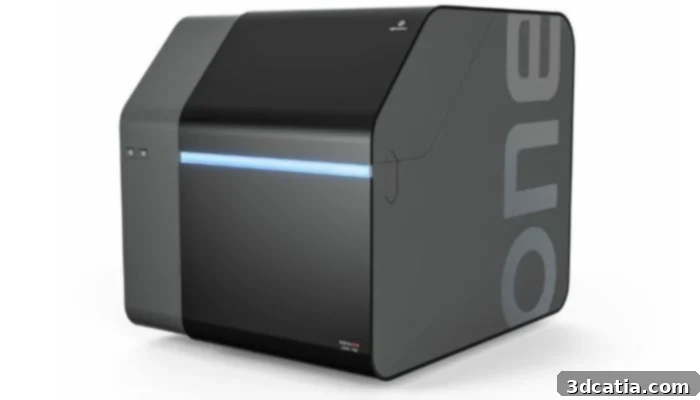
The NanoOne 2PP 3D printer, a key instrument in achieving standardized testing for 2PP parts.
Published in the esteemed journal “Advanced Materials,” this landmark study represents the inaugural instance of bulk 2PP 3D-printed samples, ranging from millimeters to centimeters in size, being subjected to standardized mechanical property testing. The implications of these new findings are far-reaching, as they directly address one of the primary barriers to 2PP 3D printing’s transition into a mainstream manufacturing method for mass production. By establishing rigorous procedures for material testing that fully align with international ISO standards, the study provides the necessary framework for quality assurance and regulatory compliance. This is crucial for industries that rely on certified materials and processes. The research was meticulously conducted using the advanced NanoOne 2PP 3D printer in conjunction with specialized resin materials developed by UpNano. The compelling results obtained by the research team demonstrate that UpNano’s proprietary UpPhoto and UpDraft resins not only exhibit superior material quality compared to traditional acrylic resin (ETA/TTA) often used in other resin-based 3D printing processes but also simplify the manufacturing workflow significantly. A key advantage is that these advanced resins require no extensive post-treatment, as they solidify rapidly and reliably on their own, streamlining production and reducing manufacturing costs.
Bernhard Küenburg, the CEO of UpNano, underscored the profound significance of this research, stating, “Currently, there is no accepted standardized test method for micro- or nanoscale 2PP 3D-printed parts. While such methods are undeniably important for fundamental research, the mechanical properties of a large-scale part cannot simply be extrapolated or inferred from these very small-scale samples. The behavior of materials can change dramatically with scale, making direct inference unreliable for industrial applications. Therefore, the diligent work of the TU Wien team and their esteemed colleagues represents a true breakthrough on the path towards the broad industrial application of 2PP 3D-printing technology. This achievement bridges a critical gap, enabling manufacturers to confidently deploy 2PP for larger, more robust components that meet stringent industry requirements.” Küenburg’s remarks highlight the unique challenge and monumental achievement of this study: extending the precision of 2PP to a macro-scale while ensuring consistent and verifiable material performance, which is a non-negotiable for industrial adoption and mass production.
Comprehensive Mechanical Property Testing for 2PP 3D Printed Parts
The comprehensive evaluation encompassed a range of critical mechanical properties designed to thoroughly characterize the performance of the 2PP 3D-printed materials. These tests included assessments of tensile strength, flexural strength, and hardness – fundamental indicators of a material’s resistance to deformation and damage under various loads. Furthermore, the research delved into more complex behaviors such as creep and fracture behavior. Creep testing measures a material’s tendency to deform permanently under sustained mechanical stress, particularly at elevated temperatures, which is vital for long-term performance in demanding environments. Fracture behavior analysis, on the other hand, provides insight into how a material responds to cracks and stress concentrations, predicting its resistance to catastrophic failure. Understanding these properties is crucial for engineering applications, as they dictate a part’s durability, reliability, and lifespan in real-world scenarios, from biomedical implants to industrial components.
For this meticulous study, the research team employed a selection of materials to compare their performance under standardized conditions. These included the widely used ETA/TTA (ethoxylated (20/3) trimethylolpropane triacrylate (ETA) in combination with trimethylolpropane triacrylate (TTA)) alongside UpNano’s cutting-edge UpPhoto and UpDraft resins. The choice of the NanoOne printer was strategic, as its advanced capabilities, combined with the use of 10x and 5x objectives, were instrumental in achieving the high printing speeds necessary to efficiently produce the larger, macro-scale samples required for ISO-compliant testing. This combination of advanced hardware and optimized optical components allowed for the rapid fabrication of substantial test specimens without compromising the intrinsic precision and quality that 2PP technology is known for, proving the scalability of the printing process itself.
Markus Lunzer, Team Lead Materials and Application at UpNano and the last author of the pivotal study, further elaborated on the groundbreaking findings: “One of the most remarkable and impactful results we obtained was the clear differentiation in suitability for upscaling among the three materials studied. We found that only UpPhoto and UpDraft resins possessed the necessary characteristics to be effectively used for producing macro-scale parts. This was primarily attributed to their exceptionally wide processing window, which offers greater flexibility during printing, and their overall well-balanced mechanical properties, ensuring consistent and reliable performance across different scales. In stark contrast, ETA/TTA proved to be fundamentally unsuitable for upscaling due to several critical limitations. These included a significantly smaller processing window, making it challenging to achieve consistent prints, a propensity for stress-induced microcracking which compromises structural integrity, and generally low toughness in the final product. These deficiencies highlight why conventional resins struggle when precision at the micro-scale needs to translate into robust performance at the macro-scale.”
This breakthrough holds immense potential, particularly for the additive manufacturing of complex microfluidic devices, where intricate internal microchannel structures can now be reliably produced at a larger scale with verified material properties. Beyond microfluidics, this advancement unlocks new possibilities across various sectors. Imagine creating robust, high-precision biomedical implants with complex internal geometries for enhanced integration, or developing advanced optical components with precise macro-scale dimensions and nano-scale surface features. Industrial sectors requiring custom, high-performance tooling or specialized sensors with intricate internal designs can also significantly benefit. The ability to standardize and test 2PP parts at a macro level drastically reduces risks associated with adoption, accelerating innovation and commercialization. It will undoubtedly be fascinating to witness how 2PP technology continues to evolve, now armed with the validation of standardized testing, leading to a surge in novel applications and a new generation of high-performance, precision-engineered parts across diverse industries.
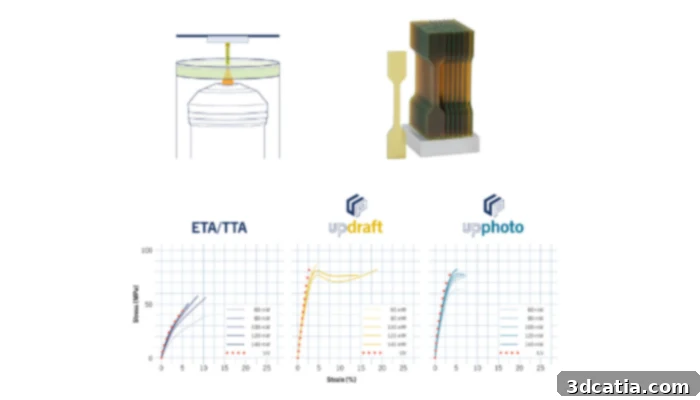
Key insights from the testing results, validating the mechanical properties of 2PP materials.
What are your thoughts on this pivotal advancement in standardized material testing for macro-scale 2PP 3D printed parts? Do you believe this will accelerate the industrial adoption of two-photon polymerization technology across various sectors? Share your insights and predictions with us in a comment below or join the conversation on our LinkedIn, Facebook, and Twitter pages! Don’t miss out on the latest developments in additive manufacturing – sign up for our free weekly newsletter here to get the freshest 3D printing news delivered straight to your inbox! You can also explore all our comprehensive videos and interviews on our YouTube channel, offering deeper dives into the world of 3D printing innovation.
*All Photo Credits: UpNano