
Exploring the Future: Top 5 Game-Changing 3D Printing Innovations and Applications
Welcome to our weekly dive into the fascinating world of 3D printing! This week, we’ve curated the top five videos that brilliantly showcase how additive manufacturing is not just evolving, but actively reshaping various facets of our society. From intricate medical advancements to groundbreaking architectural projects and industrial applications, this transformative technology continues to push boundaries across diverse sectors. Join us as we explore how these cutting-edge innovations are setting new standards, offering unique solutions, and paving the way for a future where virtually anything can be custom-made. We’ll touch upon everything from creating functional play structures to bioprinting human tissues, and much more. To discover even more compelling 3D printing content and stay ahead of the curve, don’t forget to visit our YouTube channel. We hope you enjoy this insightful selection!
1. 3D Printed Play Structures: Architectural Innovation in Action
Our first pick takes us to the cutting edge of architectural design and educational application at Rice University’s School of Architecture. Here, a powerful large-format 3D printer, affectionately known as Gigabot, is revolutionizing how students and faculty approach complex designs. This industrial-grade machine is not only pivotal for rapidly prototyping architectural models and student coursework but also for fabricating full-scale functional elements. Former Technology Fellow David Costanza provides an insightful tour, highlighting some of the most imaginative projects undertaken with Gigabot. Among these, a standout example is an innovative play structure, where 3D printed components are integrated into the final construction on the Rice campus itself. This demonstrates the immense potential of additive manufacturing in realizing bespoke, geometrically complex structures that would be challenging and costly to produce with traditional methods. The ability to quickly iterate designs and produce custom parts with a large-format 3D printer like Gigabot signifies a major leap forward for architectural fabrication, offering unprecedented design freedom and accelerating the transition from digital concept to tangible reality for public spaces and unique installations.
2. Women in 3D Printing: Fostering Diversity and Innovation
The second video shines a spotlight on a crucial aspect of technological advancement: diversity and inclusion within the workforce. Women in 3D Printing (Wi3DP) is a remarkable international organization dedicated to celebrating and empowering women professionals in the additive manufacturing sector. Spanning numerous industries and continents, Wi3DP serves as a vital platform for networking, mentorship, and advocacy. As eloquently discussed in the featured video, establishing a collective voice for women in this rapidly evolving industry is paramount. By gathering diverse thoughts, experiences, and opinions on the challenges women encounter – from career progression to representation and gender bias – Wi3DP facilitates the identification and development of effective solutions. This collaborative environment fosters not only professional growth but also encourages a broader exchange of ideas, promoting a more inclusive and innovative ecosystem for 3D printing worldwide. The organization’s efforts are instrumental in ensuring that the full spectrum of talent contributes to shaping the future of additive manufacturing, ultimately leading to more creative solutions and sustainable growth across the industry.
3. KRAKEN Project: The Future of Multimaterial Hybrid Manufacturing
Our third video introduces us to a monumental stride in industrial manufacturing: the KRAKEN project. For three intensive years, a consortium of European researchers has been meticulously developing this revolutionary hybrid manufacturing system. The KRAKEN machine seamlessly integrates both additive (3D printing) and subtractive production methods, offering an unprecedented level of versatility and capability. What sets KRAKEN apart is its impressive array of functionalities: it is equipped with three interchangeable additive manufacturing technologies, allowing for diverse material processing and geometric complexities, alongside a powerful fourth subtractive manufacturing head. This unique combination enables the KRAKEN to not only build up intricate structures but also to precisely finish them, achieving tighter tolerances and superior surface quality. One of its most astonishing features is its capacity to create colossal objects up to 20 meters in length, pushing the boundaries of what’s possible in large-scale manufacturing. The development phase of this groundbreaking machine was successfully completed at the end of September, and it is now ready for market deployment. The KRAKEN project signifies a significant leap for industries requiring large, highly precise, and multi-material components, such as aerospace, automotive, marine, and construction, promising to redefine production efficiency and design freedom.
4. Bioprinting Human Tissues: A Glimpse into Regenerative Medicine
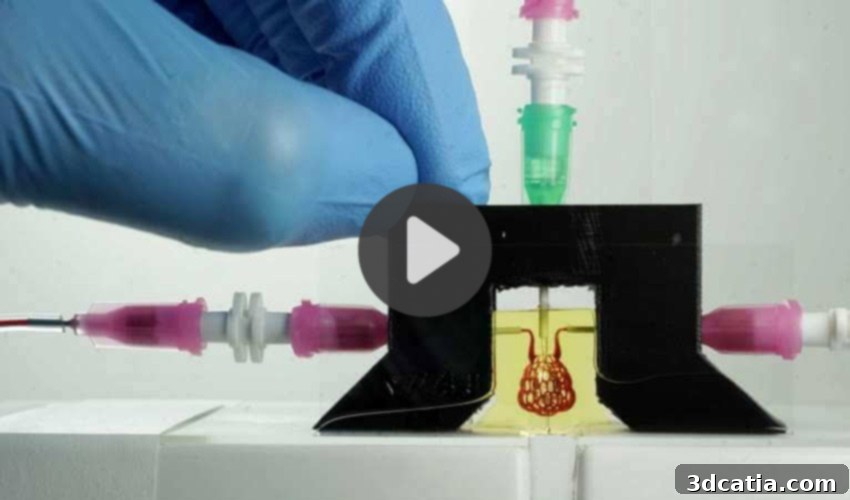
The fourth video takes us into a realm that once seemed confined to science fiction: the 3D printing of human tissues for medical applications. This burgeoning field of bioprinting is rapidly moving from concept to reality, driven by dedicated researchers worldwide. Indeed, the past few months have witnessed a flurry of groundbreaking advancements in bioprinting, bringing us closer to a future where organ shortages could be a thing of the past. One of the most significant breakthroughs occurred at Tel-Aviv University, where a team of visionary researchers successfully bioprinted a tiny human heart, complete with cells, blood vessels, and chambers. This monumental achievement demonstrates the incredible potential of bioprinting to create functional, complex organs. Further showcasing this progress, the video highlights engineers at Rice University who are pioneering the 3D printing of complex vascular networks – the intricate system of blood vessels essential for sustaining any larger human tissue. The ability to reliably replicate these vascular structures is a critical hurdle in creating viable, transplantable organs. These developments hold immense promise for regenerative medicine, offering hope for personalized treatments, advanced drug testing models, and ultimately, the potential to engineer replacement tissues and organs to improve countless lives.
5. 3Dirigo: The World’s First 3D Printed Boat and Large-Scale Manufacturing
Our final feature presents a truly monumental achievement in large-scale additive manufacturing: the creation of the world’s largest 3D printed boat, the 3Dirigo. This incredible feat was accomplished by a visionary team of researchers from the University of Maine. Utilizing an advanced, large-format polymer 3D printer developed in-house by the UMaine Advanced Structures and Composites Center, they successfully printed a colossal vessel measuring 7.62 meters (25 feet) long and weighing a substantial 2.2 tons. This project didn’t just break records; it shattered them, earning the project team three prestigious World Records: for the largest 3D printed solid part, the largest 3D printed boat, and for developing the largest polymer 3D printer. The 3Dirigo demonstrates the immense scalability of additive manufacturing and its profound implications for industries like the maritime sector. The ability to rapidly prototype and produce large structures with complex geometries, using advanced composite materials, offers significant advantages. These include reduced manufacturing time, lower material waste, enhanced design flexibility, and the potential for on-demand customization of marine vessels and components. This pioneering initiative marks a pivotal moment, showcasing how large-scale additive manufacturing is poised to revolutionize not only boat building but also construction, aerospace, and other industries requiring massive, custom-fabricated parts.
We hope this week’s selection of top 5 3D printing videos has provided you with an engaging and informative look into the cutting-edge innovations shaping our world. From architectural marvels and social impact initiatives to industrial giants and life-saving medical breakthroughs, additive manufacturing continues to prove its transformative power. We’d love to hear your thoughts on these incredible advancements! Feel free to drop a comment below or engage with us on our Facebook and Twitter pages. And to ensure you never miss out on the latest news, trends, and groundbreaking applications in the dynamic 3D printing industry, be sure to sign up for our free weekly Newsletter, delivered straight to your inbox!