
Revolutionizing Healthcare: NTU’s 3D Printed RoboFabric Transforms Medical Devices and Flexible Robotics
The landscape of modern medicine is undergoing a profound transformation, largely driven by the remarkable advancements in 3D printing technology. Once a niche prototyping method, additive manufacturing has emerged as a game-changer, pushing the boundaries of what’s possible in patient care, rehabilitation, and medical device innovation. Its versatility allows for the creation of intricate, customized solutions that were previously unimaginable. From developing advanced exoskeletons that empower individuals with mobility challenges to crafting sophisticated cancer-fighting devices designed for precision targeting, and even producing tailor-made medicines with personalized dosages, the proven worth of additive manufacturing in the medical sector is undeniable. This relentless pursuit of innovation has now led researchers at Nanyang Technological University (NTU) in Singapore to unveil an groundbreaking development: an innovative ‘active’ fabric, meticulously engineered using state-of-the-art 3D printing techniques. This breakthrough promises to redefine the functionality and adaptability of future medical and robotic systems.
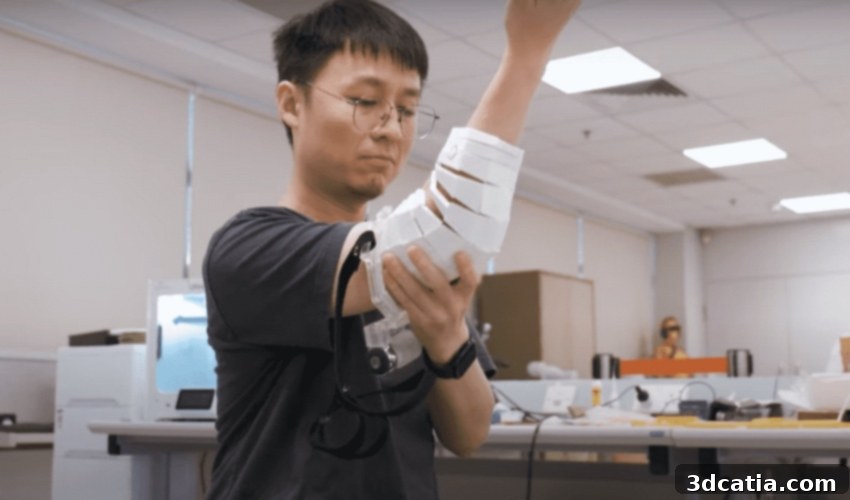
Dubbed “RoboFabric,” this revolutionary material stands out for its exceptional adaptability and flexibility, possessing the unique ability to stiffen on demand. This inherent characteristic makes it an ideal candidate for a wide array of applications, particularly within advanced medical devices and the rapidly evolving field of flexible robotics. To demonstrate its practical utility, NTU researchers have ingeniously designed an elbow brace incorporating RoboFabric. This brace is capable of providing superior support, enabling it to withstand and manage significantly heavier loads than conventional alternatives. Furthermore, they have developed a prototype wrist support specifically engineered to stabilize joints, offering invaluable assistance to Parkinson’s patients by effectively managing and reducing the severity of their tremors. The implications of such an ‘active’ fabric are vast, promising a new era of responsive, personalized assistive technologies.

RoboFabric: A 3D Printed Fabric That Reduces Muscular Effort and Enhances Support
The true marvel of RoboFabric lies in its ingenious design and bio-inspired mechanism. Drawing inspiration from the incredible natural structures found in the pangolin’s protective scales and the octopus’s unparalleled dexterity, this innovative fabric is the result of a sophisticated mathematical algorithm. This algorithm meticulously generates patterns for interlocking tiles, which are then precisely produced through advanced 3D printing. What truly sets RoboFabric apart is how these tiles are interconnected: they are intricately linked by a network of metal fibers. The magic happens when these fibers are activated; upon contraction, they cause the individual tiles to tightly interlock, transforming the fabric’s state from flexible to rigid almost instantaneously. This controlled stiffening mechanism allows RoboFabric to increase its rigidity by an astonishing factor of more than 350 times, offering an unprecedented level of dynamic support.
The efficacy and potential impact of this groundbreaking research, recently published in the esteemed journal Advanced Materials, are nothing short of remarkable. The studies demonstrate that the application of a device utilizing RoboFabric can lead to a substantial reduction in human muscular effort, decreasing it by an impressive 40%. This finding holds immense promise for various applications, particularly in assistive technology and rehabilitation. Assistant Professor Wang Yifan of Nanyang Technological University, the visionary chief scientist behind this innovation, elucidated the team’s inspiration: “Our primary inspiration came from the natural world, particularly from animals that employ complex structural designs to imbue their limbs with multiple functionalities. Think of an octopus, with its extraordinary ability to change both shape and rigidity at will, allowing for incredible versatility.” This biomimetic approach ensures that RoboFabric not only performs mechanically but also embodies the elegant efficiency found in nature.
Looking ahead, Assistant Professor Wang Yifan envisions a future where traditional, cumbersome rigid casts become relics of the past. Instead, patients will benefit from highly customizable, flexible limb supports crafted from RoboFabric. These next-generation devices would be effortlessly applied or removed with a simple touch of a button, offering unparalleled convenience and comfort. Beyond injury recovery, such technology could significantly enhance the quality of life for the elderly population. By reducing the muscular effort required for everyday tasks, such as lifting objects or maintaining posture, these adaptive supports would provide crucial assistance, fostering greater independence and reducing the physical strain associated with aging. This shift towards personalized, dynamic support represents a paradigm change in assistive medical devices, promising to greatly improve patient outcomes and daily living experiences.
How Was RoboFabric Made? The Process Behind Dynamic Personalization
The creation of RoboFabric-based medical devices underscores a sophisticated blend of digital design, additive manufacturing, and electromechanical engineering, all geared towards ultimate personalization. The customization process begins with a crucial first step: acquiring a precise 3D scan of the individual’s limb, whether it be a wrist or an elbow. This digital blueprint is paramount for ensuring a perfect, ergonomic fit that maximizes both comfort and effectiveness. Following the scan, an advanced algorithm takes center stage. This intelligent software processes the 3D data to generate intricate, geometric patterns specifically optimized for 3D printing. These patterns dictate the precise shape and arrangement of the interlocking tiles, which are the fundamental building blocks of RoboFabric, ensuring that the final structure will achieve the desired mechanical properties and dynamic stiffening capabilities. This algorithmic approach is key to replicating the bio-inspired complexity of the material.
Once the geometric patterns are finalized, the actual fabrication process commences with 3D printing the individual tile segments. These segments are meticulously designed with small openings or channels strategically placed to facilitate the subsequent integration of the functional components. Next, ultra-thin metal fibers are carefully threaded through these predefined openings, weaving them seamlessly between the printed segments. These fibers are not merely structural; they are the active elements that control the fabric’s rigidity. Each fiber is then connected to a sophisticated electrical device. This control unit is engineered to precisely regulate the tension in the cables. By adjusting the electrical input, the device can cause the metal fibers to contract or relax, thereby controlling the degree to which the tiles interlock and, consequently, adjusting the overall rigidity of the RoboFabric. This dynamic tension control is what gives RoboFabric its “active” nature, allowing users or medical professionals to fine-tune the support level as needed.
Associate Professor Loh Yong Joo from Tan Tock Seng Hospital, a leading medical institution, has enthusiastically highlighted the profound and promising applications of this innovative technology within the realm of medicine. He emphasized its potential to provide crucial, targeted support for a wide spectrum of joint injuries, facilitating more effective rehabilitation and recovery. Beyond acute injuries, Professor Loh also underscored the immense help it could offer to individuals suffering from various motor disorders. This includes patients bravely battling Parkinson’s disease, who frequently experience debilitating tremors and instability, as well as those with general upper limb weakness resulting from strokes, neurological conditions, or muscular degeneration. The ability of RoboFabric to provide customizable and dynamic support means it can adapt to the fluctuating needs of patients, offering stability when required and flexibility for daily activities. This adaptability ensures that assistive devices can truly integrate into a patient’s life, enhancing their mobility, comfort, and overall independence in unprecedented ways.
The development of RoboFabric by Nanyang Technological University represents a significant leap forward in the fusion of advanced materials, 3D printing, and personalized medicine. This smart, active fabric holds the potential to profoundly impact the lives of countless individuals, from athletes recovering from injuries to the elderly seeking greater independence, and patients managing chronic conditions. The future of assistive technology and flexible robotics looks brighter than ever with innovations like RoboFabric leading the way towards more intuitive, adaptable, and patient-centric solutions. We are eager to hear your thoughts on this remarkable new 3D printed fabric from NTU and its potential to revolutionize healthcare. Let us know your insights and predictions in a comment below or join the conversation on our LinkedIn, Facebook, and Twitter pages! Don’t forget to sign up for our free weekly newsletter here for the very latest 3D printing news and innovations delivered straight to your inbox! You can also find all our compelling videos and interviews on our dedicated YouTube channel, offering deeper dives into the world of additive manufacturing.