
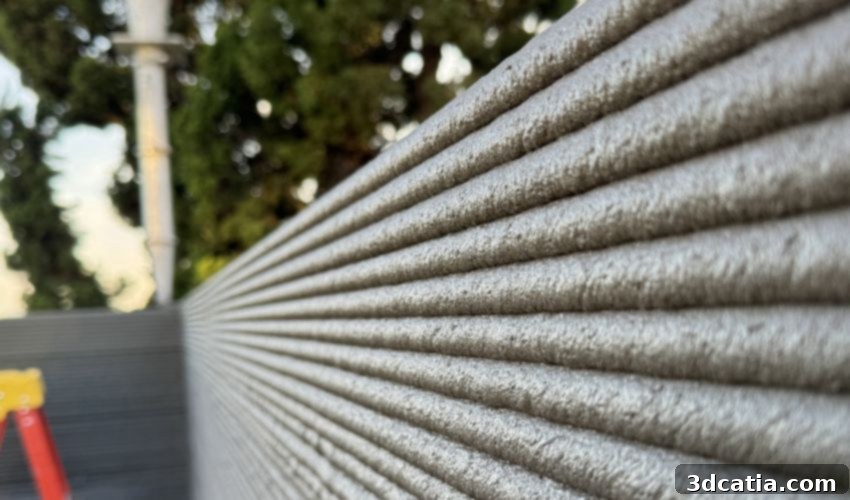
3D-Printed Fire-Resistant Homes: A Resilient Solution for Wildfire-Prone Regions and Sustainable Urban Development
The increasing frequency and intensity of wildfires present a profound and urgent challenge, particularly in regions like Southern California. Recent devastating events, such as those beginning January 7th, 2025, have laid bare the vulnerability of traditional construction, scorching over 37,000 acres, claiming 28 lives, and leaving more than 10,000 homes and businesses utterly destroyed. Beyond the immediate tragedy, these catastrophic events ignite critical questions: How can we prevent such widespread devastation in the future? How can communities, especially those in high-risk zones like Los Angeles, be rebuilt not only sustainably but also with inherent resilience against future fires? As cities grapple with rebuilding and adapting to a changing climate, innovative solutions are desperately needed. Among the most promising technologies emerging in this critical discussion is the concept of 3D-printed, fire-resistant homes, offering a vision of safer, more durable, and environmentally conscious construction for the future.
The emergence of 3D-printed buildings across the United States has steadily gained momentum over recent years, transforming the landscape of residential and commercial construction. This innovative approach moved from concept to reality with the completion of the first owner-occupied, 3D-printed house in 2021. Building on this pioneering spirit, a significant milestone was achieved recently when Builtech Construction Group and RIC Technology successfully completed the United States’ first 3D-printed, fire-resistant accessory dwelling unit (ADU). This 1,200-square-foot ADU, strategically located in Walnut, California, stands as a testament to modern resilience, less than 30 miles from the devastating wildfires that ravaged Los Angeles. Philip and Constance, the homeowners, articulated a profound sense of relief and optimism regarding their property’s safety. “We hope more people can stay in this kind of house for better protection,” they stated, underscoring the critical need for safer housing solutions in wildfire-prone areas. This project not only showcases the practical application of advanced construction techniques but also offers a beacon of hope for communities seeking durable, fire-resistant housing options in the face of escalating environmental challenges.
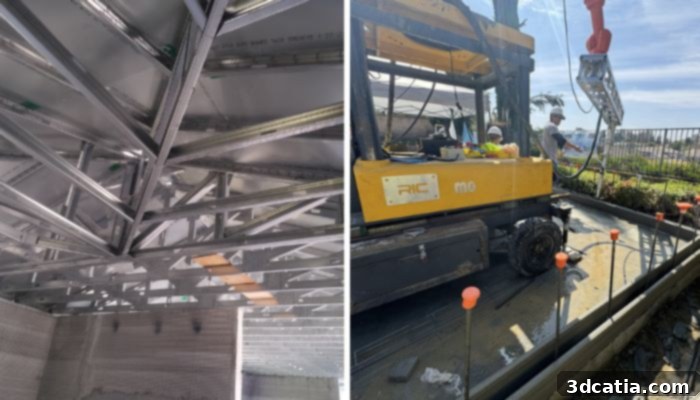
The fire-resistant steel roof (left) and RIC Technology’s robotic arm 3D printer (right). (Photo Credits: RIC Technology)
Unpacking the Fire Resistance: How 3D Printing Creates Safer Homes
The design and construction of the two-bedroom, 2.5-bathroom ADU in Walnut, California, were meticulously tailored to address the inherent risks of its location within a wildfire-prone region. Its development was not merely a construction project, but a collaborative initiative between the City of Walnut and the Los Angeles County Fire Department, emphasizing a community-wide commitment to safety and resilience. This strategic partnership ensured that every aspect of the ADU’s construction, from material selection to architectural features, was scrutinized through the lens of fire safety, making it a benchmark for future fire-resistant housing developments.
At the core of the ADU’s superior fire resistance lies its robust structural composition: steel-reinforced concrete for the walls and a resilient steel roof, completely devoid of traditional wood framing or nails. This radical departure from conventional building methods is a game-changer for wildfire mitigation. In March of 2024, during the construction phase, Aaron Liu, CEO of Builtech Construction Group and an NFPA-certified wildfire mitigation specialist (CWMS), passionately articulated the critical importance of this design choice. “The ADU will be built without a single piece of wood or nail – no ‘fuel’ on the main structure,” Liu explained. He further elaborated, “By eliminating combustible materials from the primary structural elements, we significantly minimize the likelihood of fire propagation and penetration into the home’s interior, thereby substantially reducing its susceptibility to fire damage and offering unparalleled protection to its occupants.” This fundamental principle of removing potential fuel sources from the structural shell is a cornerstone of modern wildfire-resistant construction, allowing concrete and steel to act as formidable barriers against extreme heat and flames.
Additive manufacturing technology, specifically construction 3D printing, played an indispensable role in making this project not only feasible but also economically viable. Historically, the use of such robust steel-reinforced concrete structures was largely confined to specialized applications like military bunkers and other defensive installations, primarily due to their prohibitive cost, labor-intensive construction processes, and general lack of accessibility for civilian projects. However, RIC Technology credits significant advancements in 3D printing technology for democratizing these resilient construction methods. Their innovative robotic arm 3D printer streamlines the construction process, drastically cutting down on both time and labor. The entire printing process for the Walnut ADU, from initial setup to the completion of the structural shell, remarkably took only 20 days. This accelerated construction timeline, coupled with optimized material usage and reduced manual labor, makes what was once an expensive, niche building technique now an accessible and affordable option for everyday housing, especially in areas where heightened fire safety is paramount.
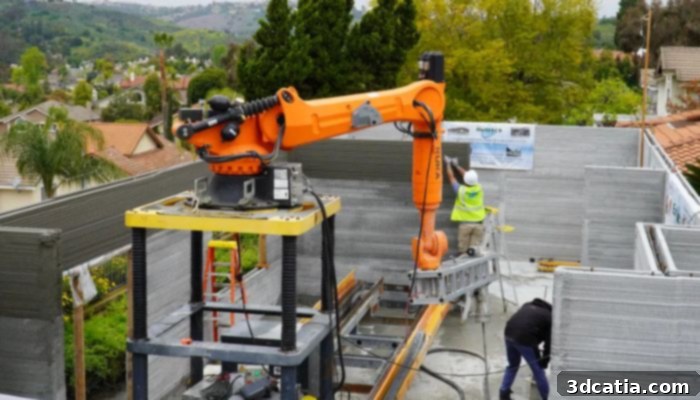
RIC Technology’s 3D printer in action (Photo Credit: RIC Technology)
Beyond the structural integrity, the construction team employed a specialized, non-combustible, high-pressure 3D printing material from the renowned concrete company Quikrete. This advanced material, precisely formulated for additive manufacturing, cures into an exceptionally dense and fire-resistant substance that significantly contributes to the home’s overall protection. Furthermore, the design incorporated strategic “defensive design” principles, addressing specific vulnerabilities that often lead to home ignition during wildfires. Elements such as eave vents and windows, which are typically weak points where embers can enter and ignite interior materials, were specially reinforced. This reinforcement creates a critical barrier, preventing embers and flames from infiltrating the house. These thoughtful design details, combined with the inherently thicker walls achievable through 3D printing, collectively awarded the house a superior fire-resistance rating. Crucially, these enhanced safety features were integrated without any significant increase in construction cost, demonstrating that advanced fire protection can be both effective and economically viable when implemented through innovative 3D printing methods.
The efficacy of 3D-printed walls in extreme fire conditions is not just theoretical; it’s rigorously tested. In 2024, ICON, a leading construction 3D printing company, subjected its proprietary 3D-printed walls to stringent fire tests. These tests were conducted in accordance with ASTM E119, a comprehensive standard developed by the American Society for Testing and Materials (ASTM) for evaluating the fire resistance of building materials and constructions. The procedure involved creating a controlled fire with a graded temperature curve, meticulously designed to simulate the escalating heat of a real wildfire over time. Following exposure to extreme heat, water was sprayed onto the walls to replicate the forceful impact of a fire hose, ensuring that the load-bearing capacity and structural integrity remained intact under duress. ICON proudly reported that their walls achieved an impressive 2-hour fire rating. This means the 3D-printed walls could withstand the intense heat and structural stresses of a fire for a full two hours before exhibiting any signs of failure. The significance of this rating cannot be overstated, as a longer duration of structural integrity provides occupants with crucial extra time for evacuation, potentially making the difference between life and death. ICON has also expressed its ambition to achieve an even higher 3-hour rated wall, continually pushing the boundaries of fire safety in additive construction.
The contrast between the fire resistance of 3D-printed homes and conventional construction is stark and profoundly impactful. A 2-hour fire rating, or even the aspirational 3-hour rating, represents a monumental leap in safety when considering the rapid burn times of standard houses. Underwriters Laboratories (UL), a globally recognized leader in fire safety testing and certification, has reported alarming statistics for typical residential structures: occupants often have three minutes or less to evacuate once a fire has ignited and taken hold. While the exact burn characteristics of any house can vary significantly based on numerous factors—including its geographical region, specific building materials used (e.g., wood framing, insulation types), and the density and flammability of interior furnishings—the fundamental vulnerability of traditional homes to rapid ignition and collapse remains a critical concern. In this context, the ability of a 3D-printed concrete house to maintain its structural integrity for hours, actively preventing flames from reaching and consuming the interior, offers a truly life-saving difference. This extended window for escape, coupled with the potential for reduced property damage, positions 3D-printed, fire-resistant construction as an essential component in developing truly resilient communities capable of weathering the growing threat of wildfires and other natural disasters.
The Future of Construction: Resilience, Sustainability, and Affordability
Proponents of construction 3D printing champion its myriad benefits, extending far beyond mere fire resistance. In terms of construction efficiency, the automated nature of 3D printing allows for significantly faster build times compared to traditional methods, drastically reducing project durations. This speed is complemented by a requirement for less manual labor and often utilizes more affordable materials, making housing projects more cost-effective. These concrete homes offer robust protection not only against fire but also against other common threats such as termites, which can cause extensive damage to wood-framed structures, and earthquakes, where the monolithic, continuous concrete structures can exhibit superior seismic performance. For instance, other innovative 3D-printed homes, such as one completed in Redding by Emergent3D, are actively demonstrating the potential of this technology to deliver not only fire-resistant but also more sustainable and inherently affordable housing solutions, addressing multiple pressing challenges faced by communities today.
The burgeoning market for 3D-printed houses underscores the growing recognition of this technology’s potential. According to Skyquest, the global 3D-printed houses market size was valued at a substantial USD 36.9 million in 2023. This market is projected for explosive growth, poised to reach an astounding USD 2899.35 million by 2032, exhibiting a remarkable Compound Annual Growth Rate (CAGR) of 62.4% during the forecast period from 2025 to 2032. This exponential growth is driven by several converging factors, including the increasing urgency of the housing crisis, the undeniable impacts of climate change necessitating more resilient construction, and rapid technological advancements in additive manufacturing itself. This escalating demand for 3D-printed buildings is also fueling a vibrant and expanding body of research dedicated to continuously improving 3D-printable concrete and other construction materials. For example, last year, researchers at the University of Virginia made significant strides by designing a 3D-printable concrete that emits an impressive 31 percent less carbon during its production, addressing critical environmental concerns related to cement manufacturing. Complementing this, just this month, engineers at the University of New Mexico successfully developed a groundbreaking bendable concrete, a material promising enhanced durability and structural flexibility, which could further improve the resilience of 3D-printed structures against seismic activity and other environmental stresses. These are merely a few examples among the myriad studies and innovations currently underway, indicating that the quality, sustainability, and versatility of concrete-based additive manufacturing will only continue to advance rapidly in the coming years.
While 3D-printed homes represent just one facet of the multifaceted solutions required to effectively confront the escalating threat of wildfires and the broader challenges posed by our changing climate, they offer an exceptionally promising and tangible avenue forward. These innovative 3D-printed buildings possess immense potential to drastically reduce the tragic loss of life and property that so often accompanies natural disasters. By integrating advanced fire-resistant materials and smart defensive designs, homes like the accessory dwelling unit in Walnut stand as powerful exemplars of what is achievable through technological foresight and collaborative effort. Investing in and pursuing the widespread adoption of such resilient construction methods is not merely an option; it is an imperative for creating safer, more sustainable, and truly future-proof communities across wildfire-vulnerable regions and beyond.
Do you think 3D-printed homes are an answer to the threat of wildfires and a key component of sustainable development? Let us know in a comment below or join the discussion on our LinkedIn, Facebook, and Twitter pages! Don’t forget to sign up for our free weekly Newsletter here, to receive the latest 3D printing news straight to your inbox! You can also find all our videos and interviews on our YouTube channel.
*Cover Photo: RIC Technology