
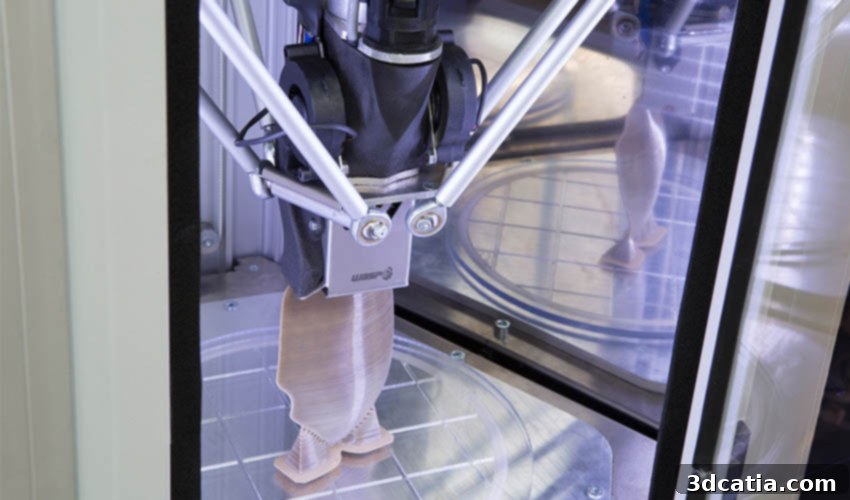
WASP Leads 3D Printing Innovation: Medical PEEK Pellets, Sustainable Construction, and Industrial Advancements Unveiled at Formnext 2019
At Formnext 2019, a premier global exhibition for additive manufacturing, WASP, a renowned 3D printer manufacturer, made significant strides by introducing a groundbreaking solution for printing medical-grade PEEK (Polyether Ether Ketone) directly from pellets. This innovation marks a pivotal moment for WASP, a company previously celebrated for its large-scale 3D printers dedicated to the construction sector. By leveraging its extensive expertise in additive manufacturing technologies, WASP is now strategically expanding its focus into the critical healthcare sector. The company has astutely identified the transformative benefits that additive manufacturing can bring to medicine, particularly in delivering highly personalized products and solutions to patients with unprecedented precision and efficiency. To facilitate this expansion, WASP launched a comprehensive new product line: the Delta WASP Tech Line, signaling a clear commitment to specialized industrial applications.
The ability to print medical-grade PEEK from pellets is poised to revolutionize the field of medical implants. PEEK is an advanced, high-performance thermoplastic polymer known for its exceptional properties, including outstanding biocompatibility, remarkable mechanical strength, high resistance to wear and chemicals, and excellent sterilizability. These characteristics make it an ideal material for permanent implants and other medical devices that require long-term stability within the human body. Traditionally, PEEK has been processed using conventional manufacturing methods or filament-based 3D printing, which can be costly and restrict design freedom. WASP’s innovative approach of direct pellet extrusion offers a compelling alternative, enabling the production of complex, patient-specific implants from digital designs using this superior material at a significantly reduced cost compared to existing methods. This breakthrough promises to democratize access to advanced medical solutions, making high-performance implants more affordable and accessible globally.
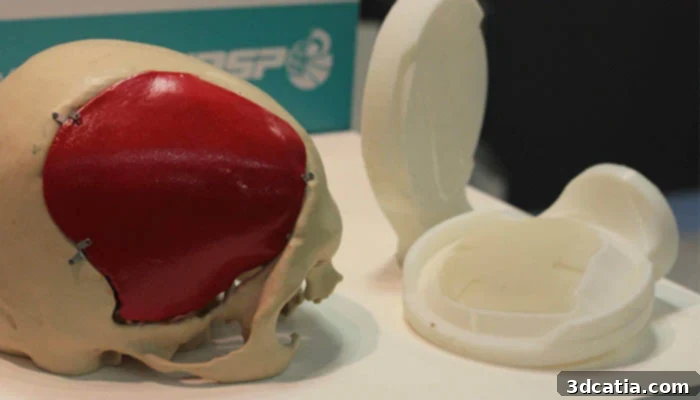
PEEK implants from pellets originated from extensive research conducted with Dr. Villiam Dallolio on the creation of cranial prostheses using 3D printers | Credits: WASP
The conceptualization of PEEK implant printing directly from pellets originated from profound and extensive research carried out in collaboration with Dr. Villiam Dallolio. Their long-standing partnership focused specifically on the creation of cranial prostheses using 3D printing technologies. This pioneering research aimed to address the complex challenges associated with craniofacial reconstruction, where custom-fit implants are essential for both functional and aesthetic outcomes. The test results from this collaborative effort have demonstrated that the prostheses produced via this method exhibit outstanding resistance while remaining remarkably lightweight – a critical factor for patient comfort and reduced surgical invasiveness. Dr. Villiam Dallolio further elaborated on the process, explaining that after 3D printing, these prostheses can undergo an annealing treatment at 200°C in an oven. This post-processing step significantly enhances their mechanical performance, further solidifying their suitability for demanding medical applications. Looking to the near future, WASP has outlined an ambitious plan to develop a complete, integrated system designed for the production of cranial prostheses. This comprehensive ecosystem will encompass specialized software for design and preparation, the advanced 3D printer itself, and optimized materials, all working in synergy to produce patient-specific prostheses directly from individual CT scans. “PEEK pellet printing is undoubtedly a revolutionary application, and the impact of this innovation on the entire WASP-printers-line is extraordinary,” the company asserted in a recent press release, underscoring the profound significance of this technological leap.
Beyond the immediate medical applications, the transition to pellet-based printing carries broader implications for additive manufacturing. Utilizing pellets instead of traditional filaments significantly reduces material costs, as pellets are typically a more economical raw material form. Furthermore, it expands the range of available materials, allowing for the use of engineering-grade polymers that might not be available in filament form. This approach also contributes to greater material sustainability, as pellets can often be sourced from recycled plastics, aligning with a circular economy model. The inherent flexibility of pellet extrusion systems also means they can handle a wider variety of material viscosities and melt temperatures, opening doors for custom material blends and enhanced material science research in additive manufacturing. For the medical sector, specifically, this translates into more cost-effective production of high-quality, customized implants, which can reduce healthcare costs and improve patient outcomes by providing perfectly tailored solutions for complex anatomical challenges.
While venturing into the medical domain, WASP has not strayed from its core strengths. The company remains widely recognized for its pioneering contributions to the construction sector, offering innovative additive manufacturing solutions that challenge conventional building practices. Since 2012, WASP has been a fervent advocate and implementer of circular economy principles, striving to construct 3D printed houses in the shortest possible timeframe and with the highest degree of sustainability. Their vision is centered on creating eco-friendly, affordable housing solutions that utilize locally sourced, reusable, and recyclable materials, thereby minimizing environmental impact and promoting self-sufficiency in communities. This commitment to sustainable construction was powerfully demonstrated in October when the company unveiled its groundbreaking TECLA prototype. TECLA, a portmanteau of “technology” and “clay,” represents a new paradigm in circular housing models. This innovative dwelling was meticulously designed and constructed using entirely reusable and recyclable materials, predominantly taken directly from the local terrain. The project exemplifies WASP’s dedication to developing truly sustainable architectural solutions that are both environmentally responsible and resilient, offering a glimpse into the future of eco-conscious habitation.

The Delta WASP 3MT CONCRETE 3D printer | Credits: WASP
The extensive range of innovations introduced by WASP at Formnext 2019 underscored the company’s multifaceted approach to additive manufacturing. Alongside the medical PEEK initiative, WASP proudly showcased its Delta WASP 3MT CONCRETE 3D printer, a powerful machine designed to redefine large-scale construction. This impressive system is engineered to print substantial structures using fluid and dense materials, specifically enabling the 3D printing of concrete through an advanced, continuous feeding method. This capability opens up vast possibilities for rapidly constructing housing, infrastructure, and complex architectural elements with unparalleled efficiency and reduced material waste. The continuous feeding system is critical for large-scale projects, allowing for uninterrupted printing cycles and the creation of monolithic structures without the limitations of smaller material batches. Furthermore, WASP also presented its new Delta WASP 3MT INDUSTRIAL 4.0 3D printer. This sophisticated system stands out with its robust continuous feeding mechanism and an exquisitely optimized extruder, meticulously engineered to process and print 100% recycled pellet polymers. This development represents a significant step forward in industrial sustainability, allowing manufacturing companies to reduce their ecological footprint by transforming waste plastics into valuable industrial components and prototypes. The Delta WASP 3MT INDUSTRIAL 4.0 is not just a printer; it’s a statement about the future of eco-conscious manufacturing, offering businesses a tangible pathway towards a more circular economy.
WASP’s diverse product portfolio, spanning medical, construction, and general industrial applications, demonstrates a clear vision for the future of additive manufacturing. By simultaneously innovating in high-precision medical implants and large-scale sustainable construction, the company is proving that 3D printing technology is not confined to niche markets but possesses the versatility and potential to transform multiple industries. The introduction of pellet-based printing across their lines signifies a commitment to cost-effectiveness, material accessibility, and environmental responsibility, making advanced manufacturing more viable and impactful for a wider range of users and applications. These developments at Formnext 2019 solidified WASP’s position as a forward-thinking leader, not just in developing cutting-edge 3D printers, but in shaping the very future of how we design, build, and heal through the power of additive manufacturing.
For more comprehensive details on WASP’s innovative technologies and latest offerings, please visit their official website HERE.
What are your thoughts on the groundbreaking Delta WASP Tech Line and WASP’s ambitious ventures into medical and sustainable industrial 3D printing? We encourage you to share your insights and opinions in the comment section below, or engage with us on our social media platforms, including Facebook and Twitter pages! Don’t miss out on the latest advancements and news in the world of 3D printing; sign up for our free weekly Newsletter to receive all updates directly in your inbox.