
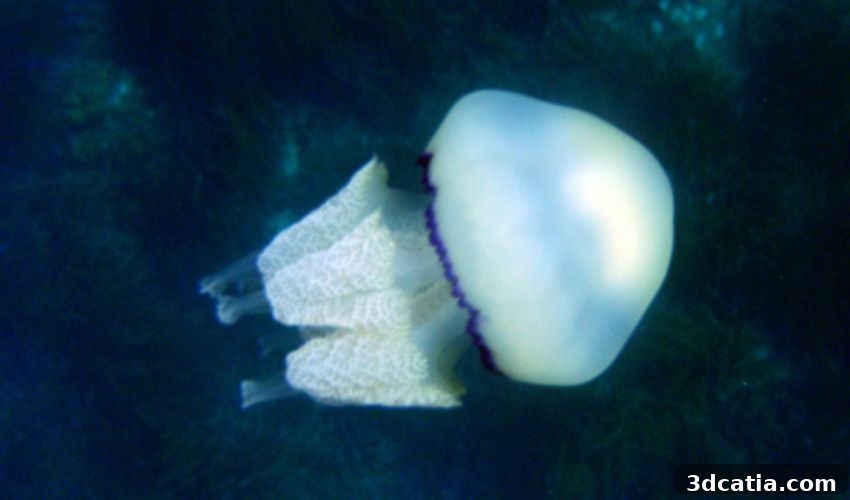
Jellyfish Collagen Paves the Way for Advanced Bioprinting and Tissue Engineering
Bioprinting stands at the forefront of medical innovation, representing one of the most transformative applications of 3D printing technology in the healthcare sector. This cutting-edge field promises the unprecedented ability to create functional organs and intricate biological tissues, pushing the boundaries of what is medically possible. It embodies the pinnacle of human ingenuity, offering hope for countless patients worldwide. In a significant recent development, two pioneering companies, Jellagen and Copner Biotech, have achieved a remarkable world-first. Following substantial support from the SMART Cymru innovation funding, they successfully developed a next-generation precision bioprinter. The groundbreaking element? An ancient jellyfish species, whose unique properties were harnessed to formulate the advanced bioinks central to this revolutionary bioprinting solution.
This monumental achievement was made possible through a generous SMART Cymru Innovation Award totaling £123,724. This vital funding was specifically allocated to accelerate the development of advanced 3D bio-technologies. The SMART Cymru initiative is strategically designed to bolster Welsh businesses, such as Jellagen and Copner Biotech, by providing crucial financial and strategic support. Its mission is to facilitate the development, rigorous implementation, and successful commercialization of innovative new products, processes, and services within Wales. In this particular instance, the award empowered the creation of a sophisticated bioprinting software and a robust hardware platform, seamlessly integrated with prototype bioinks derived from sustainable sources. Both companies harbor ambitious aspirations for their groundbreaking solution, envisioning its widespread adoption in both fundamental research and advanced tissue engineering applications in the near future, thereby potentially transforming the landscape of regenerative medicine.

A 40X magnified captured image showcases a bioprinted Collagen Type 0 line, expertly created using the microfluidic settings of GRAPE-S1 (photo credits: Jellagen).
Professor Andrew Mearns Spragg, the esteemed Founder and Chief Scientific Officer of Jellagen, expressed his profound enthusiasm for the project’s outcomes. “Although our solution is not yet commercially available, the invaluable SMART Cymru funding has been instrumental in forging a world-first partnership in 3D bioprinting with Copner Biotech,” he commented. “We are absolutely delighted with the compelling data outputs generated from this project. These results have unequivocally demonstrated the immense potential for our proprietary Collagen Type 0 biomaterials in the ongoing development of future bio-inks. We are incredibly excited to witness how this innovative technology can be further advanced and refined, ultimately leading to transformative medical tissue engineering applications and groundbreaking solutions for the cell culture research market.” This statement underscores the profound impact of the collaboration and the promising trajectory of their jellyfish-derived biomaterials in pushing the boundaries of medical science.
Jellyfish-Derived Bioinks: A Revolutionary Approach to Bioprinting
At the very heart of this innovative project was a concentrated effort on the development of novel bioinks. Jellagen specifically leveraged its exclusive proprietary biomaterial, known as Collagen Type 0. This groundbreaking collagen is uniquely derived from jellyfish, presenting a significant departure from traditional mammalian-sourced collagens. In their official press release, Jellagen highlights a crucial distinction: Collagen Type 0 can be considered as originating from the very root of the evolutionary tree. This fundamental difference confers several critical advantages, making it inherently safer, demonstrably more efficacious, and remarkably versatile when compared to its mammalian counterparts. Unlike mammalian collagen, which often carries risks of immunogenicity or pathogen transmission, jellyfish collagen offers a pristine and biologically compatible alternative, minimizing adverse reactions and enhancing patient safety.
Furthermore, the sourcing of this revolutionary collagen presents an elegant solution to an environmental challenge. The Collagen Type 0 used by Jellagen is sustainably harvested from Barrel Jellyfish (Rhizostoma octopus) found in the Irish Sea. These jellyfish have, in recent years, become a significant concern for marine biodiversity around the UK coast, forming vast blooms of what are increasingly considered marine pests. By utilizing these abundant organisms, Jellagen not only secures a renewable and ethically sound source of biomaterial but also contributes to the ecological management of these expanding jellyfish populations. This dual benefit underscores the project’s commitment to both scientific advancement and environmental responsibility.
The choice of jellyfish-derived collagen for bioprinting is not merely a matter of scientific novelty; it also addresses a spectrum of complex ethical, safety, and even religious implications. A major hurdle in many current bioprinting projects involves the use of mammalian sources for biomimetic materials and living cells. These sources can raise concerns regarding animal welfare, the potential for zoonotic disease transmission, and compatibility issues. Moreover, for certain religious or cultural groups, the use of animal-derived products can pose significant barriers. Jellagen’s Collagen Type 0 elegantly circumvents these challenges, offering a biologically inert, non-mammalian alternative that broadens the applicability and acceptance of bioprinted tissues across diverse communities.
Precision Bioprinting with the GRAPE-S1: Mimicking Life’s Micro-Environments
The successful integration of Jellagen’s novel hydrogel technology and advanced bio-ink platform with Copner Biotech’s innovative bioprinter, the GRAPE-S1, has yielded extraordinary results. This synergistic partnership enabled the GRAPE-S1 to print remarkably fine 3D structures, with diameters measuring less than 100 micrometers (<100um). Achieving such unparalleled precision is a monumental step forward in the field of bioprinting, as it allows for the creation of intricate, microscopic architectures essential for functional tissue development. The ability to print features at this scale is critical because the complex biological environments within living tissues, such as blood vessels and cellular matrices, operate at micro- and nano-meter dimensions.
This exceptional precision further facilitates the creation of highly detailed 3D architectures that possess the potential to precisely mimic the micro-environment of a living biological system. Mimicking these intricate cellular niches is, in essence, the ultimate goal for advanced bioprinters. A living micro-environment is characterized by specific extracellular matrix compositions, growth factor gradients, and mechanical cues that profoundly influence cell behavior, differentiation, and overall tissue function. By accurately replicating these conditions, researchers can engineer tissues that behave more like their natural counterparts, which is vital for both disease modeling and regenerative medicine applications. Jordan Copner, Founder and CEO of Copner Biotech, succinctly summarized the significance of this breakthrough:
“3D bioprinting holds immense potential to fundamentally transform lives through the power of tissue engineering. Through this latest and highly successful partnership with Jellagen, we are incredibly excited to be able to demonstrate the tangible, real-world benefits that this innovative technology is poised to deliver.”
The Future of Bioprinting: Unlocking New Frontiers in Medicine
The pioneering work by Jellagen and Copner Biotech, leveraging jellyfish-derived bioinks and advanced bioprinting technology, opens vast new frontiers for medical research and therapeutic applications. The immediate focus for their solution is on accelerating research and advancing the field of tissue engineering. In research, this precision bioprinter and bioink combination can enable the creation of more accurate in vitro models for drug discovery and disease study. By mimicking human tissues and organs more faithfully than traditional 2D cell cultures, these 3D models can provide invaluable insights into disease progression, drug efficacy, and toxicology, potentially reducing the need for animal testing and accelerating pharmaceutical development.
In the realm of tissue engineering, the long-term vision is even more ambitious. The ability to create complex 3D structures that closely resemble native tissue micro-environments brings us closer to engineering functional tissues for repair or replacement. This includes possibilities like growing skin grafts for burn victims, cartilage for joint repair, or even more complex constructs like liver or kidney tissue for transplantation. The regenerative potential is immense, offering solutions for organ shortages and chronic diseases that currently have limited treatment options. As the technology evolves, we can foresee a future where personalized organs, perfectly matched to a patient’s genetic makeup, could be bioprinted on demand, eliminating issues of immune rejection and significantly improving patient outcomes.
This collaboration between Jellagen and Copner Biotech represents a significant leap forward, not just for the companies involved, but for the entire field of regenerative medicine. By addressing key challenges related to biomaterial sourcing, ethical considerations, and printing precision, they are setting new standards and paving the way for the next generation of bioprinted solutions. The integration of sustainable, evolutionarily advantageous biomaterials with state-of-the-art hardware and software platforms exemplifies how interdisciplinary innovation can overcome complex scientific hurdles and bring us closer to a future where functional human tissues and organs can be reliably engineered.
To delve deeper into Jellagen’s innovative work and their revolutionary biomaterials, you can find more information on their official website HERE. We are eager to hear your thoughts on this latest bioprinting project and its profound implications. Please share your comments below or engage with us on our LinkedIn,Facebook, andTwitter pages! For the very latest updates in the world of 3D printing, don’t forget to sign up for our free weeklyNewsletter here, delivering essential news straight to your inbox! Additionally, you can explore all our insightful videos on our dedicatedYouTube channel.
*Cover Photo Credits: tato grasso, CC BY-SA 3.0, via Wikimedia Commons