
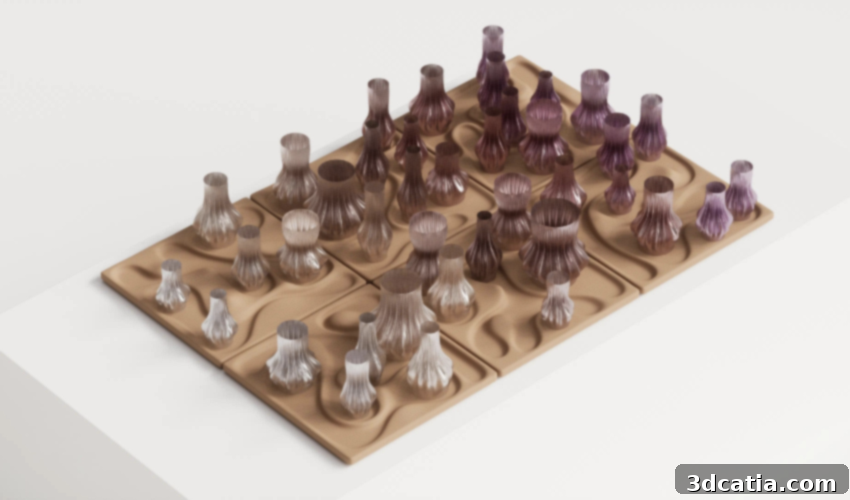
Revolutionizing Art: Julia Koerner’s Visionary 3D Printed Glass Installation in Venice
In an era defined by rapid technological advancements, additive manufacturing, commonly known as 3D printing, has emerged as a transformative force. While its profound impact on sectors such as medicine, automotive, and aerospace is widely acknowledged, its revolutionary influence on the world of art and design is equally compelling, albeit sometimes less highlighted. This innovative intersection of technology and creativity has been powerfully demonstrated by acclaimed designer Julia Koerner, whose groundbreaking 3D printed glass installation recently captivated audiences in Venice. Through her work, Koerner, a visionary artist who has also lent her additive manufacturing expertise to fashion, notably by creating elaborate costumes for a Marvel movie, unequivocally illustrates the significant role 3D printing now plays in contemporary art, with a particular emphasis on glasswork.
Koerner’s artistic philosophy seamlessly blends elements of nature, cutting-edge technology, and pioneering material innovation. These three core principles brilliantly define “Crystal Lamellas,” the awe-inspiring installation she meticulously brought to life in Venice. As a celebrated artist hailing from Salzburg, Koerner consistently pushes the boundaries of design, and “Crystal Lamellas” stands as a testament to her unique vision. This fabulous creation was a highlight of The Italian Glass Weeks, a prestigious festival that took place from September 10th to 25th. The event itself was held in conjunction with the United Nations International Year of Glass, underscoring the global recognition of glass as a vital material for both utility and artistic expression. The chosen venue for this remarkable exhibit was none other than the historic Gritti Palace in Venice, with the installation elegantly displayed in one of its most venerable spaces: the Explorer’s Library. This juxtaposition of a futuristic, digitally fabricated artwork within a centuries-old, richly historical setting created a profound dialogue between past and future, tradition and innovation, natural forms and technological prowess, inviting visitors to reflect on the evolving landscape of art.
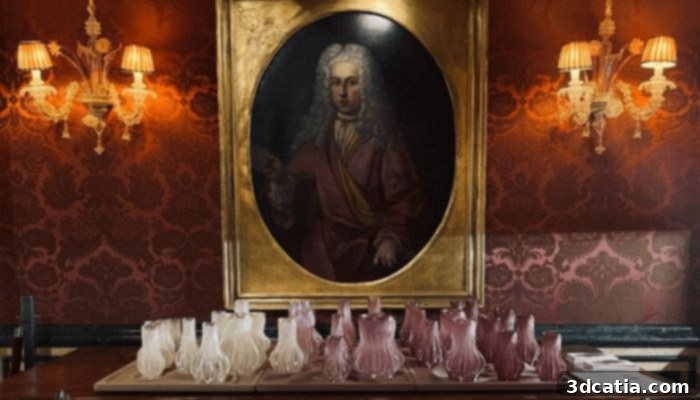
Julia Koerner’s stunning 3D-printed glass sculptures, “Crystal Lamellas,” exhibited in the historic Gritti Palace in Venice.
3D Printed Art: A Groundbreaking Collaboration With Swarovski
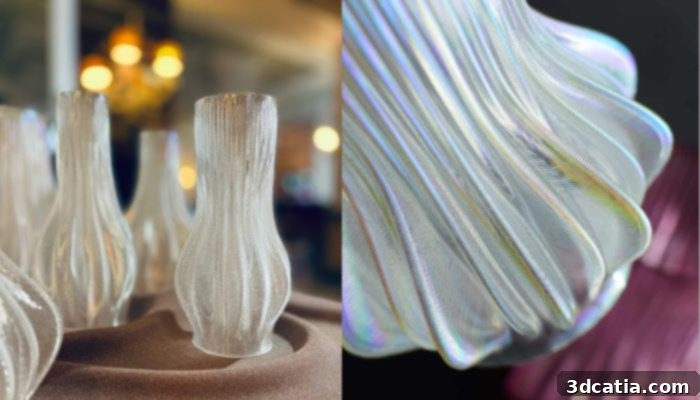
The conceptual genesis of the 3D-printed “Crystal Lamellas” draws deeply from the natural world, specifically from the intricate structures, subtle colors, and delicate shapes found in the gills and lamellae of mushrooms. Julia Koerner’s inspiration from biomimicry is evident in every curve and contour, transforming organic biology into stunning digital art. To translate this complex vision into tangible glass objects, Koerner embarked on a groundbreaking collaboration with the renowned crystal company, Swarovski. This partnership was instrumental, as Swarovski provided its unparalleled expertise and state-of-the-art 3D glass printing technology. This advanced manufacturing capability was crucial, enabling the precise and intricate production of these mushroom-inspired figures in a continuous spiral shape, all within a single print cycle. This ‘single print’ approach not only highlights the efficiency and precision of 3D printing but also allows for a fluidity of form that would be incredibly challenging, if not impossible, to achieve through conventional glassworking techniques.
One of the most captivating aspects of the “Crystal Lamellas” installation is the inherent uniqueness of each individual piece. Much like the subtle variations found in nature where no two mushrooms are exactly alike, each 3D-printed object within Koerner’s series possesses distinct details and characteristics. This individuality is further amplified by the innovative coloring technology provided by Swarovski. Their advanced techniques allowed for a nuanced application of color, creating captivating gradients and textures that enhance the organic feel of the sculptures. The interplay of light through the colored glass imbues each lamella with a dynamic quality, constantly shifting and reflecting its surroundings. This collaboration not only showcases the artistic potential of 3D printing but also exemplifies how cutting-edge technology, combined with a deep respect for natural forms and an artist’s vision, can redefine the boundaries of material expression and artistic creation. The fusion of Koerner’s design philosophy with Swarovski’s technological prowess has opened up new avenues for exploring texture, light, and transparency in glass art, setting a new benchmark for digital fabrication in creative fields.
Pushing Boundaries: Sustainability, Innovation, and Design
The “Crystal Lamellas” installation exhibited in Venice represents a pivotal continuation and evolution of the collaborative synergy between Julia Koerner and Swarovski. This enduring partnership is not merely focused on aesthetic outcomes but is deeply committed to exploring and advancing the critical aspects of sustainability, innovative manufacturing technologies, and groundbreaking design. The success of this integrated approach is undeniable, as evidenced by the profound impact and artistic integrity of “Crystal Lamellas.” This project signifies a deliberate move towards more environmentally conscious practices within art and industrial design, leveraging 3D printing’s potential to reduce waste, optimize material usage, and enable on-demand production. By embracing digital fabrication, Koerner and Swarovski are demonstrating a viable path towards a more sustainable future for creative industries, where artistic ambition aligns with ecological responsibility.
Significantly, the exquisite 3D-printed glass lamellae are an inspired extension of Koerner’s well-known JK3D lamellae series. While the earlier series utilized polymers and was celebrated for its diverse range of sizes and forms, this new glass iteration elevates the concept to a new material plane, showcasing the versatility of Koerner’s design language across different mediums. This continuity underscores Koerner’s consistent artistic vision and her pioneering spirit in material exploration, moving beyond conventional plastics into the challenging yet rewarding realm of 3D-printed glass. Her work consistently explores how digital design can mimic, enhance, and reinterpret natural structures, often creating complex geometries that are impossible with traditional crafting methods. The success of “Crystal Lamellas” serves as a powerful testament to the potential of additive manufacturing to not only replicate intricate forms but also to imbue them with new meaning and aesthetic value, challenging our perceptions of art, technology, and nature. This ongoing journey of innovation cements Julia Koerner’s position as a leading figure at the forefront of digital design and artistic expression. For those eager to delve deeper into her extraordinary portfolio and innovative approaches, more information about the artist is available directly on her website HERE.
The Broader Impact of Additive Manufacturing on Art
The “Crystal Lamellas” installation is more than just an art exhibit; it’s a profound statement about the future of creative endeavors. It highlights how additive manufacturing empowers artists like Julia Koerner to transcend the limitations of traditional materials and techniques. Glass, a notoriously difficult material to manipulate, can now be shaped into forms of unprecedented complexity and detail, opening up entirely new avenues for artistic expression. This paradigm shift means artists are no longer bound by the tools of the past but can harness digital tools to bring their most ambitious visions to life. The ability to create unique, intricate pieces on demand, with precise control over geometry and color, democratizes the art-making process to some extent, allowing for greater experimentation and innovation.
Furthermore, Koerner’s work with Swarovski illustrates the critical role of interdisciplinary collaboration in fostering innovation. When design, art, and advanced engineering converge, the possibilities become limitless. Such partnerships not only push technological boundaries but also inspire new aesthetic movements that challenge conventional notions of beauty and form. The “Crystal Lamellas” project, with its blend of natural inspiration and digital fabrication, stands as a beacon for how technology can serve as a conduit for deeper artistic exploration rather than merely a tool. It encourages a broader conversation about how sustainable practices, enabled by efficient manufacturing processes like 3D printing, can be integrated into high-end art and design, proving that environmental responsibility and artistic excellence can coexist harmoniously.
As we look to the future, the influence of 3D printing in art is only set to expand. Artists will continue to experiment with new materials, develop more complex algorithms, and explore the interplay between digital design and physical manifestation. Julia Koerner’s “Crystal Lamellas” is a crucial milestone in this journey, demonstrating the breathtaking potential when human creativity meets the power of advanced manufacturing. It invites us all to ponder the question: what new forms of beauty and innovation will additive manufacturing unlock next?
What are your thoughts on this incredible 3D printed glass installation in Venice and the broader impact of additive manufacturing on art? We’d love to hear your perspective! Let us know in a comment below or connect with us on our LinkedIn, Facebook, and Twitter pages! Don’t forget to sign up for our free weekly Newsletter here to get the latest 3D printing news delivered straight to your inbox! You can also find all our compelling videos and interviews on our YouTube channel, where we explore the most exciting developments in the world of 3D printing and additive manufacturing.
*All Photo Credits: Julia Koerner