

AI-Powered Large Format 3D Printing: Revolutionizing Custom Furniture and Sustainable Manufacturing
A groundbreaking collaborative initiative, spearheaded by visionary industrial engineers and pioneering furniture startups, is fundamentally redefining the landscape of custom furniture manufacturing. This ambitious project, led by Feng Ju, an esteemed associate professor of industrial engineering at Arizona State University, brings together a formidable consortium of industry leaders including Haddy, Oak Ridge National Laboratory, and the University of Tennessee – Knoxville. Their collective mission is to harness the transformative power of artificial intelligence (AI) to elevate 3D printing processes to unprecedented levels of efficiency, innovation, and design flexibility, ultimately paving the way for a new era in bespoke furniture production.
At the heart of this initiative lies a profound focus on Large Format Additive Manufacturing (LFAM). This advanced technique represents a monumental leap forward in fabrication capabilities, enabling the production of industrial-scale objects that range from intricate automotive components and robust aerospace parts to uniquely designed furniture pieces. The engineering team views LFAM not merely as a manufacturing method but as a strategic enabler, offering the capacity to produce furniture-scale objects with remarkable speed, unparalleled creative freedom, and inherent flexibility. When synergistically coupled with the intelligent capabilities of AI, the benefits of LFAM are amplified exponentially, promising a paradigm shift in how custom pieces are conceived, designed, and brought to life.
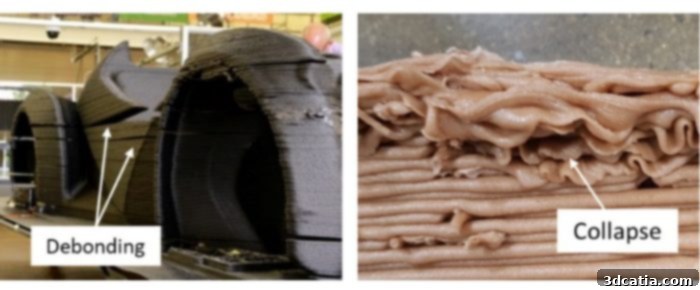
LFAM requires a careful balance in printing speed. When 3D printing materials are extruded too rapidly, they may collapse, while printing them too slowly can result in debonding.
Despite its immense potential, Large Format Additive Manufacturing presents a critical engineering challenge: maintaining optimal printing temperatures throughout the fabrication process. Dylan Hoskins, a Senior Engineer at Haddy, eloquently likens this complex process to the nuances of baking. He elaborates on the meticulous calibration required for printing speeds to prevent material defects, stating, “You don’t want something to be underbaked because then it’s just going to turn to mush. You don’t want something to be overbaked because then it’s too hard. In both cases, the result is useless.” This analogy perfectly encapsulates the delicate balance inherent in LFAM. If the molten material is extruded too quickly, it might not cool and solidify sufficiently before the next layer is applied, leading to structural collapse or deformation. Conversely, if the extrusion speed is too slow, the material could cool excessively, compromising adhesion between layers and resulting in delamination or ‘debonding,’ ultimately rendering the printed object structurally unsound and commercially unviable. This highlights the absolute necessity for precise, real-time thermal management to ensure material integrity and product quality.
Addressing this fundamental challenge head-on, Professor Feng Ju and his dedicated team are pioneering the development of sophisticated AI algorithms. These intelligent systems are designed to continuously process vast amounts of thermal data, environmental cues, and material properties in real-time. By dynamically analyzing these inputs, the AI can automatically adjust crucial printing parameters—such as extrusion speed, nozzle temperature, and cooling fan intensity—on the fly. This adaptive control mechanism ensures that materials are always deposited under optimal conditions, mitigating the risks of collapse or debonding, and thereby guaranteeing consistent structural integrity and aesthetic quality. This innovative approach is expected to yield significantly enhanced productivity, drastically improve print consistency, and represent a major leap forward in adopting sustainable manufacturing practices. As Professor Ju articulates, “The concept here is to help the machine make real-time decisions automatically for the printing process, speeding up when it can and slowing down when it has to.” This intelligent automation promises to optimize material usage, reduce waste, and accelerate the entire production cycle for custom furniture.
Beyond process optimization, Ju and his team are venturing into another exciting frontier: the application of generative AI for furniture design. Drawing profound inspiration from the capabilities of large language models like ChatGPT, they are diligently working on developing an intuitive digital assistant specifically tailored for designers. This revolutionary tool will empower designers to translate their conceptual visions, articulated through plain language descriptions and natural dialogue, into intricate, high-fidelity 3D models that are instantly ready for printing. Imagine a designer simply describing a “mid-century modern armchair with a sweeping organic form and integrated storage,” and the AI assistant instantly generating multiple design iterations complete with detailed specifications. This development is poised to democratize the design process, making advanced 3D modeling accessible to a broader range of creatives regardless of their technical proficiency in complex CAD software. By dramatically shortening the design cycle and enabling rapid prototyping, generative AI will empower designers to bring their most imaginative ideas to fruition with unparalleled speed and ease, fostering an environment of boundless creativity and personalization in the furniture industry.
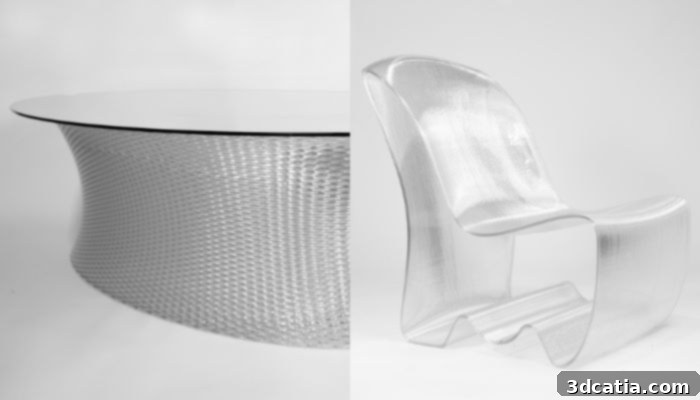
Recyclable furniture.
The profound impact of this project extends far beyond merely enhancing productivity and creativity; it is a powerful catalyst for significantly improving environmental sustainability within the manufacturing sector. Haddy, a key partner in this initiative, is championing a truly innovative closed-loop system designed to minimize waste and maximize resource efficiency. This is achieved by strategically integrating high-quality recycled materials into the furniture design and manufacturing process. Furthermore, each custom-printed piece of furniture is equipped with embedded Near Field Communication (NFC) tags. These tags serve as digital passports, storing vital information about the furniture’s composition, material origin, and end-of-life recycling instructions. This robust system ensures that when a piece of furniture reaches the end of its functional life, its constituent materials can be efficiently identified, sorted, and repurposed, thereby diverting waste from landfills and significantly reducing the demand for virgin resources. This commitment to circular economy principles represents a bold step towards a more responsible and eco-conscious furniture industry, demonstrating how advanced manufacturing can align with ecological imperatives. The collective research and developments from Professor Ju’s team are slated to be showcased this June at the highly anticipated Manufacturing Science and Engineering Conference in Knoxville, Tennessee, where they are expected to generate considerable interest and further discussions on the future of sustainable manufacturing.
This collaborative effort between academia and industry is not just about building better furniture; it’s about establishing a new paradigm for manufacturing itself. By integrating artificial intelligence into every stage—from predictive process control in large format 3D printing to generative design—the team is tackling some of the most pressing challenges in modern production: efficiency, customization, and sustainability. The ability to rapidly iterate on designs, produce unique pieces on demand, and ensure those pieces are part of a circular economy fundamentally alters the value proposition for both manufacturers and consumers. For manufacturers, it means less material waste, faster time-to-market for new designs, and the agility to adapt to evolving market demands. For consumers, it offers unparalleled personalization, access to innovative designs, and the assurance that their purchases contribute to a more sustainable future. This initiative is a clear testament to how cross-disciplinary collaboration can unlock transformative potential, pushing the boundaries of what’s possible in custom furniture and setting a precedent for smart, sustainable manufacturing across various industries.
What are your thoughts on this pioneering initiative between Arizona State University, Haddy, and their partners? We invite you to share your insights in a comment below or engage with us on our LinkedIn, Facebook, and Twitter pages! Don’t forget to sign up for our free weekly newsletter here for the very latest 3D printing news delivered straight to your inbox! You can also explore all our informative videos on our dedicated YouTube channel.
*All Photo Credits: Arizona State University