
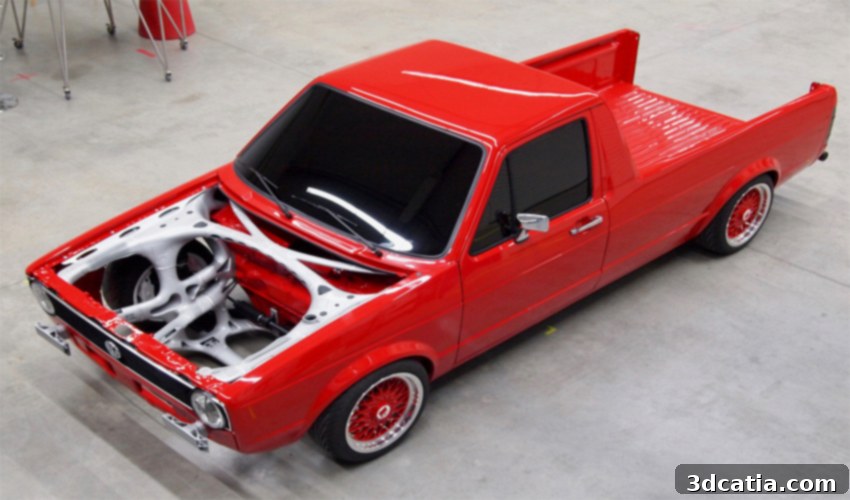
Revolutionizing Automotive Manufacturing: Volkswagen’s 3D Printed Caddy 1 Front End with 3i-PRINT
Volkswagen is accelerating its embrace of 3D printing technology, building on its earlier initiatives like producing spare parts for classic car models. In a significant leap forward, the automotive giant has partnered with a consortium of leading companies—Altair, APWORKS, EOS GmbH, csi entwicklungstechnik, GERG, and Heraeus—to undertake an ambitious project: 3D printing the entire front end of a vintage Volkswagen Caddy 1. This collaborative effort demonstrates the immense potential of additive manufacturing to transform both modern vehicle production and the preservation of automotive heritage.
This groundbreaking partnership was forged under the umbrella of 3i-PRINT, an innovative engineering platform dedicated to the research and development of novel prototype concepts. It was within this dynamic framework that the diverse group of experts converged, embarking on the challenging yet rewarding endeavor of creating a completely additively manufactured front structure for the classic Caddy 1, showcasing a blend of cutting-edge technology and nostalgic automotive design.
Strategic Choice: The VW Caddy 1 and Bridging Old with New
The selection of the VW Caddy 1, a light commercial vehicle produced between 1980 and 1990, was a deliberate and strategically sound decision. Far from a coincidence, this choice underscored a fundamental objective of the 3i-PRINT team: to emphatically demonstrate that 3D printing is not merely a tool for advancing new technologies but possesses an exceptional capability to integrate seamlessly with, and even enhance, pre-existing structural designs. By applying state-of-the-art additive manufacturing to a decades-old vehicle, the project aimed to highlight the technology’s versatility and its potential for revitalization, customization, and efficient spare part production for older models, thereby extending the lifespan and functionality of classic automobiles.
The primary objective that galvanized the team was to engineer a prototype that could redefine the front structure of future vehicles. This project envisioned a future where car components are not only lighter and more efficient but also produced with unprecedented design freedom and integrated functionalities. Each member of the consortium was acutely aware of the transformative impact additive manufacturing is rapidly making across the automotive sector. This awareness was fueled by a growing number of innovative projects already launched by influential players in the industry, including manufacturers like Mercedes-Benz, who have also begun to leverage the benefits of 3D printing for specialized parts and prototyping. The Caddy 1 project was thus conceived not just as an experiment, but as a tangible proof-of-concept for the next generation of automotive design and production.
Breaking New Ground: A Lightweight, Functional Front End
Stefan Herrmann of csi entwicklungstechnik articulated the enthusiasm surrounding the project’s outcome: “We are proud to present the Caddy with an exemplary new additively manufactured front end structure.” He further emphasized the profound implications of their achievement, stating, “The new structure and the contrast between old and new impressively demonstrates the potential that 3D printing and functional integration offer, particularly for the automotive industry.” This sentiment encapsulates the core innovation: creating a structure that is simultaneously a tribute to a classic design and a beacon for future manufacturing processes.
By meticulously combining their collective ideas, profound know-how, and the very latest in additive manufacturing technologies, the 3i-PRINT team successfully engineered and produced the first entirely 3D-printed metal front structure for the Caddy 1, weighing a mere 75 lbs (approximately 34 kg). This remarkable feat was accomplished using Scalmalloy, a high-performance aluminum alloy specifically developed by APWORKS for additive manufacturing, renowned for its exceptional strength-to-weight ratio. The project culminated in a fully functional front end for the Caddy 1, a testament to the power of inter-company collaboration. While it might seem challenging to coordinate so many diverse companies on a single project, each partner brought indispensable, specialized expertise to every facet of the design and production process. For instance, Altair played a crucial role in developing advanced applications for the synthesis and optimization of designs and processes, ensuring the structural integrity and efficiency of the printed part. Concurrently, EOS provided the state-of-the-art EOS M 400 3D printing system, a robust and precise machine essential for APWORKS to bring the intricate designs to life with unparalleled accuracy and quality.
The Power of Collaboration: Agile Development and Expert Integration
The efficiency and speed of the project were equally remarkable. Stefan Herrmann highlighted this aspect, stating, “I would…like to emphasize the agile, time-efficient route from the initial idea to the fully converted vehicle, which was completed within only nine months.” This rapid turnaround from concept to tangible prototype is a stark contrast to traditional manufacturing timelines, showcasing the inherent advantages of additive manufacturing workflows combined with agile project management. He further praised the synergy among the partners: “Each of the participating companies is a leader in its field. The outstanding collaboration and combined expertise has made the 3i-PRINT project a resounding success.” This collaborative model, where diverse specialists integrate their unique strengths, is proving to be a highly effective paradigm for innovation in complex engineering challenges.
The collective expertise brought together by 3i-PRINT exemplifies a holistic approach to additive manufacturing. APWORKS, with its deep knowledge in advanced materials and industrial 3D printing, was instrumental in materializing the complex designs. EOS, as a pioneer in high-end industrial 3D printing solutions, provided the critical hardware and technical support. Altair’s role extended beyond design optimization; their software allowed for sophisticated simulations, predicting how the printed parts would perform under various stresses and conditions, ensuring the integrity and safety of the final product. Heraeus contributed its vast experience in material science, possibly in powder metallurgy or material characterization, crucial for working with advanced alloys like Scalmalloy. GERG and csi entwicklungstechnik, with their automotive engineering and development prowess, provided the essential context for integrating these innovative parts into a functional vehicle, ensuring that the 3D-printed front end met all necessary automotive standards and requirements. This multi-faceted collaboration not only yielded a novel car part but also established new benchmarks for inter-industry cooperation in advanced manufacturing.
The EOS M 400 3D printing system
Showcasing Innovation: Public Display and Future Implications
The groundbreaking partially 3D printed Caddy 1 was prominently featured at two significant industry events: the Converge 2017 exhibition in Essen and the formnext 2017 show in Frankfurt. These exhibitions are key platforms for additive manufacturing and advanced engineering, drawing experts, enthusiasts, and potential investors from across the globe. Showcasing the Caddy 1 at these events allowed the 3i-PRINT consortium to present their tangible achievements, share insights, and inspire further innovation within the broader industrial landscape. It served as a powerful demonstration of how seemingly disparate technologies and classic designs can converge to create something entirely new and impactful, pushing the boundaries of what is considered possible in automotive production.
The implications of projects like the 3i-PRINT Caddy 1 extend far beyond individual car models. This initiative is a clear indicator of the automotive industry’s trajectory towards more flexible, efficient, and sustainable manufacturing processes. Additive manufacturing offers unprecedented design freedom, enabling engineers to create complex geometries that are impossible with traditional methods. This allows for topological optimization, where material is placed only where structurally necessary, leading to significantly lighter components without compromising strength. Such weight reductions translate directly into improved fuel efficiency and reduced emissions for new vehicles. For older models, it opens up avenues for creating custom spare parts on demand, circumventing the challenges of obsolete tooling and diminishing stock, thereby ensuring classic cars can remain on the road for generations to come. The future of automotive manufacturing, as illuminated by Volkswagen’s initiative, is one of innovation, customization, and renewed longevity.
Join the Conversation: The Future of 3D Printing in Automotive
The question remains: will initiatives like 3i-PRINT, harnessing the power of advanced 3D printing, truly be able to usher in an era where our beloved vehicles, both classic and contemporary, can be brought back to life, enhanced, and sustained with unprecedented efficiency? The evidence from Volkswagen’s Caddy 1 project suggests a resounding yes, pointing towards a future where customized, lightweight, and robust components are not just possibilities but realities. We invite you to share your thoughts and predictions on this exciting development. Let us know what you think in the comments below or engage with us on our Facebook and Twitter pages! For those eager to stay at the forefront of this evolving industry, don’t forget to sign up for our free weekly Newsletter, delivering all the latest news and insights in 3D printing directly to your inbox!