

South Africa’s Bold Leap: 3D Printing 25 Homes to Revolutionize Affordable Housing
The global housing crisis is an escalating challenge, demanding innovative and scalable solutions. Across continents, millions lack adequate shelter, pushing governments and industries to explore unconventional methods. Among these, additive manufacturing, commonly known as 3D printing, has emerged as a particularly promising technology, offering unprecedented speed, cost-efficiency, and design flexibility in construction. Recognizing this potential, the South African government is taking a pioneering step forward. Through its Department of Science and Innovation (DSI), the nation has embarked on an ambitious pilot project to construct 25 houses using advanced 3D printing technology. This initiative is a direct response to the critical shortage of affordable housing in the country, aiming not only to provide immediate solutions but also to lay the groundwork for a more sustainable and technologically advanced construction sector.
While the concept of 3D-printed buildings is gaining traction worldwide, its adoption across the African continent is still in its nascent stages. Notable projects, such as the 3D-printed school in Malawi, have demonstrated the technology’s viability in creating essential infrastructure. However, these remain isolated examples. South Africa’s DSI project signifies a significant expansion of additive manufacturing’s role in addressing fundamental social needs on a larger scale. This endeavor positions South Africa at the forefront of leveraging Fourth Industrial Revolution (4IR) technologies to tackle persistent development challenges, setting a precedent for other nations grappling with similar issues.
More than just providing shelter, this pilot project is envisioned as a catalyst for fundamental change within South Africa’s construction industry. The DSI’s objective extends beyond merely erecting buildings; it seeks to transform traditional construction methods to facilitate the creation of genuinely sustainable and smart human settlements. In a comprehensive report to the South African Parliament, the Department of Science and Innovation articulated its vision: “In search of an innovation-based system to improve the delivery of human settlements, the DSI supported the demonstration of 3D printing of houses through the use of additive materials technologies. The initiative aligns to the countries effort to transition sustainable human settlements to smart, green and sustainable settlements in the context of 4IR and climate change.” This statement underscores a dual commitment: harnessing technological innovation for social good and aligning national development with global sustainability imperatives and climate resilience.
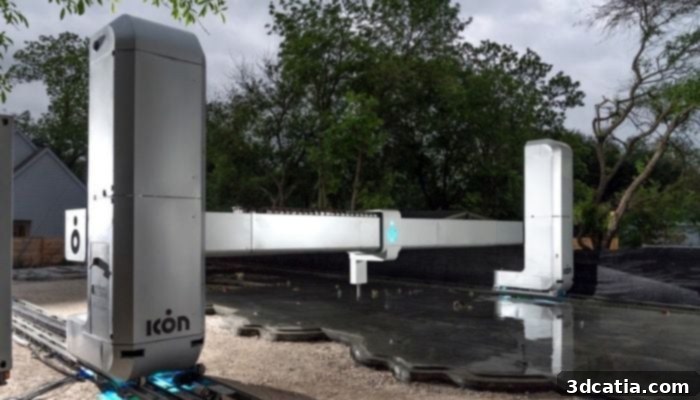
The Vulcan II 3D printer (photo credits: ICON)
Revolutionizing Housing Solutions: The Power of Construction 3D Printing
The application of 3D printing technologies to address housing needs is not an entirely new concept, yet its potential is only just beginning to be fully realized. Globally, various initiatives have successfully deployed this innovative approach to help people find homes more efficiently and affordably. A prime example is the groundbreaking collaboration in Texas, United States, where ICON, a leader in construction 3D printing, partnered with Lennar, a prominent American construction giant, to 3D print an entire community of no less than 100 houses. This monumental project showcased the scalability and transformative power of additive manufacturing in large-scale residential development.
The growing adoption of 3D printing in construction is driven by its inherent advantages, particularly its sustainable and economic aspects. Construction 3D printing works by extruding specialized concrete mixtures or geopolymers layer by layer, building structures from the ground up based on digital designs. This process allows for unprecedented precision, minimizes material waste, and significantly reduces construction timelines. Compared to conventional methods, 3D printing can slash labor costs, simplify logistics, and enable rapid deployment, especially in remote or underserved areas.
For nations like South Africa, these benefits are particularly compelling. President Cyril Ramaphosa has articulated that this pioneering project is strategically designed to contribute to the country’s broader economic recovery efforts, while simultaneously addressing pressing environmental issues. By embracing 3D printing, South Africa can stimulate local innovation, create new skilled jobs in technology and advanced manufacturing, and potentially position itself as a continental leader in sustainable development. The reduction in construction time means homes can be delivered faster to communities in need, alleviating the burden of housing shortages more effectively than traditional build cycles allow.
The Technology Behind the Vision: ICON’s Vulcan II and Future Prospects
While the Department of Science and Innovation has yet to release specific details regarding the exact printing methods and materials to be deployed for their pilot project, keen observers and industry experts anticipate a strong interest in state-of-the-art technologies. Notably, the South African government appears to be closely evaluating solutions offered by industry leaders, with ICON’s Vulcan II 3D printer drawing significant attention. ICON, a Texas-based construction technology company, has been at the forefront of developing large-scale additive manufacturing systems capable of producing durable and resilient structures.
The Vulcan II, as highlighted by ICON, is engineered to design buildings that are not only resistant but also exceptionally quick to construct. A key feature of this machine is its capability to produce structures capable of withstanding extreme weather conditions, a crucial factor for many regions across South Africa that experience diverse and sometimes harsh climates. This resilience ensures the longevity and safety of the 3D-printed homes, offering occupants robust and secure living spaces. The efficiency of the Vulcan II also means that entire homes can be printed in a matter of days, dramatically accelerating the housing delivery process and addressing urgent shelter needs with unprecedented speed.
The broader implications of adopting such advanced technology extend beyond mere construction. It signals South Africa’s commitment to fostering a new generation of skilled workers trained in operating and maintaining these sophisticated machines. This includes engineers, architects, and technicians who can adapt and innovate within the additive manufacturing ecosystem. Furthermore, the ability to rapidly deploy housing infrastructure could significantly impact disaster relief efforts and the development of new urban or rural settlements, offering a flexible and responsive solution to evolving demographic and environmental pressures. The use of locally sourced materials, where feasible, could also boost domestic industries and reduce the carbon footprint associated with transporting conventional building materials over long distances.
Beyond the immediate benefits, this pilot project could serve as a blueprint for wider adoption across the African continent. As nations strive to meet the demands of growing populations and urbanization, 3D printing offers a scalable and sustainable pathway to development. It encourages architectural innovation, allowing for complex and culturally relevant designs that might be cost-prohibitive with traditional methods. The reduced environmental impact, coupled with the potential for creating energy-efficient homes, aligns perfectly with global agendas for sustainable development and climate action. South Africa’s initiative, therefore, represents a pivotal moment in demonstrating how cutting-edge technology can be harnessed for profound social and economic good, setting a powerful example for the future of construction in the 21st century.
Paving the Way for Sustainable Urbanization in Africa
The journey toward widespread adoption of construction 3D printing in South Africa, and indeed across Africa, will undoubtedly present its own set of challenges. These include navigating regulatory hurdles to integrate new building codes that accommodate 3D-printed structures, ensuring the consistent availability and quality of specialized printing materials, and developing a skilled workforce capable of operating and maintaining these advanced systems. However, the proactive stance of the Department of Science and Innovation, coupled with the proven efficacy of technologies like the Vulcan II, suggests a strong foundation for overcoming these obstacles.
The pilot project is more than just an engineering feat; it’s a strategic investment in the future of South Africa’s human settlements. It embodies the nation’s commitment to leveraging the Fourth Industrial Revolution for societal benefit, transforming urban landscapes into smart, green, and sustainable environments that can withstand the pressures of climate change and rapid urbanization. By pioneering this approach, South Africa not only addresses its immediate housing crisis but also positions itself as a leader in innovative, sustainable development on the global stage. This move could inspire a domino effect across the continent, encouraging other African nations to explore similar technological solutions to their pressing infrastructure and housing challenges.
Ultimately, the success of this project will be measured not only by the number of homes built but by its ripple effect – its ability to spur economic growth, create new industries, empower communities with resilient housing, and set a new standard for sustainable construction practices. The vision for future African cities, characterized by efficiency, environmental consciousness, and accessibility, is being shaped today through projects like this one. It’s a testament to the power of innovation to solve complex problems and build a better tomorrow for all.
What are your thoughts on the South African government’s decision to utilize 3D printing as a crucial tool in tackling the national housing shortage? We invite you to share your insights and comments below, or engage with us on our social media platforms: Linkedin, Facebook, and Twitter. For the latest updates and breaking news in the world of 3D printing, remember to sign up for our free weekly Newsletter here, delivered straight to your inbox! You can also explore our extensive collection of videos on our YouTube channel.