
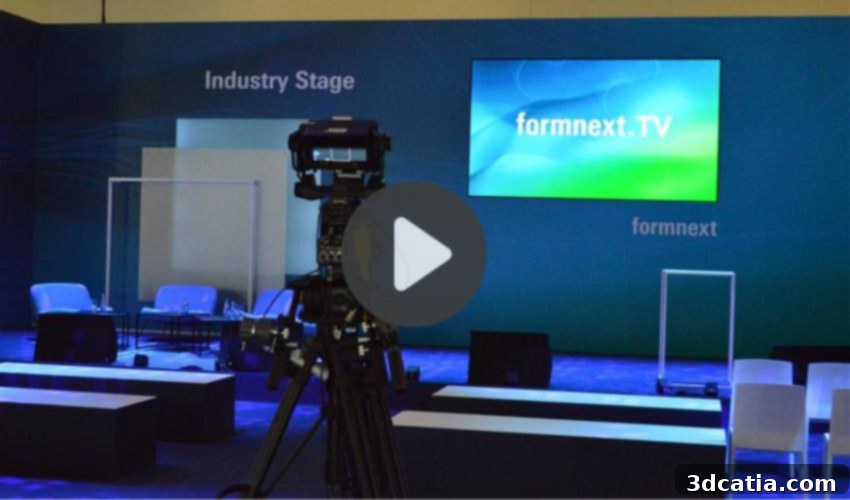
Formnext 2024 Recap: Unveiling the Future of Additive Manufacturing Through Pioneering Innovations
Formnext, aptly celebrated as “Where Ideas Take Shape,” stands as the global epicenter for additive manufacturing and industrial 3D printing technologies. This premier four-day trade show recently concluded, leaving behind a wealth of ground-breaking insights and transformative solutions that are poised to redefine various industries. From revolutionary 3D printing systems to fascinating real-world applications and cutting-edge material science, the event offered an unparalleled glimpse into the future of manufacturing. Our team at 3Dnatives was on the ground, capturing the most significant developments, conducting exclusive interviews, and compiling a comprehensive video series to bring the essence of Formnext directly to you. We delved into the top big 3D printers, explored the latest advancements in metal additive manufacturing, and engaged with numerous companies to uncover their innovative breakthroughs. Join us as we revisit the highlights and key trends that shaped Formnext 2024.
The energy at Formnext 2024 was palpable, driven by a collective excitement for the next generation of additive manufacturing. Our extensive coverage aimed to distill this vast landscape of innovation into actionable insights, providing our audience with a front-row seat to the advancements that matter most. Below, you’ll find a curated compilation of all the 3Dnatives videos from the show, each offering a unique perspective on the technologies, materials, and strategies that are pushing the boundaries of what’s possible with 3D printing. Whether your interest lies in industrial-scale production, specialized materials, or the integration of artificial intelligence into manufacturing workflows, Formnext 2024 showcased solutions that cater to every facet of the additive manufacturing ecosystem.
The Rise of Metal Additive Manufacturing: Top 5 Metal 3D Printers at Formnext
Metal additive manufacturing continues to be a driving force in industrial production, offering unprecedented design freedom and the ability to produce complex, high-performance parts. At Formnext 2024, metal 3D printing solutions took center stage, demonstrating significant advancements in speed, cost-effectiveness, and material capabilities. 3Dnatives embarked on a specialized tour to identify and showcase the top five most impactful metal 3D printing solutions featured at the event. Our exclusive video highlights pioneering machines from industry leaders such as Caracol, known for its large-format robotic additive manufacturing, Solukon, a specialist in automated depowdering, and AMFREE, offering innovative metal binder jetting solutions. We also feature ATO Lab’s precision-focused systems and WAAM (Wire Arc Additive Manufacturing) technologies, illustrating the diverse approaches companies are taking to unlock the full potential of metal. These innovations promise to revolutionize how critical components are manufactured across aerospace, automotive, medical, and defense sectors.
The machines spotlighted in our video represent a spectrum of metal AM technologies, from powder bed fusion to direct energy deposition and binder jetting, each offering unique advantages for different applications. Witness first-hand how these companies are pushing the boundaries of material properties, surface finish, and geometric complexity, making metal 3D printing more accessible and powerful than ever before. This segment provides a crucial overview for anyone looking to understand the current state and future direction of metal additive manufacturing. Discover the machines that are enabling the creation of stronger, lighter, and more efficient metal parts, and see how these cutting-edge solutions can transform your manufacturing processes.
3D Printing Show: Unpacking Key AM Trends and Industry Insights
The “3D Printing Show” at Formnext 2024 provided an invaluable platform for deep dives into the industry’s most pressing topics and emerging trends. In this special episode, Alex Martel, CEO of 3Dnatives, sat down with representatives from three diverse companies to extract their latest innovations and strategic visions. These candid conversations illuminated critical advancements across various segments of additive manufacturing, offering a holistic view of the industry’s direction and the solutions that are shaping its future.
First, Alex engaged with Michael Sun, CEO of InssTek, a renowned pioneer in Directed Energy Deposition (DED) solutions. Their discussion focused on InssTek’s distinctive DED technology, which allows for the repair and fabrication of high-performance metal parts with exceptional precision and material flexibility. Michael highlighted how InssTek’s approach differentiates itself from competitors, particularly in applications requiring advanced material properties and geometric freedom. Understanding DED’s capabilities is essential for industries like aerospace and defense, where material integrity and rapid repair are paramount. This interview offered key insights into how such sophisticated technologies are being optimized for broader industrial adoption.
Following this, Alex met with Pierre Gonnetan from Arkema, a global leader in specialty materials. Arkema’s contributions are vital to the advancement of additive manufacturing, particularly through the development of high-performance polymers. Pierre elaborated on the company’s significant new release: an innovative PA12 powder. This new material is engineered to address some of the persistent challenges in powder bed fusion processes, particularly concerning cost-efficiency and performance. The introduction of this PA12 powder is expected to significantly impact the economic viability and accessibility of polymer 3D printing for a wider range of industrial applications, making high-quality parts more affordable to produce at scale. Their discussion underscored the critical role of material science in unlocking new possibilities for additive manufacturing.
Finally, the conversation shifted to the desktop 3D printing market with Zora from Creality, a popular brand known for its accessible and user-friendly printers. Zora, who manages Creality’s engaging livestreams, offered insights into the comprehensive printer ecosystems the brand provides. She explained how Creality is not just selling individual machines but building integrated solutions that empower hobbyists and small businesses alike. This includes advancements in ease of use, software integration, and community support, which are crucial for driving wider adoption of 3D printing technologies. Her perspective highlighted the ongoing efforts to make additive manufacturing accessible to everyone, from educational institutions to creative professionals. This segment demonstrated the breadth of innovation happening across the entire spectrum of 3D printing, from industrial giants to desktop manufacturers.
Pushing Boundaries: The Top 5 BIG 3D Printers at Formnext 2024
One of the most exciting trends at Formnext 2024 was the undeniable enthusiasm surrounding large-format 3D printers. The demand for bigger build volumes and the ability to produce industrial-scale parts has led to significant innovations in this sector. Our video tour spotlights the top five impressive large-scale additive manufacturing solutions that truly stood out at the event. These aren’t just larger versions of existing technology; they represent sophisticated engineering solutions designed for high throughput and diverse material capabilities, demonstrating that size no longer restricts technological choice.
The selection showcases remarkable diversity in approach and technology. We feature a groundbreaking robotic printer from Yizumi, exemplifying the integration of advanced robotics with additive manufacturing to achieve unprecedented scale and flexibility. Meltio demonstrated its Wire-Laser Metal Deposition (W-LMD) technology applied to larger components, offering robust metal part production. DWS, known for its precision, presented an advanced Stereolithography (SLA) solution capable of producing large, highly detailed polymer parts with exceptional surface finish. Fanum and KraussMaffei also showcased their state-of-the-art large-format systems, catering to various industrial needs from prototyping to end-use parts. These printers collectively illustrate a crucial point: build volume no longer dictates a compromise on the type of 3D printing technology employed. From intricate resin models to robust metal structures, the large-format segment is rapidly expanding its capabilities, enabling manufacturers to scale their additive production significantly.
The innovations highlighted here are critical for industries requiring large-scale components, such as automotive, aerospace, marine, and construction. They enable the production of functional prototypes, tooling, and even end-use parts that were previously impossible or prohibitively expensive to manufacture using traditional methods. The advancements in large-format 3D printing are democratizing access to industrial-scale additive solutions, opening new avenues for innovation and efficiency. Watch our video to explore these colossal machines that are literally shaping the future of large-scale manufacturing and pushing the boundaries of what is conceivable in additive production.
Material Innovations Driving Sustainability and Performance: HP’s New Flame-Retardant Material
Material science forms the backbone of additive manufacturing, continuously evolving to meet demanding industrial requirements for performance, durability, and sustainability. At Formnext 2024, HP, a key player renowned for its Multi Jet Fusion (MJF) technology in the additive manufacturing space, showcased significant advancements in this crucial area. In recent years, HP has intensified its focus on sustainability initiatives within 3D printing, striving to develop materials that not only perform exceptionally but also minimize environmental impact. Their latest introduction marks a significant step forward in this commitment: a new halogen-free, flame-retardant material.
Our exclusive interview with Alex Monino, Senior Vice President of Personalization and 3D Printing at HP, provided profound insights into the company’s overarching vision. Alex candidly discussed the persistent challenge of scalability in additive manufacturing and outlined HP’s strategic approaches to overcome these hurdles, emphasizing the importance of robust hardware, software, and material ecosystems. Following this, Duygu Gunay, a 3D Product Manager, introduced the groundbreaking PA12FR. This new halogen-free, flame-retardant nylon material boasts an impressive 50% recyclability, developed through a synergistic collaboration with Evonik, a leading specialty chemicals company. The PA12FR is designed to meet stringent safety standards in industries such as aerospace, automotive, and electronics, where flame resistance is critical, without compromising on sustainability objectives. Its properties make it ideal for applications requiring both high performance and compliance with fire safety regulations. The material’s high recyclability also positions it as a leader in sustainable additive manufacturing solutions, reducing waste and promoting a circular economy.
Adding to this, Liz Stortstrom, also a 3D Product Manager, shed light on HP’s ongoing efforts to lower the total cost of ownership (TCO) for its equipment while simultaneously delivering increasingly sustainable solutions. This dual focus on economic viability and environmental responsibility underscores HP’s commitment to industrializing additive manufacturing. The integration of such advanced materials, coupled with a focus on TCO and sustainability, represents a holistic approach to driving widespread adoption of 3D printing in demanding industrial environments. This video offers a compelling look at how HP is not just creating new materials but is also crafting a more sustainable and economically sound future for additive manufacturing.
Advancements in Specific Additive Manufacturing Technologies
TPM3D’s Groundbreaking SLS Technology Expands Globally
Selective Laser Sintering (SLS) continues to be a cornerstone technology in additive manufacturing, revered for its ability to produce highly functional, robust plastic parts with excellent mechanical properties. TPM3D, a name that has already established significant prominence in the Chinese market, is now making substantial strides in its venture into the international arena with its advanced SLS 3D printers. At Formnext 2024, TPM3D showcased its latest innovations, cementing its position as a global contender in industrial additive manufacturing.
We had the privilege of speaking with Lucy Zhai, the insightful CEO of TPM3D, who shared invaluable perspectives on the company’s rich history, its strategic growth, and its pivotal participation at this year’s Formnext event. Zhai emphasized TPM3D’s commitment to innovation and customer-centric solutions. She highlighted several impressive applications showcased at their booth, which powerfully demonstrated the extensive capabilities and versatility of TPM3D’s flagship S600DL 3D printer. The S600DL stands out as the largest SLS solution within their formidable portfolio, designed for high-volume production and large-scale parts, catering to demanding industrial requirements across various sectors. These applications ranged from complex automotive components to intricate functional prototypes, all produced with the precision and consistency that SLS technology is known for.
The company’s expansion strategy includes building strong distribution networks and providing comprehensive support to international clients, ensuring their cutting-edge SLS technology is accessible worldwide. TPM3D’s presence at Formnext underscored its ambition to bring reliable, high-performance SLS solutions to a global audience, helping manufacturers achieve greater efficiency and innovation in their production processes. Discover the robust capabilities of TPM3D’s SLS technology and hear directly from CEO Lucy Zhai about their vision for the future of additive manufacturing in our dedicated video coverage.
3DCeram Transforms 3D Printing with Artificial Intelligence for Ceramics
Ceramic 3D printing represents a specialized yet incredibly important segment of additive manufacturing, enabling the creation of parts with exceptional thermal, chemical, and mechanical properties. 3DCeram, a distinguished French company, stands at the forefront of this niche, specializing in advanced ceramic 3D printing technologies, particularly through stereolithography (SLA). Known for their expertise, the 3DCeram team has consistently developed a range of industrial machines that offer unparalleled precision, remarkable speed, and the capability for Large Format Additive Manufacturing (LFAM) in ceramics.
This year at Formnext, 3DCeram made a pivotal announcement that promises to revolutionize industrial ceramic additive manufacturing: the introduction of CERIA. CERIA is their latest, sophisticated artificial intelligence system, seamlessly integrated into their cutting-edge 3D printers. This AI system is not merely an enhancement; it’s a transformative tool designed to elevate additive manufacturing on an industrial scale by intelligently managing and optimizing the entire printing process. CERIA’s capabilities include real-time analysis of both the print files and the dynamic manufacturing processes, allowing for immediate adjustments and proactive problem-solving. This advanced diagnostic and predictive capability significantly reduces the likelihood of errors, minimizes material waste, and ensures consistent part quality, which is critical in high-stakes ceramic applications.
To delve deeper into this groundbreaking innovation, we interviewed Kareen Malsallez, the Marketing Manager at 3DCeram. She elaborated on how CERIA empowers manufacturers to achieve unprecedented levels of efficiency and reliability in ceramic 3D printing, enabling the production of highly complex ceramic components for demanding applications in medical, aerospace, and luxury goods sectors. The integration of AI like CERIA signifies a major leap towards fully automated, intelligent additive manufacturing workflows, where human intervention is optimized, and machine learning ensures continuous improvement. Discover how 3DCeram is leveraging artificial intelligence to unlock new frontiers in ceramic additive manufacturing and drive industrial adoption in our comprehensive video report.
SPEE3D’s Cold Spray Technology and EMU for Printing On-Demand
In the realm of metal additive manufacturing, speed and cost-effectiveness are paramount. SPEE3D is revolutionizing these parameters with its unique Cold Spray 3D Printing Technology, which offers an entirely new paradigm for on-demand metal part production. This innovative process stands apart from traditional metal 3D printing methods by using supersonic speeds to deposit metal powder, significantly reducing printing times and energy consumption. At Formnext 2024, 3Dnatives had the opportunity to engage with Byron Kennedy, CEO and co-founder, and Darren Kitching, European Sales Manager, to uncover how SPEE3D’s technology is fundamentally reshaping the landscape of on-demand manufacturing.
During our discussion, Byron and Darren unveiled the immense power and versatility of SPEE3D’s Expeditionary Manufacturing Unit (EMU). The EMU is not just a printer; it’s a rapidly deployable, large-scale metal part production system designed for environments where speed and autonomy are critical. This unit enables efficient, large-scale metal part production with unmatched speed and cost-effectiveness, making it ideal for defense applications, remote locations, and scenarios requiring immediate component replacement. The unique cold spray process used by SPEE3D allows for the printing of a wide range of metals, including copper, aluminum, and steel, making metal 3D printing quicker, more energy-efficient, and incredibly versatile.
The ability to print functional metal parts on-demand, often in minutes rather than days or weeks, has profound implications for supply chain resilience, field repairs, and prototyping. SPEE3D’s technology is poised to impact industries globally, offering a robust solution for industries looking to reduce lead times, minimize inventory, and enhance operational readiness. Its capacity for rapid manufacturing and broad material compatibility makes it a game-changer for critical applications where time and reliability are of the essence. Dive into our exclusive video interview to understand how SPEE3D’s cold spray technology and the EMU are setting new benchmarks in metal additive manufacturing and redefining what’s possible in rapid, on-demand production.
An Intro to Lumia X1, Hi-SPEED SLA from Axtra3D
Stereolithography (SLA) has long been celebrated for its ability to produce highly detailed and smooth parts, and Axtra3D is now fundamentally changing the perception of this technology with its innovative approach. At Formnext 2024, Axtra3D showcased advancements that are pushing the boundaries of what SLA 3D printing can achieve, particularly in terms of speed and versatility. Our exclusive interview with Rajeev Kulkarni, Chief Strategy Officer at Axtra3D, provided a deep dive into the company’s groundbreaking Hi-SPEED SLA technology and the standout features of their latest offering, the Lumia X1.
Rajeev elaborated on how Axtra3D’s unique Hi-SPEED SLA process combines the precision of traditional SLA with significantly accelerated print times, making it a compelling solution for industrial applications that require both high quality and rapid turnaround. A key highlight of the Lumia X1 is its remarkable capabilities in silicone printing, opening up new frontiers for manufacturing flexible and biocompatible components. This innovation is particularly significant for medical devices, soft robotics, and specialized consumer products, where material flexibility and detailed geometries are crucial. Kulkarni also provided valuable insights into Axtra3D’s strategic business roadmap, emphasizing their commitment to developing a robust material ecosystem that supports their innovations.
He discussed the importance of collaborative partnerships with material developers to ensure a broad range of high-performance resins are available for the Lumia X1, catering to diverse customer applications. From intricate prototypes to functional end-use parts, Axtra3D’s Hi-SPEED SLA technology is poised to impact various industries by offering a faster, more versatile, and more economically viable approach to resin-based additive manufacturing. This interview provided a comprehensive understanding of Axtra3D’s vision, technological differentiators, and the real-world impact of their innovations. Watch our video to see how the Lumia X1 is setting new standards in SLA 3D printing and transforming what’s possible with resin-based additive solutions.
Metal and Polymer Series Production with Farsoon’s CAMS Technology
Farsoon Technologies, a leading Asian manufacturer, has established itself as a formidable force in the additive manufacturing industry, specializing in high-performance 3D printing systems for both metals and plastics. The company has garnered significant recognition for its groundbreaking Continuous Additive Manufacturing Solution (CAMS), a revolutionary system designed to enable uninterrupted production processes through an ingenious conveyor system with interchangeable cartridges. This innovation is crucial for industrial applications demanding high throughput and minimized downtime.
At Formnext 2024, we engaged with key representatives from Farsoon: Oliver Li (Managing Director), Kevin Veysseix (Technical Support Manager), and René Kopatsch (Technical Service Engineer). Our interview provided an in-depth exploration of Farsoon’s advanced metal and polymer printers, revealing the intricate engineering and strategic thinking behind their robust offerings. They detailed how the CAMS technology enhances productivity by allowing continuous batch processing, significantly reducing idle times between builds and optimizing the overall manufacturing workflow. This system is particularly beneficial for series production, where maintaining a consistent output is paramount.
The discussion also covered Farsoon’s strategic plans for expansion and growth within the European market, highlighting their commitment to providing localized support and tailored solutions to meet regional industry demands. Farsoon’s ability to offer versatile solutions for both metal and polymer materials, combined with their focus on continuous operation and efficiency, positions them as a critical partner for industries seeking to scale their additive manufacturing operations. Their machines are designed for reliability, precision, and high performance, catering to diverse applications from automotive to consumer goods. Our video offers a unique opportunity to gain insights into how CAMS is driving unprecedented productivity and what Farsoon’s future looks like in the global additive manufacturing landscape. Discover how Farsoon is enabling the next generation of industrial series production with their cutting-edge technology.
Formnext 2024 truly underscored the dynamic and rapidly evolving nature of the additive manufacturing industry. From pioneering material developments that prioritize sustainability and performance to transformative large-format and metal printing solutions, and the crucial integration of artificial intelligence, the event showcased a future where 3D printing is more accessible, efficient, and powerful than ever before. We hope our comprehensive video recap has provided valuable insights into these incredible advancements. We’d love to hear which Formnext 2024 video or innovation captured your attention the most! Let us know in a comment below or engage with us on our LinkedIn, Facebook, and Twitter pages. Don’t forget to sign up for our free weekly Newsletter here to get the latest 3D printing news delivered straight to your inbox. You can also find all our comprehensive video coverage and more on our official YouTube channel. Stay connected with 3Dnatives for continuous updates on the world of additive manufacturing!