
SelectAM: Revolutionizing Additive Manufacturing Adoption with AI-Powered Part Selection
Additive manufacturing (AM), commonly known as 3D printing, is increasingly recognized for its potential to produce final parts across diverse industries. However, despite its promise, many companies still face significant hurdles in fully adopting this transformative technology. The transition from early-stage prototyping to reliable small-batch or even large-scale production can be particularly challenging, especially for organizations lacking deep in-house AM expertise. This often leads to misdirected investments and financial losses, which in turn create reluctance and skepticism towards further AM integration.
Addressing these critical barriers and aiming to democratize access to advanced manufacturing, Finnish startup SelectAM has developed an innovative solution. Their fully automated, AI-driven platform is designed to intelligently identify the most suitable parts for 3D printing. By analyzing user-provided data, SelectAM’s system accurately estimates costs, predicts production times, and quantifies potential savings when compared to traditional manufacturing techniques. To delve deeper into this groundbreaking solution, we sat down with the SelectAM team to discuss their platform’s mechanics, ongoing projects, and their vision for the pervasive influence of artificial intelligence in the evolving 3D printing industry.
Meet the Visionaries: SelectAM’s Co-Founders and Their Additive Manufacturing Journey
3DN: Could you introduce yourselves and your connection to 3D printing?
Niklas Kretzschmar: My name is Niklas Kretzschmar, and I am a co-founder and the Managing Director of SelectAM. My initial encounter with 3D printing was during my mechanical engineering studies. I was immediately captivated by the immense design freedom and possibilities that additive manufacturing offered, not just for rapid prototyping, but more profoundly, for creating highly functional production components. Before co-founding SelectAM, my work focused on developing decision support systems for metal powder bed fusion technologies and establishing an ontology for industrial 3D printing knowledge, which laid foundational insights for our current platform.
Kalle Lepola: I’m Kalle Lepola, and I’ve been immersed in the additive manufacturing world for nearly eight years now. My journey began in 2017 with HP’s Multi Jet Fusion (MJF) technology. After a brief but valuable stint at SAP, exploring enterprise software solutions, I found myself drawn back to the dynamic AM industry. This passion led me to join SelectAM, initially as an advisor, and now as their Chief Business Officer. What truly excites me about this industry is its promise of a more sustainable and efficient manufacturing future, significantly reducing the need for extensive logistics and warehousing. On a personal note, I eagerly await the day when I can simply 3D print a new ligament for my troublesome knee, showcasing the ultimate potential of personalized manufacturing.
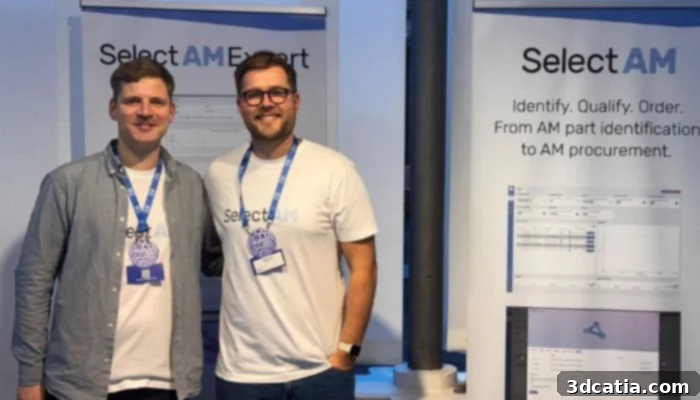
Niklas Kretzschmar (left) and Kalle Lepola (right)
SelectAM’s Core Mission: Empowering Data-Driven Manufacturing Decisions
3DN: What is SelectAM’s mission?
At SelectAM, our foundational mission is to empower companies to manufacture the right parts for the right reasons. We are dedicated to making digital manufacturing truly accessible, enabling businesses to leverage highly efficient and sustainable processes. This approach not only significantly reduces waste but also ensures the prioritization of targeted products throughout their entire lifecycle, from initial design concepts to final delivery.
In our previous professional roles, we identified substantial systemic issues within the additive manufacturing industry that were hindering companies from fully realizing the benefits and vast potential of 3D printing. A pervasive problem is the continued reliance on a select few internal “experts” to identify and qualify parts for additive manufacturing. Often, the crucial decision of which parts to 3D print is based on intuition, historical knowledge, and a limited understanding of the full spectrum of manufacturing techniques available. This manual, expert-dependent process is inefficient and prone to human bias and oversight.
Furthermore, the process of identifying and qualifying the most efficient production method for a specific part remains largely manual and incredibly time-consuming for many organizations. This bottleneck prevents rapid iteration and optimization. Finally, broader challenges in the manufacturing sector, such as excessive overstocking of products due to high minimum order quantities (MOQ) and the inherent vulnerabilities of long and complex supply chains, highlight the urgent need for a more agile and responsive manufacturing paradigm.
Our core offering at SelectAM is to provide companies with an “automated 3D printing expert,” available 24/7. This intelligent system allows them to make data-driven, objective, and bias-free choices. Unlike relying on a few experts with limited scope, our platform draws upon a broad knowledge base encompassing numerous manufacturing technologies, ensuring optimal decision-making for every part.
How SelectAM’s AI Platform Streamlines Additive Manufacturing Decisions
3DN: Could you explain how the SelectAM online platform works?
The SelectAM platform offers a versatile suite of tools designed to address various use cases within additive manufacturing adoption. We can categorize its main functionalities as follows:
- Top-down Identifying for Portfolio Optimization: Companies leverage our solution to conduct comprehensive analyses of their entire part libraries, drawing data from their existing ERP, PDM, PLM, or data lake solutions. The platform intelligently identifies which parts are ideal candidates for additive manufacturing, which would benefit significantly from a redesign for AM, and which are still best produced using conventional methods. This top-down approach considers a multitude of critical supply chain parameters, including Minimum Order Quantity (MOQ), remaining service lifetimes, historical and projected yearly demands, current stock levels, and many other relevant factors. Our system then calculates a comprehensive Total Cost of Ownership (TCO) for each part, simulating and comparing it against the estimated additive manufacturing cost. This capability enables our customers to holistically assess how AM integrates into their broader operations. We’ve observed that our platform can identify up to a five percent share of components suitable for AM, while drastically reducing the time required for such strategic decisions by up to 90%, especially when analyzing large datasets beyond single parts.
- Real-time Price Check and Streamlined Ordering: Our solution, particularly its free tier, serves as an invaluable tool for library screening, providing real-time market prices for accurate cost-per-piece determination for AM component procurement. This functionality represents the heart of our solution, and we intentionally made it accessible to everyone. A significant advantage is that these evaluations can be performed effectively both with and without CAD files, consistently delivering accurate results. Ultimately, if 3D printing proves to be the most cost-effective solution among various manufacturing technologies, the platform also facilitates the seamless ordering of these parts directly through our network.
- Automated Quotation Generation: We collaborate closely with 3D printing service providers and the internal AM teams of large Original Equipment Manufacturers (OEMs). Our platform empowers them to accurately and rapidly estimate production costs and timeframes, including all necessary post-processing steps. This capability allows our customers to generate detailed quotes for their machines in mere seconds. We have documented automation rates ranging from 40% to 60%, signifying that a full-time employee previously dedicated to manual quoting can now be redeployed to more strategic tasks, or dramatically increase their sales capacity if production allows.
- Intelligent Re-design Estimates: When companies first analyze their existing part libraries, it’s common to find that only 2-5% of components are directly suitable for additive manufacturing without modification. This is entirely understandable, as the vast majority of products in current supply chains were not initially designed with AM in mind. This percentage can be significantly increased through strategic redesigns. Our re-design estimates provide customers with the unique ability to quantitatively assess the economic viability of their components *after* a theoretical redesign. This answers critical questions like, “How much material or mass do I need to remove for this component to become a positive business case with AM?” All these crucial insights are provided upfront, long before any actual engineering work or redesign efforts begin, saving valuable time and resources.
A Technology-Agnostic Approach to Additive Manufacturing
3DN: What 3D printing technologies are supported by your solution?
Our solution is fundamentally technology-agnostic, meaning we possess the flexibility to integrate and support any type of additive manufacturing technology within our estimation profiles. The way this operates is straightforward: for each new customer project, the initial setup involves a collaborative configuration of machine-specific parameters with the client. For instance, factors like labor costs and material prices can vary significantly between different companies and geographical regions. The cost structures for technologies such as Wire Arc Additive Manufacturing (WAAM) are entirely distinct from those of Selective Laser Melting (SLM), and each technology often necessitates different types of post-processing. All these technology-specific and company-specific parameters are meticulously considered and inputted into the system before we commence running any assessments, ensuring highly accurate and customized evaluations.
Beyond custom configurations, we also provide instant access to real-market prices for the most prominent and widely used AM technologies. This includes processes like SLM (Selective Laser Melting), SLS (Selective Laser Sintering), MJF (Multi Jet Fusion), FDM (Fused Deposition Modeling), SLA (Stereolithography), SAF (Selective Absorption Fusion), and many others. Crucially, our system also simulates and accurately estimates the impact of sophisticated nesting strategies and various post-processing requirements on these market prices, offering a comprehensive and realistic cost outlook.
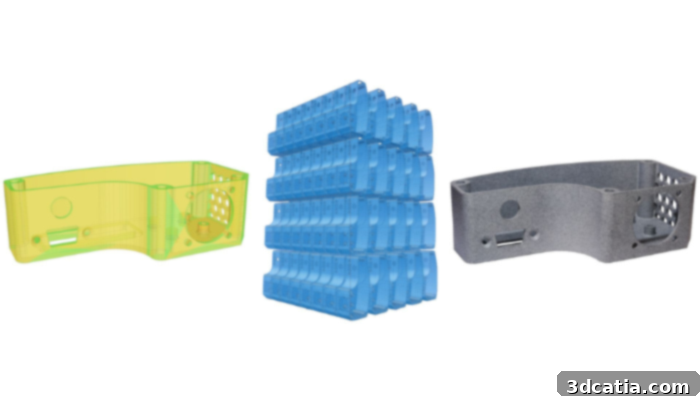
SelectAM’s solution estimates production cost and time by analyzing numerous factors such as the impact of nesting or post-processing.
Customers who own additive manufacturing machines derive substantial benefits from our automated estimations and simulations. They can quickly determine which of their machines is the optimal fit for a specific component and accurately forecast the associated cost and time to produce that part. Moreover, the ability to simulate the impacts of nesting strategies, print orientations, support structure requirements, potential redesigns, packing densities, and more, provides our customers with the definitive answers needed to select the best technology for their application. Alongside this, we simulate the costs of conventional manufacturing methods to identify precise break-even points, allowing companies to strategically analyze at which stage of a product’s lifecycle it should be moved to or from additive manufacturing.
In essence, strategically shifting production to AM for suitable components will consistently lead to decreased costs, reduced waste, and shorter lead times. Thoughtful redesigns will significantly enhance resource efficiency and, in many cases, improve the performance characteristics of the parts themselves. This move to AM also empowers companies to adopt a just-for-demand production model, minimizing inventory and bolstering supply chain resilience. The extensive list of AM benefits begins with making informed, data-backed choices, and that’s precisely where SelectAM provides unparalleled value.
The Transformative Power of AI and Machine Learning in Additive Manufacturing
3DN: What is the role of machine learning and AI in your software? What transformative impact do you foresee AI having on the additive manufacturing sector in the coming years?
Artificial intelligence (AI) and machine learning (ML) are not just supporting elements; they play a profoundly important role within the foundational architecture of our software solution. The remarkable fact that our platform can perform highly accurate evaluations even without the presence of detailed CAD files is a direct testament to the advanced intelligence embedded in our algorithms. Furthermore, as we delve into complex process parameters and intricate simulations, intelligent technologies are indispensable for performing the “heavy lifting” – processing vast datasets and deriving actionable insights. We strongly predict and actively work towards AI playing an even more critical role in significantly improving data quality across the additive manufacturing ecosystem. The question is no longer *if* the industry will be transformed by AI, but rather *when* this transformation will become fully pervasive. We are rigorously committed to remaining at the vanguard of this development, and our customers can anticipate seeing visible AI capabilities rolled out in the forthcoming larger version of our Platform 2.0.
The additive manufacturing industry is poised to witness a significant surge in AI-based solutions across various critical areas. This includes sophisticated in-process monitoring and controls, advanced topology optimizations that push the boundaries of design, highly efficient manufacturing execution systems (MES), dynamic capacity planning tools, and robust quality control systems. Moreover, we anticipate the rapid integration of computer vision and powerful big data frameworks into the industry in the near future. There are countless exciting opportunities to apply AI and other modern technologies to AM; just consider the immense amounts of data generated from a single print job. This data can be leveraged to accurately predict outcomes, meticulously optimize print processes, and ultimately drive unprecedented levels of efficiency and reliability.
Current Initiatives and Future Horizons for SelectAM
3DN: What are your current and future projects?
As previously mentioned, our dedicated development team is diligently working on the creation of Platform 2.0. This next-generation platform will introduce a host of new features and enhanced capabilities that we plan to release to the market throughout 2025. Many of these upcoming features, reflecting our commitment to accessibility, will be offered free of charge. More specifically, we are heavily investing in developing advanced artificial intelligence capabilities designed to tackle complex data-level issues and to further refine the accuracy of our estimation and redesign analysis tools. We are also exploring more automated workflows within the entire estimating process, aiming for even greater efficiency and user experience.
In parallel, we are actively engaged in several technology-specific projects. For instance, we are collaborating with a large manufacturer to optimize their Wire Arc Additive Manufacturing (WAAM) operations, helping them maximize efficiency and output. We were also a key participant in an “Impact Chain” project, which involved numerous Small and Medium-sized Enterprises (SMEs). This project focused on identifying, qualifying, and ordering AM parts, assisting these companies in their nascent stages of adopting additive manufacturing. Although our customer base is global, we maintain a strong commitment to being active on our home turf in Finland. Consequently, we are deeply engaged with the Finnish Additive Manufacturing Ecosystem (FAME) and are currently undertaking several interesting projects with them, all with the overarching goal of accelerating and strengthening the Finnish 3D printing industry.
A Final Message: De-risking Additive Manufacturing Investments
3DN: Any last words for our readers?
We have encountered numerous customers who, in the past, have unfortunately “burned their fingers” when attempting to integrate additive manufacturing into their operational workflows beyond the initial stages of R&D and tooling. These early, often unsupported, attempts frequently led to significant wastage of money, time, valuable materials, and energy. Fortunately, with our data-driven approach at SelectAM, such losses can now be prevented. We are uniquely positioned to truly help companies accurately identify and unequivocally justify valuable investments in additive manufacturing, ensuring that their adoption of this powerful technology is both strategic and profitable.
What are your thoughts on SelectAM’s innovative platform? We invite you to share your insights in a comment below or connect with us on our LinkedIn, Facebook, and Twitter pages! Don’t forget to sign up for our free weekly Newsletter here to receive the latest 3D printing news straight to your inbox! You can also find all our videos on our YouTube channel.
*All Photo Credits: SelectAM