
Revolutionizing Health: How a 3D Printed Wearable Sweat Sensor is Transforming Health Monitoring
While the summer months bring a host of enjoyable activities, it’s undeniable that some aspects of the season can be less pleasant. The discomfort of sweating in the heat, for instance, often leads to embarrassing marks on clothing, increased agitation, and body odor. Yet, what if this seemingly inconvenient bodily function held the key to unlocking crucial insights into our health? Researchers at the University of Hawai’i at Mānoa College of Engineering are making a significant bet on this very idea. Through an innovative project, they have developed a groundbreaking 3D printed wearable sweat sensor, affectionately nicknamed the “sweatainer,” designed to gather vital health and disease-related information directly from perspiration.
Sweating is far more than just a cooling mechanism; it’s a remarkably beneficial physiological process. Beyond regulating body temperature and aiding in the expulsion of toxins, sweat is a rich, untapped resource for medical professionals seeking to track various health indicators. The Hawai’i researchers emphasize its ability to provide not only immediate clues regarding dehydration, fatigue, and blood sugar fluctuations, but also to facilitate the monitoring of more serious, chronic conditions. These include critical diseases such as cystic fibrosis, diabetes, and heart failure. Considering that in the United States alone, an estimated 40,000 children and adults live with cystic fibrosis, 37.3 million adults grapple with diabetes, and 6.5 million suffer from heart failure, the potential for such a device to significantly improve patient care and health maintenance is immense. The flexibility and precision offered by 3D printing proved instrumental in enabling the creation of this sophisticated, non-invasive diagnostic tool.

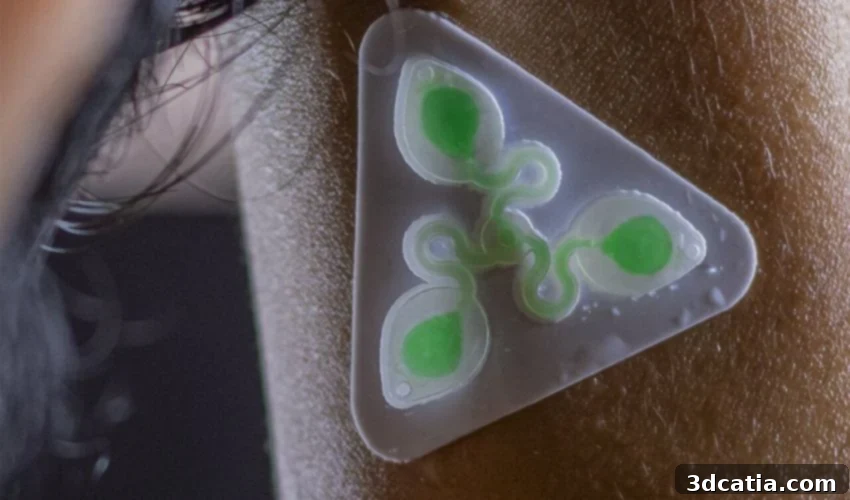
The innovative sweat sensor is meticulously designed to be worn directly on the skin, facilitating accurate and continuous monitoring (photo credits: Ray Research Group)
Unlocking Health Insights: The Advantages of the 3D Printed Sweat Sensor
While perhaps not as commonly discussed as blood drawing, sweat collection has a long-standing, albeit often cumbersome, role in diagnostic testing for various diseases, particularly cystic fibrosis. Traditional sweat collection methods have historically presented significant challenges. These approaches typically involve pressing absorbent pads or delicate microbore tubes against the epidermis to capture sweat, a process that is often costly, time-consuming, and labor-intensive. Such methods necessitate trained personnel, specialized handling procedures, and expensive laboratory equipment, creating barriers to widespread, convenient testing. Even with the advent of earlier wearable devices, they have largely remained single-use, limiting their utility for continuous or multi-point analysis. However, thanks to the revolutionary capabilities of additive manufacturing, the University of Hawai’i researchers have overcome these limitations. They have successfully engineered a new wearable device that they assert dramatically expands the capabilities of existing wearable sweat sensors, representing a monumental leap forward in the field of sweat analysis and diagnostic technology.
The “sweatainer” sensor was fabricated using a commercial Digital Light Processing (DLP) 3D printer, though the specific brand was not disclosed. This compact, wearable device is comparable in size to a child’s sticker, making it unobtrusive and comfortable for extended wear. Its primary function is the efficient collection and analysis of sweat, but it boasts several unique features that the researchers believe will catalyze innovation toward more accessible, convenient, and insightful personal health monitoring. One such groundbreaking feature highlighted in the press release is the “multi-draw” sweat collection method. This innovative design allows for the collection of multiple, distinct sweat samples, which can then be analyzed directly on the device or transported to a laboratory for further investigation. This capability is a significant departure from traditional single-point sampling, offering a more dynamic and comprehensive view of physiological changes over time.
According to the research team, the “multi-draw” method significantly enhances the efficiency of sweat collection. It opens up exciting possibilities for at-home testing, empowering individuals to take a more proactive role in managing their own health. Furthermore, the ability to store multiple samples facilitates future research, allowing for longitudinal studies and a deeper understanding of disease progression or treatment efficacy. This improved method also promises better integration with existing health monitoring systems, creating a more cohesive and comprehensive healthcare ecosystem. The broader movement towards more personalized, at-home health solutions is a major trend in the medical sector, and it’s a prime example of the transformative benefits that medical 3D printing technologies are increasingly delivering across various applications.
The versatility of 3D printing played a critical role in the “sweatainer’s” development. Traditional manufacturing techniques would struggle to create the intricate microfluidic channels and complex internal structures necessary for multi-sample collection and on-board analysis within such a compact form factor. Additive manufacturing, however, excels at producing geometries with unprecedented complexity and precision, making it the ideal choice for this advanced diagnostic device. This design freedom not only accelerated the prototyping phase but also allowed for iterative improvements, optimizing the sensor’s performance and user experience. The potential for customizability—tailoring sensors to individual physiological characteristics—also presents a compelling future avenue for truly personalized medicine.
Tyler Ray, one of the principal authors of the research and an Assistant Professor in the Department of Mechanical Engineering, eloquently summarizes the profound impact of this technological marriage: “3D printing enables an entirely new design mode for wearable sweat sensors by allowing us to create fluidic networks and features with unprecedented complexity. With the sweatainer, we are utilizing 3D-printing to showcase the vast opportunities this approach enables for accessible, innovative and cost-effective prototyping of advanced wearable sweat devices.” This statement underscores the paradigm shift that additive manufacturing brings to medical device development, moving beyond conventional limitations to unlock novel diagnostic capabilities. The research not only presents a remarkable device but also serves as a compelling proof-of-concept for how 3D printing can democratize access to advanced health monitoring tools. If you wish to delve deeper into the specifics of this groundbreaking project, the entire research paper is accessible HERE.
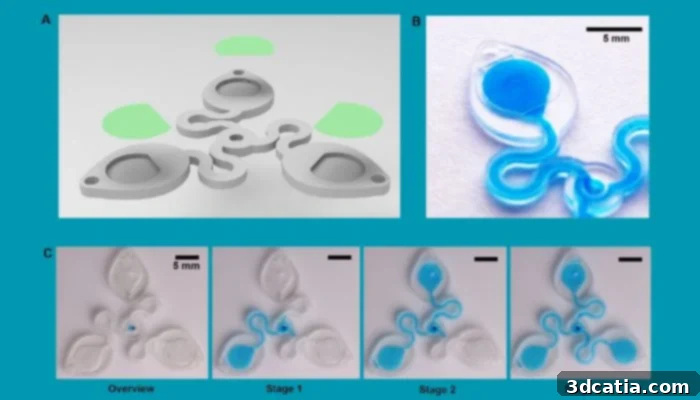
An explanatory diagram visually detailing the intricate mechanisms of the 3D printed sweat sensor (photo credits: Ray Research Group)
The implications of the “sweatainer” extend beyond just disease monitoring. Imagine athletes monitoring hydration and electrolyte loss in real-time to optimize performance and prevent injury, or individuals using the device to track stress hormones throughout their day. This technology paves the way for truly continuous, non-invasive physiological assessment, moving healthcare from reactive treatment to proactive prevention. While further clinical trials and regulatory approvals will be necessary before widespread adoption, the University of Hawai’i’s innovative 3D printed sweat sensor represents a significant stride towards a future where personal health insights are readily available, empowering individuals to take unprecedented control over their well-being. This convergence of advanced materials, additive manufacturing, and wearable technology promises to redefine our understanding and management of human health.
What are your thoughts on this innovative 3D printed sweat sensor and its potential impact on personalized health monitoring? We invite you to share your insights in a comment below or engage with us on ourLinkedIn,Facebook, andTwitter pages! Don’t miss out on the latest advancements in additive manufacturing; remember to sign up for our free weeklyNewsletter here to receive the most current 3D printing news directly in your inbox. You can also explore all our compelling videos and interviews on our dedicatedYouTube channel for more in-depth content.
*Cover Photo Credits: Roxanne Kate Balanay, Tyler Ray/University of Hawai’i