
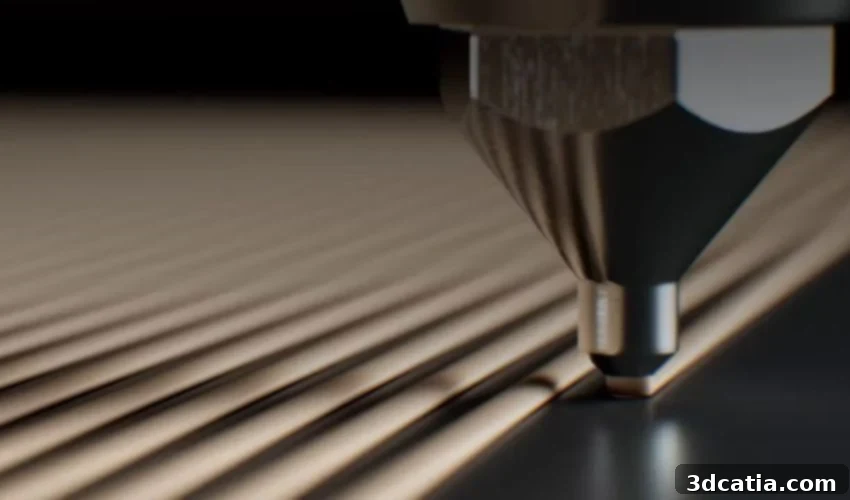
Revolutionizing Spinal Care: FDA Clears First 3D Printed PEEK Interbody System from Nvision and Invibio
The landscape of medical technology continues to evolve at an astonishing pace, and what once seemed confined to the realm of science fiction is now becoming clinical reality. As our readers are well aware, 3D printed medical implants are at the forefront of this revolution, offering unprecedented levels of customization and biocompatibility. In a significant stride forward for spinal care, two leading companies, Nvision Biomedical Technologies and Invibio Biomaterial Solutions, have successfully co-developed and secured U.S. Food and Drug Administration (FDA) clearance for the first-ever 3D printed PEEK Interbody System. This groundbreaking system comprises innovative devices specifically designed for spinal fusion procedures, marking a pivotal moment in the treatment of various spinal conditions.
The newly cleared system includes Cervical and Anterior Lumbar Interbody Fusion (ALIF) spine devices, meticulously crafted using Invibio’s high-performance PEEK-OPTIMA™ polymer. This FDA clearance, announced recently, means these state-of-the-art implants are now available for clinical use, promising to enhance surgical outcomes and improve patient quality of life. The development represents not just an advancement in material science and additive manufacturing but also a testament to collaborative innovation aimed at addressing complex medical challenges. It highlights a critical shift towards more sophisticated, tailored solutions in spinal surgery, where material properties and precise geometries play an indispensable role in promoting healing and long-term stability.
PEEK, or polyether ether ketone, stands out as a semi-crystalline thermoplastic revered for its exceptional properties, making it an ideal choice for demanding medical applications. Its inherent sterilizability, biocompatibility, and impressive resistance to heat, wear, and chemicals are critical for implantable devices that must perform reliably within the human body for extended periods. Beyond these fundamental characteristics, PEEK possesses a modulus of elasticity that closely mimics that of natural bone. This ‘bone-like’ property is profoundly significant; when implanted, PEEK can facilitate the natural reconstruction of surrounding tissues and accelerate osseointegration—the direct structural and functional connection between living bone and the surface of a load-bearing implant.
Invibio’s PEEK-OPTIMA™ material, a specialized grade of PEEK, has a proven track record, having been successfully incorporated into over 15 million implants worldwide. Its widespread adoption underscores its reliability and superior performance in diverse medical fields. A particularly valuable attribute of PEEK-OPTIMA™ for spinal applications is its excellent imaging capability. Unlike metallic implants that can create significant artifacts (shadows or distortions) on X-rays, CT scans, and MRIs, PEEK-OPTIMA™ is radiolucent. This allows surgeons to accurately and clearly monitor the progression of spinal fusion post-operatively, providing crucial information without interference. This clarity is instrumental for timely intervention and assessing the success of the fusion process, offering a substantial advantage over traditional metallic implants.
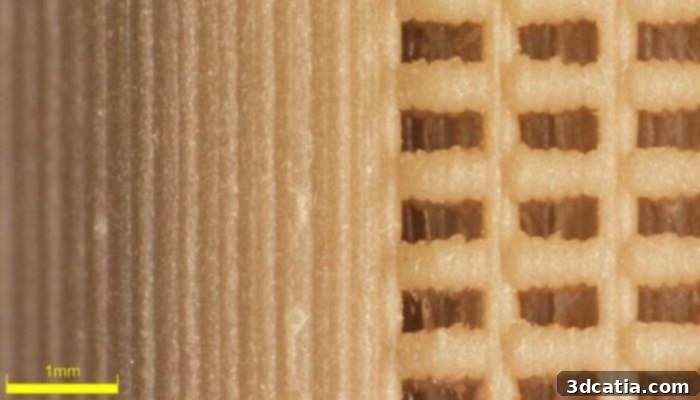
This close-up of the Nvision Interbody System shows its porous PEEK-OPTIMA structure (photo credits: Invibio)
The ingenuity of Nvision and Invibio’s ALIF spine devices lies in their sophisticated architectural design, which ingeniously incorporates both porous and solid structures. This dual-structure approach is a biomechanical marvel, engineered to optimize both immediate stability and long-term biological integration. Dr. John Devine, a key figure at Invibio, elucidated the profound purpose behind this design: “The combination of solid and highly intricate porous PEEK-OPTIMA structures within the Nvision system allows for potential bone ingrowth to achieve fixation while maintaining the inherent benefits of PEEK-OPTIMA for imaging and bone-like modulus.” This quote encapsulates the core advantage – the porous regions act as a scaffold, inviting natural bone to grow into the implant, forming a robust biological bond that enhances fixation and stability over time. Simultaneously, the solid sections provide the necessary structural integrity and load-bearing capacity, ensuring the device can withstand physiological stresses while preserving PEEK-OPTIMA’s desirable modulus and superior imaging characteristics. This meticulous balance is crucial for successful spinal fusion, enabling the implant to become an integral part of the patient’s skeletal system.
Creating a Breakthrough 3D Printed Spinal Device with Advanced Manufacturing
The realization of such an intricate and high-performance interbody system was made possible through the application of cutting-edge additive manufacturing. The Nvision and Invibio team leveraged BOND3D’s specialized technology for this demanding task. BOND3D’s manufacturing process is distinguished by its ability to produce parts with truly isotropic strength across all directions, eliminating the common issue of anisotropic properties often found in traditionally 3D printed parts. Furthermore, their process ensures that parts are 100 percent voidless, a critical feature for medical implants where even microscopic defects could compromise structural integrity or biological performance.
The inherent advantages of additive manufacturing were fully harnessed, granting Nvision and Invibio unparalleled design freedom that would be impossible with conventional subtractive manufacturing methods. This freedom allowed engineers to create complex geometries, such as the integrated porous structures designed for optimal bone ingrowth, which are essential for the device’s efficacy. Dr. John Devine from Invibio further elaborated on the transformative benefits of 3D printing for this specific project: “The proprietary BOND3D advanced manufacturing process used in this device is available through Invibio to allow device companies to realize their innovative designs. Being able to access this process is a breakthrough for device companies because it allows much greater design freedom that would not otherwise be possible with conventional manufacturing methods.” This speaks to the precision and flexibility offered by 3D printing, enabling the creation of patient-specific or anatomically optimized devices that were previously unimaginable. The ability to control internal architecture down to the micron level ensures that each implant performs exactly as intended, promoting superior patient outcomes.
Clinical Impact and Enhanced Patient Care
The introduction of these advanced interbody devices is poised to significantly impact clinical practice. Dr. Steven Lee, a respected spine and orthopedic surgeon, offered invaluable insight into how the Nvision and Invibio devices are expected to transform surgical procedures and patient recovery. “These new interbody devices,” Dr. Lee affirmed, “will allow me to further improve the quality of care and surgical outcomes that I can provide to my patients.” This sentiment underscores the potential for these implants to not only streamline surgical techniques but also contribute to faster rehabilitation and more durable fusion results for patients suffering from degenerative spinal conditions.
Dr. Lee further elucidated the specific mechanisms through which these benefits are achieved. He explained that “PEEK-OPTIMA’s modulus of elasticity helps to prevent subsidence.” Subsidence, a common complication where an implant sinks into the vertebral bone, can lead to loss of disc height and neural compression. PEEK-OPTIMA’s bone-like stiffness reduces this risk, promoting more physiological load sharing across the fusion site. He continued, highlighting that its “radiolucency allows for the confirmation of the fusion process.” This capability is critical for surgeons to non-invasively monitor bone healing without the obscuring effects of metal, thereby enabling precise post-operative assessments.
The most profound benefit, according to Dr. Lee, is encapsulated in the statement: “The benefit of a printed porous structure that mimics native bone allows for bone growth into the device itself – thereby enhancing the construct stability.” This biological integration is the holy grail of implant design. By encouraging direct bone apposition and growth within the implant’s porous architecture, the Nvision system achieves a level of stability that surpasses mechanically fixated implants. This leads to a more robust and long-lasting fusion, ultimately contributing to better long-term patient outcomes and reducing the likelihood of revision surgeries. The combination of PEEK-OPTIMA’s intrinsic properties with the advanced structural designs made possible by 3D printing represents a significant leap forward in addressing the complexities of spinal fusion surgery.
The Collaborative Power Behind Medical Innovation
This landmark achievement is the result of a powerful collaboration between two industry leaders. Nvision Biomedical Technologies, headquartered in San Antonio, Texas, USA, is renowned as a dedicated medical device and implant manufacturer with a strong focus on orthopedic and spinal solutions. Invibio Biomaterial Solutions, based in Lancashire, UK, is globally recognized for providing high-performance biomaterial solutions, particularly PEEK-OPTIMA™, to medical device manufacturers worldwide. Their combined expertise in advanced materials, innovative design, and precision manufacturing has been instrumental in bringing this complex and revolutionary product to fruition. This partnership exemplifies how synergistic collaboration across different specialties can accelerate the development and regulatory approval of cutting-edge medical technologies that address critical unmet needs in patient care. To delve deeper into their successful partnership and the detailed implications of the FDA approval for their ALIF devices, interested readers can access Invibio’s comprehensive press release here.
Looking Ahead: The Future of 3D Printed PEEK Implants
The FDA clearance of Nvision and Invibio’s 3D printed PEEK Interbody System is more than just a product launch; it’s a clear indicator of the transformative potential of additive manufacturing and advanced biomaterials in medicine. As research and development continue, we can anticipate further innovations in personalized implants, complex anatomical reconstruction, and enhanced patient-specific solutions across various medical disciplines. The ability to precisely control material properties and geometric intricacies through 3D printing, especially with a material as versatile as PEEK, opens doors to treatments that are increasingly effective, safer, and tailored to individual patient needs. This breakthrough sets a new standard for spinal fusion devices and paves the way for a future where medical implants are not just functional but truly integrated biological solutions.
What are your thoughts on the revolutionary potential of 3D printing with PEEK for medical implants? Share your insights and perspectives in a comment below, or join the conversation on our Facebook and Twitter pages! Don’t miss out on the latest advancements and news in the world of additive manufacturing – be sure to sign up for our free weekly Newsletter, delivered straight to your inbox!