
3D Printing Revolutionizes Maritime Defense: The SeaRush Unmanned Boat Project
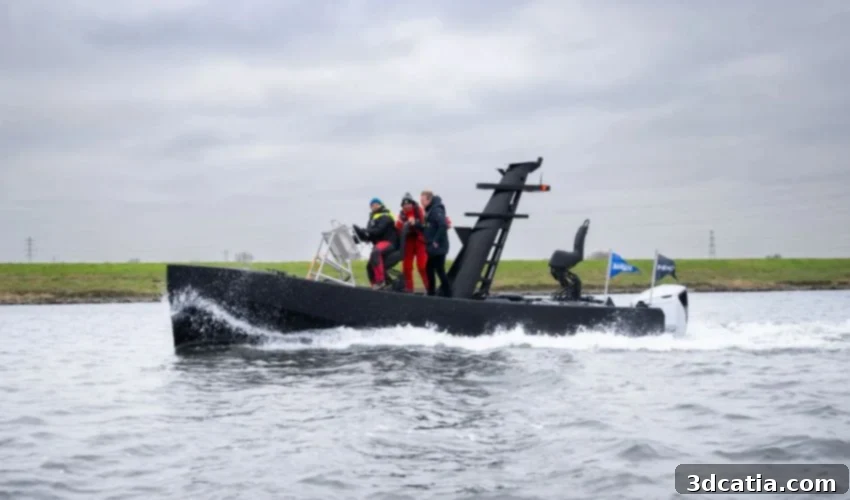
The defense sector’s increasing adoption of additive manufacturing is becoming undeniable, with 3D printing integrated as a crucial technology in its operations. A recent project by the Navy in the Netherlands, known as SeaRush, exemplifies this trend. SeaRush is a functional prototype of a 3D-printed unmanned boat, representing a significant advancement in the development of unmanned surface vessels (USVs).
Spearheaded by the Maritime Research Institute Netherlands (MARIN) in collaboration with the MIND Innovation Center, the SeaRush project addresses the growing need for rapidly deployable and cost-effective USVs that can be continuously improved through iterative design. MARIN emphasizes that amidst rising international tensions and personnel limitations within navies, SeaRush aims to demonstrate the feasibility of swiftly transitioning from a conceptual design to a fully operational system.
The success of the SeaRush prototype hinges on close collaboration across the entire production chain. IMPACD Boats was responsible for translating the conceptual design into a 3D-printable model, while CEAD leveraged its expertise in large-format additive manufacturing for the maritime industry. The hull was 3D printed in under a week at the Dutch Boat Factory in Delft, followed by the integration of equipment to create a fully functional USV in Woudsend. The propulsion system features a Honda outboard motor, linked to a control system jointly developed with the Italian company UltraFlex, enabling remote operation of the vessel.
Unmanned Surface Vessels (USVs) are gaining strategic importance in both defense and the broader maritime sector. MARIN’s official statement highlights that factors such as escalating international conflicts, the growing economic and geopolitical significance of the North Sea, and a shortage of specialized personnel are compelling navies to embrace innovative operational approaches. In this context, USVs are emerging as essential complements to manned vessels, mitigating human risk and enabling coordinated operations with other systems, including drones.
Initial testing of the SeaRush prototype took place last December at the Rijnhaven river port in Wageningen, confirming the viability of the project’s approach in terms of both rapid manufacturing and seamless systems integration. Following the validation of various operational concepts through simulations, the next phase involves demonstrating these concepts at sea using multiple experimental USVs. These trials will culminate in the Maritime Uncrewed Sea Trials (MUST) 2026 exercise, where the effectiveness of cooperation between manned and unmanned vessels will be rigorously evaluated. The SeaRush project unequivocally underscores the transformative potential of 3D printing as a cornerstone technology in future maritime operations.
The Strategic Importance of USVs in Modern Maritime Operations
The rise of Unmanned Surface Vessels (USVs) is not just a technological trend; it’s a strategic imperative reshaping maritime operations. Several converging factors are driving this shift, making USVs an increasingly indispensable asset for navies and maritime organizations worldwide.
Addressing Geopolitical Instability: The intensification of international conflicts necessitates a more agile and adaptable naval presence. USVs offer a cost-effective and low-risk solution for maintaining maritime security in contested areas, allowing for continuous surveillance and rapid response capabilities without jeopardizing human lives.
Securing Critical Waterways: The North Sea, for example, has become a vital economic and geopolitical artery. Protecting its resources and infrastructure requires constant vigilance, and USVs are ideally suited for persistent monitoring, ensuring the safety and security of maritime traffic and critical assets.
Overcoming Personnel Constraints: Many navies face a shortage of skilled personnel, limiting their operational capacity. USVs can augment existing manned vessels, performing routine tasks and freeing up human crews for more complex missions. This force multiplier effect allows navies to maintain a strong presence even with limited resources.
Enhanced Operational Capabilities: USVs are not simply replacements for manned vessels; they offer unique capabilities that enhance overall maritime operations. They can operate in hazardous environments, conduct long-endurance missions, and seamlessly integrate with other unmanned systems, such as drones and underwater vehicles, creating a networked and highly effective maritime force.
3D Printing: The Key Enabler for Rapid USV Development
The SeaRush project highlights the critical role of 3D printing in accelerating the development and deployment of USVs. Additive manufacturing offers several key advantages that are transforming the maritime industry.
Rapid Prototyping and Iteration: 3D printing allows for the rapid creation of prototypes, enabling designers to quickly test and refine their designs. This iterative process significantly reduces development time and allows for continuous improvement of USV performance and functionality.
Customization and Design Flexibility: Traditional manufacturing methods often require significant tooling costs and limitations in design complexity. 3D printing overcomes these constraints, allowing for the creation of highly customized USVs tailored to specific mission requirements. This design flexibility enables the optimization of hull shapes, propulsion systems, and sensor integration for maximum performance.
On-Demand Manufacturing and Reduced Lead Times: 3D printing enables on-demand manufacturing, eliminating the need for large inventories and reducing lead times. This is particularly crucial for defense applications, where rapid deployment and maintenance are essential. Damaged or worn components can be quickly replaced or manufactured on-site, minimizing downtime and ensuring operational readiness.
Cost-Effectiveness: While initial investment in 3D printing equipment may be significant, the long-term cost benefits are substantial. Reduced tooling costs, lower material waste, and streamlined production processes contribute to significant cost savings compared to traditional manufacturing methods.
The Future of Maritime Operations: Manned and Unmanned Collaboration
The future of maritime operations will likely involve a seamless integration of manned and unmanned vessels. USVs will not replace human crews entirely, but rather complement their capabilities, creating a more resilient and effective maritime force.
Enhanced Situational Awareness: USVs equipped with advanced sensors can provide real-time surveillance and intelligence gathering, enhancing situational awareness for manned vessels. This improved understanding of the operational environment allows for more informed decision-making and proactive threat response.
Force Multiplication: USVs can extend the reach and capabilities of manned vessels, performing tasks such as reconnaissance, mine countermeasures, and anti-submarine warfare. This force multiplication effect allows a smaller number of manned vessels to cover a larger area and respond to a wider range of threats.
Risk Mitigation: USVs can be deployed in high-risk environments, reducing the exposure of human crews to danger. This is particularly important for missions such as mine clearing, where the risk of injury or death is significant.
The SeaRush project is a testament to the transformative potential of 3D printing in the maritime sector. As technology continues to advance, we can expect to see even more innovative applications of additive manufacturing in the development and deployment of USVs, revolutionizing maritime operations and enhancing global security.