
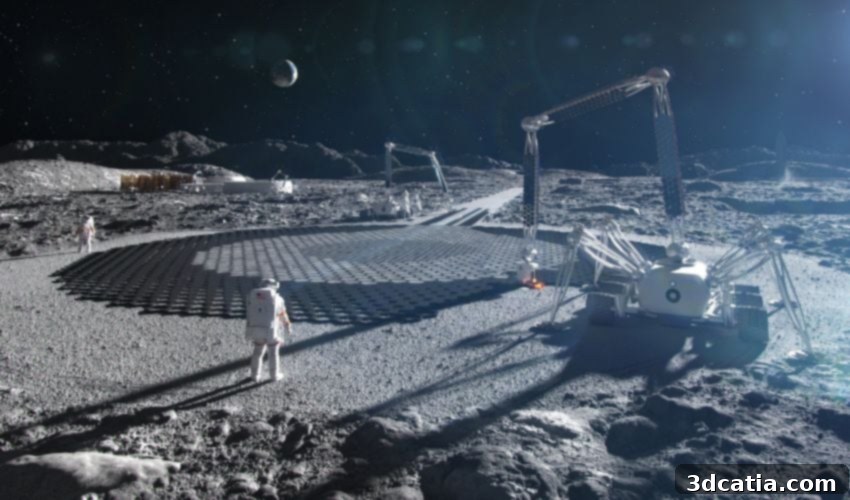
ICON and NASA Pioneer 3D Printed Lunar Construction with Project Olympus: Building Humanity’s Future on the Moon
While ICON has garnered significant recognition for its innovative 3D printed construction projects here on Earth, the company’s ambitions are now literally reaching for the stars. In a landmark announcement, ICON revealed that it has been awarded a substantial $57.2 million by NASA to further develop a cutting-edge lunar surface construction system. This latest funding infusion significantly bolsters previous investments from both NASA and the Department of Defense into ICON’s ambitious Project Olympus. The overarching goal of this initiative is to research and engineer advanced space-based 3D printing construction systems specifically tailored for exploration and eventual habitation on the Moon. This collaborative effort is poised to usher in a new era of space exploration, culminating in what is expected to be humanity’s first-ever permanent construction on another planetary body.
For many years, NASA has envisioned not merely visiting other planetary bodies, but establishing a sustainable human presence on them. Realizing such an audacious goal necessitates the development of groundbreaking technologies that can transform theoretical possibilities into tangible realities. Among these critical innovations, additive manufacturing has emerged as a particularly highlighted solution, especially for its transformative potential in extraterrestrial construction. Numerous ongoing projects worldwide are striving to enable the 3D printing of robust and resilient structures on both the Moon and Mars within the foreseeable future. NASA’s ambitious Artemis program, which recently celebrated its first successful launch, explicitly targets the Moon as the initial off-Earth site for sustained surface exploration. This long-term exploration naturally demands a permanent and sustainable human presence, requiring unprecedented infrastructure development capabilities.
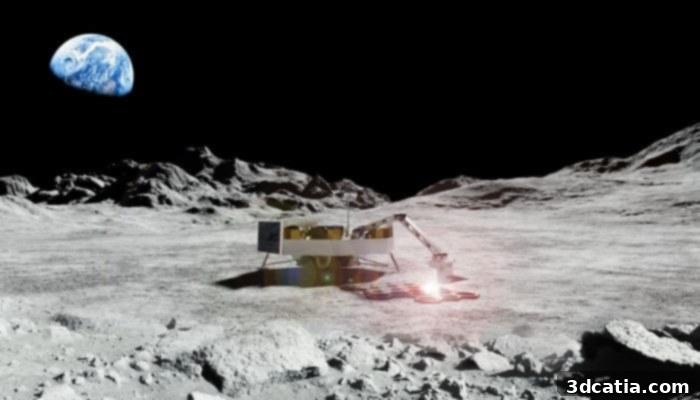
This significant award will empower ICON to accelerate the development of a revolutionary solution, enabling the construction of vital infrastructure, including future human habitations, on the lunar surface (photo credits: ICON).
The Vision: From ‘There and Back Again’ to ‘There to Stay’
Jason Ballard, ICON co-founder and CEO, eloquently articulated the profound importance of innovation, particularly through advanced 3D printing technologies, for the success of Project Olympus. He emphasized, “To truly change the space exploration paradigm from ‘there and back again’ to ‘there to stay,’ we’re going to need robust, resilient, and broadly capable systems that can effectively utilize the local resources found on the Moon and other planetary bodies. We are immensely pleased that our extensive research and engineering efforts to-date have unequivocally demonstrated that such sophisticated systems are indeed possible, and we now eagerly look forward to transforming that exciting possibility into a concrete reality. The ultimate deliverable of this groundbreaking contract will be nothing less than humanity’s first truly permanent construction on another world, and that represents an absolutely special and historic achievement for all mankind.” This statement underscores the monumental shift in space exploration philosophy that ICON and NASA are spearheading – moving beyond fleeting visits towards establishing a permanent foothold beyond Earth.
Establishing a durable presence on the Moon presents a myriad of formidable challenges. The lunar environment is characterized by extreme temperature fluctuations, harmful cosmic and solar radiation, and constant bombardment by micrometeorites. Traditional construction methods, relying on pre-fabricated modules launched from Earth, are prohibitively expensive and logistically complex due to launch mass limitations. This is precisely where additive manufacturing shines. By enabling in-situ resource utilization (ISRU), 3D printing allows structures to be built using materials already available on the Moon, dramatically reducing the need to transport materials from Earth. This not only cuts down on costs but also provides greater flexibility and resilience for lunar operations. ICON’s specialized technology, drawing from years of experience in terrestrial 3D construction, is being adapted to meet these unique extraterrestrial demands, promising a revolutionary approach to space infrastructure.
Project Olympus: Advancing 3D Printed Construction on the Moon
So, what exactly are the practical expectations and immediate next steps for Project Olympus? The current strategic plan involves ICON deploying its sophisticated advanced hardware and software systems into a simulated lunar environment, most likely via a specialized lunar gravity simulation flight. This crucial phase will allow engineers to fine-tune the robotic construction systems under conditions mimicking the Moon’s reduced gravity. Simultaneously, ICON will be conducting extensive research and testing using precious lunar regolith samples, those invaluable dust and rock fragments painstakingly brought back from the historic Apollo missions. These samples will be rigorously analyzed to determine their precise mechanical behavior and suitability as a primary construction material in simulated lunar gravity.
These meticulously planned tests are absolutely critical for several reasons. Firstly, they will provide invaluable data and insights necessary to formulate robust and effective future lunar construction approaches specifically for ICON’s deployment. Secondly, the findings will contribute significantly to the broader space community, fostering a collective understanding of extraterrestrial construction challenges and solutions. The ultimate objective is to develop and implement the essential critical infrastructure required for a truly sustainable lunar economy. This ambitious blueprint includes, of course, secure and long-term lunar habitations capable of supporting human life, but also extends to constructing vital elements such as durable landing pads for spacecraft, protective blast shields to safeguard critical equipment, and reliable roads to facilitate mobility across the lunar surface. Each of these elements is crucial for enabling continuous scientific research, resource extraction, and eventual commercial activities on the Moon.
The philosophy underpinning Project Olympus is a pragmatic and resource-efficient “live off the land” approach. This strategy prioritizes the extensive use of native lunar materials, primarily regolith, to minimize reliance on costly and logistically challenging resupply missions from Earth. By leveraging local resources, ICON aims to build robust infrastructure that can provide superior thermal insulation against extreme temperature swings, enhanced protection against harmful radiation, and resilient defense against constant micrometeorite impacts. These features are non-negotiable for ensuring the safety and longevity of any human presence on the Moon. Developing techniques to process and utilize lunar regolith for printing durable, protective structures is a cornerstone of this endeavor, representing a significant technological leap in space exploration. This approach not only makes lunar habitation more feasible but also opens up possibilities for greater autonomy and self-sufficiency for future lunar colonies.
Building a Spacefaring Civilization: The Long-Term Impact
Ultimately, the profound goal driving these efforts is to transform humanity into a truly spacefaring civilization. This vision extends far beyond simply visiting the Moon; it encompasses establishing permanent bases, enabling long-duration missions to Mars, and eventually exploring even more distant reaches of our solar system. Niki Werkheiser, director of technology maturation in NASA’s Space Technology Mission Directorate, underscored this grand ambition, stating, “In order to explore other worlds, we need innovative new technologies adapted to those unique environments and our specific exploration needs. Pushing this development forward with our commercial partners will create the essential capabilities we need for future missions, paving the way for unprecedented discoveries and sustained human presence beyond Earth.” This partnership with ICON exemplifies NASA’s strategy of collaborating with private industry to accelerate technological advancements that are critical for achieving its bold exploration objectives.
The implications of successful lunar construction are far-reaching. Beyond immediate habitation needs, a robust lunar infrastructure could serve as a vital staging point for deeper space missions, allowing for the assembly and refueling of spacecraft in a lower gravity environment. It could also unlock new opportunities for lunar resource extraction, leading to the development of a self-sustaining lunar economy. The knowledge gained from Project Olympus will be invaluable for future missions to Mars, where similar challenges regarding in-situ resource utilization and extraterrestrial construction will need to be overcome. By proving the viability of 3D printing on the Moon, ICON and NASA are laying the groundwork for a future where humanity can truly thrive across the solar system, making space not just a destination, but a new frontier for permanent settlement and economic activity.
You can find out more about this exciting partnership and NASA’s initiatives HERE.
What are your thoughts on ICON’s revolutionary plans to create a system capable of 3D printed construction on the Moon? Do you envision a future where lunar bases are a common sight? We’d love to hear your perspective! Let us know your opinions in a comment below or engage with us on our LinkedIn, Facebook, and Twitter pages! Don’t forget to sign up for our free weekly Newsletter here to receive the latest 3D printing news directly to your inbox! You can also find all our engaging videos and exclusive content on our YouTube channel.
*Cover Photo Credits: ICON