
The Cutting Edge of Additive Manufacturing: From High-Speed Racecars to Life-Changing Prosthetics
This week, we delve into the groundbreaking applications of 3D printing, also known as additive manufacturing (AM), across diverse and exciting fields. From revolutionizing the design and performance of high-speed racecars to enabling the creation of advanced robotic components and affordable, customized prosthetics, AM is proving itself as a truly transformative technology. Its ability to produce complex geometries, optimize designs for weight and functionality, and facilitate rapid prototyping and iteration makes it an indispensable tool for engineers, innovators, and researchers alike. We’ll explore how students are leveraging AM to develop the next generation of electric and autonomous racecars, making them more agile and efficient – qualities absolutely critical in the demanding world of motorsports. Furthermore, we’ll see how a leading university is pushing the boundaries of material science with multi-material printing, and get an exclusive look at the latest advancements in consumer-friendly resin 3D printers. Join us as we uncover these fascinating stories that highlight the immense potential and real-world impact of 3D printing today.
TOP 1: Fueling Innovation: Racecars Engineered with 3D Printed Parts
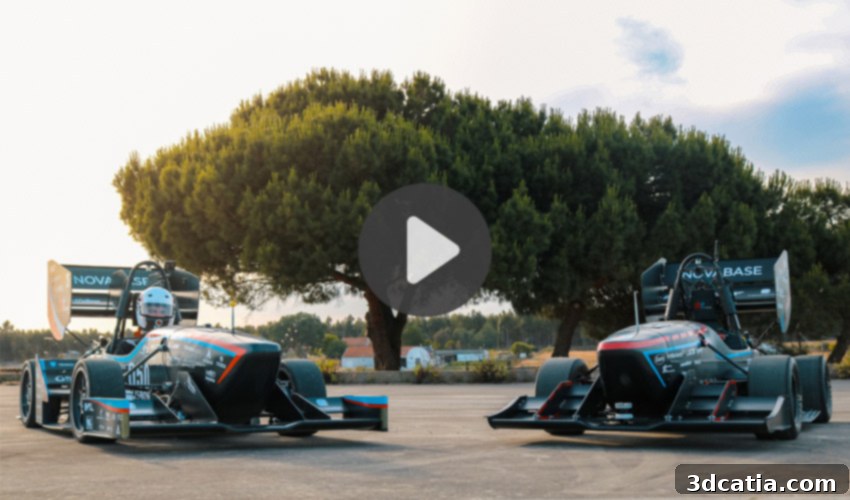
In the fiercely competitive realm of motorsports, every gram saved and every aerodynamic advantage gained can mean the difference between victory and defeat. This is precisely why additive manufacturing has become a game-changer for student teams like FST Lisboa in Portugal. Founded two decades ago, this Formula Student team comprises approximately 60 dedicated students committed to designing and building the racecars of tomorrow. Their approach heavily relies on the versatility of 3D printing, particularly during the crucial prototyping phase, where fused deposition modeling (FDM) offers an excellent balance of cost-effectiveness, material variety, and speed for iterative design improvements. This allows them to quickly test and refine new concepts before committing to final designs.
Beyond mere prototyping, FST Lisboa has strategically integrated finished 3D printed components directly into their vehicles. For these functional parts, they’ve turned to selective laser sintering (SLS) technology. SLS stands out for its ability to produce highly resistant, durable, and complex components from strong engineering plastics like nylon, which exhibit isotropic mechanical properties—meaning they possess uniform strength in all directions. This is a critical advantage for parts subjected to high stresses and vibrations inherent in racecar operation. For instance, two of their latest car designs feature several key components produced on a Sintratec SLS machine, including custom electronic containers, robust camera and screen mounts, and intricately designed cooling system ducts. The electronic containers benefit from precise custom fits, ensuring optimal protection and integration within tight spaces, while simultaneously reducing overall weight. The camera and screen mounts are engineered for minimal vibration and aerodynamic efficiency, crucial for data acquisition and driver visibility. Meanwhile, the cooling system ducts leverage the design freedom of SLS to create complex internal geometries that optimize airflow and thermal management, directly contributing to engine longevity and performance. By embracing these advanced manufacturing techniques, FST Lisboa is not only pushing the boundaries of automotive engineering but also equipping its students with invaluable skills for the future of the industry, where additive manufacturing is increasingly becoming a standard.
TOP 2: Advancing Robotics and Engineering at the University of Colorado Boulder with 3D Printing
Academic institutions frequently serve as epicenters for technological innovation, and the University of Colorado Boulder is no exception. Their engineering center has made a significant investment in cutting-edge additive manufacturing technology, specifically a Stratasys PolyJet J750 machine, to support the development of advanced components for various robotics projects. This state-of-the-art PolyJet printer represents a leap forward in prototyping and part production, offering capabilities far beyond conventional 3D printing methods. The J750’s primary strength lies in its ability to print multiple materials simultaneously, allowing engineers to create parts with varying material properties within a single build. This multi-material functionality is invaluable for robotics, where designs often require components that are both flexible and rigid, or even transparent and opaque, to achieve optimal performance.
For robotics teams, this means they can design complex parts like robotic grippers with soft, compliant tips for delicate handling and rigid bases for structural integrity, all produced in a single print job. Similarly, custom sensor housings can be integrated with flexible hinges or vibration-dampening elements. This capability dramatically accelerates the design and testing cycles, as prototypes can accurately replicate the functional properties of final products. The PolyJet technology also excels in producing parts with extremely fine detail and smooth surface finishes, which are crucial for precision engineering and fluid dynamics applications in robotics. Furthermore, the ability to print in full color allows for realistic mock-ups and functional prototypes that not only perform as intended but also look like the final product. The video below offers a compelling glimpse into the diverse array of objects and sophisticated robotic components that are conceptualized, designed, and brought to life daily at the University of Colorado Boulder, showcasing the immense power of this advanced additive manufacturing technology in fostering innovation and educating the next generation of engineers.
TOP 3: Prusa’s Latest Innovation: The Next Generation of Resin 3D Printing
Prusa Research, a renowned Czech 3D printer manufacturer, has carved out a significant niche in the additive manufacturing industry, primarily celebrated for its high-quality, open-source desktop FDM (Fused Deposition Modeling) machines. Their FDM printers, known for their reliability, ease of assembly, and vibrant community support, have garnered a massive global following and are widely utilized by hobbyists, educators, and professionals alike. A few years ago, Prusa made an anticipated entry into the resin 3D printing market, a move that excited many enthusiasts. This expansion was marked by the launch of their first open-source LCD-based resin printer, the SL1, which brought Prusa’s commitment to quality and accessibility to the realm of stereolithography (SLA) technologies. The SL1 was designed to be user-friendly while offering impressive detail and precision, typical of resin printers.
Now, three years after the initial introduction of the SL1, Prusa is once again pushing the envelope with the unveiling of the SL1S. This latest iteration is not just an update but a significant evolution of its predecessor, promising unparalleled speed and even finer detail. The SL1S leverages advancements in LCD technology and resin curing processes to achieve faster print times without compromising on the exceptional surface finish and intricate details that resin printing is known for. This makes it an ideal solution for applications requiring high resolution, such as miniature figures, jewelry prototypes, dental models, or highly detailed functional prototypes where smooth surfaces are paramount. The commitment to open-source principles continues with the SL1S, ensuring that the community can contribute to and benefit from its ongoing development. Prusa’s continued innovation in the resin printing space solidifies its position as a leading manufacturer in the 3D printing world, offering a diverse range of reliable and high-performance machines for various applications and user needs. The video below provides a detailed look at the capabilities and features of this impressive new machine.
TOP 4: Unlimited Tomorrow: Revolutionizing Prosthetics with Affordable 3D Printed Solutions
It has become widely recognized that additive manufacturing technologies possess immense potential to produce highly precise, customized, and significantly more cost-effective prostheses for both humans and animals. This capability addresses a critical need in healthcare, offering personalized solutions that were once prohibitively expensive or technologically unfeasible. At the forefront of this innovative movement is Easton LaChappelle, a visionary who famously crafted his first robotic arm at the remarkable age of 14, spending a mere $300. This early achievement, combined with the glaring lack of affordable and accessible prostheses on the market, ignited his passion and spurred him to found the company Unlimited Tomorrow.
Easton’s mission through Unlimited Tomorrow is to fundamentally revolutionize the prosthetic industry by making advanced, functional prostheses accessible to a wider population. His business model ingeniously integrates several cutting-edge technologies: remote care, sophisticated 3D scanning, and advanced additive manufacturing. Through this approach, individuals requiring prosthetics can undergo precise 3D scanning of their residual limb from the comfort of their home, eliminating the need for multiple, often costly and inconvenient, clinical visits. This 3D scan data is then used to design a custom-fitted prosthesis that is perfectly tailored to the individual’s anatomy, ensuring maximum comfort and functionality. The custom design is then brought to life using 3D printing, which allows for complex internal structures, lightweight components, and highly aesthetic finishes that mimic natural skin tones and textures. This streamlined process dramatically reduces the manufacturing costs and lead times associated with traditional prosthetic production, making high-quality, personalized devices available at a fraction of the conventional price. Unlimited Tomorrow’s innovative approach not only provides life-changing devices but also empowers individuals by giving them access to technology that truly adapts to their unique needs and challenges. Discover Easton’s full inspiring story and the impactful work of Unlimited Tomorrow in the video provided below.
TOP 5: Raise3D Compares Additive Manufacturing with Traditional Production Methods
Raise3D, a prominent American manufacturer specializing in large-scale industrial 3D printers, consistently shares valuable insights into the manufacturing landscape. In the insightful video featured below, the company leverages its extensive expertise as Technical Engineer Nick Phalen undertakes a comprehensive comparison of various manufacturing processes. This analysis critically examines different methods in terms of crucial factors such as price, production time, material capabilities, and design complexity. The discussion extends beyond just additive processes, providing a holistic view that includes not only FDM (Fused Deposition Modeling), SLA (Stereolithography), and SLS (Selective Laser Sintering), but also traditional manufacturing stalwarts like injection molding and CNC (Computer Numerical Control) machining.
Nick Phalen expertly breaks down the advantages and disadvantages of each method, helping businesses and engineers make informed decisions. For additive manufacturing, he highlights benefits such as unparalleled design freedom for complex geometries, rapid prototyping capabilities, customization at scale, and reduced material waste. However, he also addresses considerations like build size limitations, material costs for certain processes, and potential post-processing requirements. When comparing these to traditional methods, the video points out that injection molding remains superior for extremely high-volume production due to its low per-unit cost once tooling is established, while CNC machining offers exceptional precision and material strength for specific applications. The analysis also delves into scenarios where hybrid approaches, combining both additive and traditional manufacturing, can yield the most efficient and effective results, such as using 3D printed jigs, fixtures, or even molds for injection molding. Furthermore, the video offers a valuable comparative analysis on the advantages and disadvantages of investing in and owning your own 3D printer versus utilizing a 3D printing service. Owning a printer provides direct control, faster iteration cycles, intellectual property security, and can be more cost-effective for frequent, in-house production. Conversely, a 3D printing service offers access to a wider range of technologies and materials without significant upfront investment, alongside expert advice and specialized post-processing capabilities. This detailed comparison serves as an essential guide for anyone looking to optimize their manufacturing strategy.
We hope you found this deep dive into the diverse applications of 3D printing as fascinating as we did. The continuous evolution of additive manufacturing promises to unlock even greater potential across industries, from pushing the limits of automotive performance to delivering personalized healthcare solutions. We are particularly interested in hearing your thoughts on how 3D printing is being used for racecars and which application you find most impactful. Please share your insights and comments below, or engage with us on our Facebook and Twitter pages. Don’t forget to sign up for our free weekly Newsletter to receive all the latest news, innovations, and trends in the world of 3D printing delivered straight to your inbox!