
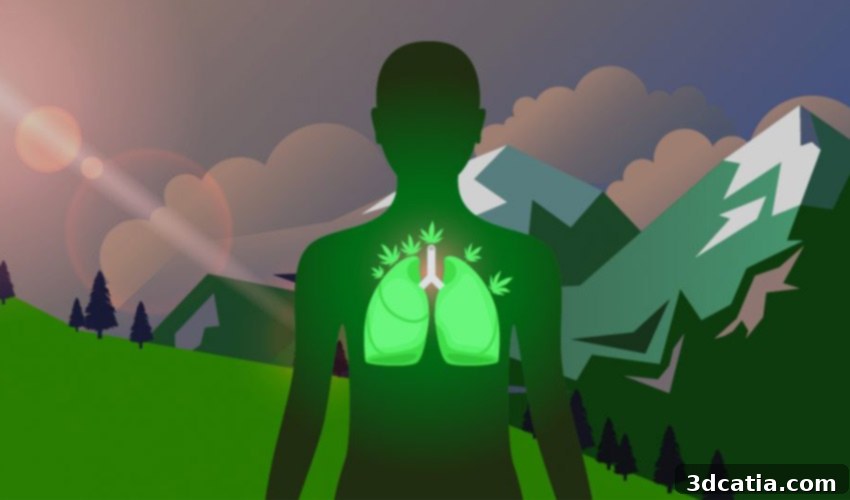
Revolutionizing Lung Research: 3D Printing Unveils Cannabis Smoke’s Impact on Respiratory Health
In a groundbreaking development poised to significantly advance our understanding of respiratory health, scientists from Canada’s McMaster University and the University of Waterloo have harnessed the power of 3D printing to investigate the intricate effects of cannabis smoke on human lungs. This pioneering research centers around an innovative, open-source 3D printed device designed to mimic the natural breathing process of a human lung. By meticulously observing this device as it inhales cannabis smoke, the research team has been able to gain unprecedented insights into the physiological consequences of exposure. This sophisticated in vitro exposure system (IVES) holds profound implications, particularly in the ongoing global dialogue surrounding the legalization of cannabis for both therapeutic and recreational purposes, prompting critical questions about public health and safety.
The convergence of additive manufacturing and cannabis research is, in fact, not a novel intersection within various industrial and scientific sectors. A growing number of researchers and forward-thinking companies are increasingly exploring the vast potential of this versatile plant, especially within a stringent medical context. Cannabis, particularly certain strains, is renowned for its richness in beneficial compounds, including cannabinoids like CBD and THC, which can be therapeutically exploited for their wide array of medicinal properties. For instance, Syqe Medical stands out as a prime example, having successfully developed a medical cannabis inhaler that leverages advanced 3D printing technologies to ensure precise and consistent dosage delivery, thereby enhancing patient safety and efficacy. Beyond direct medical devices, industrial hemp, a close relative of cannabis, is also finding its way into additive manufacturing as a sustainable alternative. Hemp is sometimes incorporated into composite 3D printing materials, frequently blended with polymers such as PLA, to create eco-friendly and robust filaments for various applications, showcasing the plant’s diverse utility.
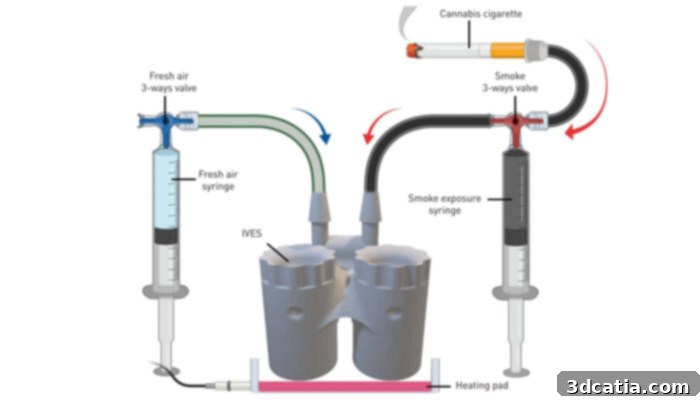
The innovative 3D printed in vitro exposure system (IVES) devised by the researchers for cannabis lung studies.
In this particular study, the dedicated team of researchers embarked on a mission to specifically understand the immediate and long-term impact of cannabis smoke exposure on human epithelial cells. These crucial cells are omnipresent throughout our organs, forming vital protective walls that serve as the body’s first line of defense against external pathogens, environmental toxins, and various foreign substances. To accomplish this, the scientists ingeniously developed their In Vitro Exposure System (IVES) using a Formlabs Form 2 3D printer, renowned for its high-resolution stereolithography (SLA) capabilities. The meticulously designed device features four distinct exposure chambers, equipped with two inlets for smoke entry, four outlets for exhaust, and four plugs to facilitate sample handling and maintenance. The fundamental principle of its operation is elegantly simple yet highly effective: the system draws in cannabis smoke through one of its inlets, expertly distributes it uniformly into the four chambers, each pre-loaded with a culture of human airway epithelial cells, and then expels the residual smoke. The researchers elaborated that the intricate design of their system was modeled using industry-standard Autodesk Inventor software, and the components were precisely printed using Formlabs’ clear resin, a material chosen for its optical clarity, detailed resolution, and stability, which are critical for accurate observation and repeatable experiments in such sensitive biological studies.
Following a rigorous series of repeated tests and thorough analysis, the research team made a significant and concerning discovery: the vital autoimmune function of the epithelial cells that were exposed to the cannabis smoke suffered discernible damage. Scientific literature extensively documents that the compromise or complete absence of this protective barrier in the human body can precipitate a range of serious respiratory problems, making individuals more susceptible to infections, inflammation, and chronic lung diseases. While the potential harmful effects associated with smoking any substance, including cannabis, have long been suspected and are generally acknowledged, this sophisticated 3D printed device offers an unprecedented and far more concrete depiction of these damaging consequences at a cellular level. It moves beyond mere suspicion, providing empirical evidence. Crucially, the current generation of existing in vitro test models available on the market often proves to be prohibitively expensive, cumbersome to operate, and frequently unreliable due to their inherent lack of precision and ability to replicate realistic physiological conditions. Thanks to the accessibility and versatility of 3D printing technology, a broader spectrum of laboratories and research institutes are now empowered to conduct more in-depth, accurate, and repeatable tests, facilitating the necessary replication of experiments as many times as required to validate findings, thereby significantly accelerating scientific discovery in respiratory toxicology.
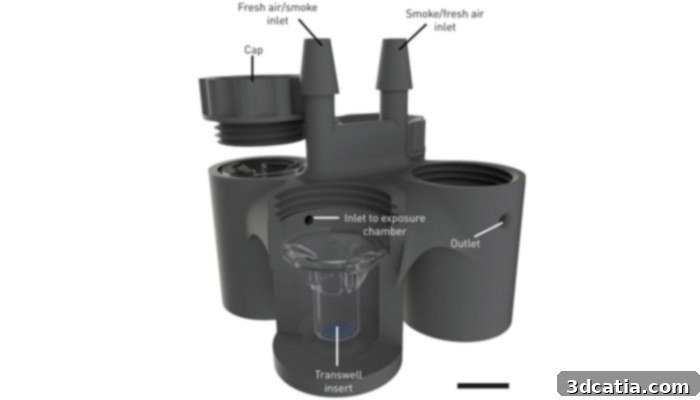
The open-source 3D printed IVES device provides an accessible platform for respiratory research.
The ability of 3D printing to create highly detailed, custom, and functional prototypes rapidly was instrumental in the development of the IVES device. Traditional manufacturing methods would have incurred significantly higher costs and longer lead times, making such advanced research less accessible. Furthermore, the open-source nature of the IVES design is a game-changer. It means that researchers worldwide can replicate, adapt, and improve upon the system without proprietary restrictions, fostering global collaboration and accelerating the pace of scientific inquiry into cannabis and lung health. This democratizes sophisticated research tools, moving away from expensive, single-vendor solutions to a more community-driven, accessible approach. The precision offered by SLA 3D printing, specifically with the Formlabs Form 2, allowed for the creation of intricate internal geometries necessary for precise smoke distribution and cell exposure, mimicking the complex microenvironment of the human lung more accurately than ever before.
In their concluding remarks, the researchers underscored the critical importance of their work: “The growing legalisation of cannabis on a global scale must be paired with research related to potential health impacts of lung exposures. IVES represents an accessible, open-source, exposure system that can be used to model varying types of cannabis smoke exposures with human airway epithelial cells grown under air–liquid interface culture conditions.” This powerful statement highlights the urgent need for robust scientific data to inform public health policies and educate consumers as cannabis becomes more readily available. The findings from this study are just the beginning, paving the way for further research into different cannabis strains, methods of consumption (e.g., vaping versus smoking), varying concentrations of active compounds, and long-term exposure scenarios. Moreover, the adaptable IVES platform holds promise for studying the effects of other airborne toxins and pollutants on the human respiratory system, extending its utility far beyond cannabis research. This innovative integration of 3D printing and biological research provides an essential tool for protecting public health in an evolving world. For those interested in delving deeper into the specifics of this pioneering study, the entire research paper is available HERE.
* Photo credits: InfoCBD
What are your thoughts on the groundbreaking application of 3D printing in this critical public health research project? We invite you to share your insights and opinions in a comment below, or connect with us on our Facebook, Twitter and LinkedIn pages! For the very latest updates and breaking news in the world of additive manufacturing, make sure to sign up for our free weekly Newsletter here, delivering all the essential 3D printing news straight to your inbox!