
Revolutionizing Industries: Your Weekly Roundup of Top 3D Printing Innovations
Welcome to our definitive compilation of this week’s most compelling videos showcasing the groundbreaking advancements and diverse applications of 3D printing. This week’s edition plunges into a spectrum of innovations, from the intricate challenge of replicating a high-tech sports product to the robust integration of additive manufacturing in heavy industry. We’ll explore how this transformative technology is not only pushing the boundaries of what’s possible in manufacturing but also reshaping our everyday experiences, offering unprecedented levels of customization, efficiency, and sustainability. Prepare to be inspired by how 3D printing continues to evolve, creating ripples across various sectors and paving the way for a more innovative future.
Our journey begins with an ambitious project to perfectly replicate the unique bounce of Wilson’s groundbreaking $2,500 3D printed airless basketball. Following this, BigRep reveals how industrial additive manufacturing is fundamentally enhancing heavy-duty truck innovation at CNHTC, a titan in China’s commercial vehicle sector. TechTalkCentral then takes us on a journey into the future of 3D printing, discussing its profound impact on global manufacturing and rapid prototyping, with a strong emphasis on its inherent sustainability and unparalleled customizability. Next, Performance Bicycle introduces us to advanced 3D printed mirror saddles, promising riders improved comfort and support for both enduring journeys and challenging off-road terrains. Finally, we conclude this week’s insightful top 5 with a deep dive into Lincoln Electric Asia’s experience, exploring the significant adoption and manifold benefits of wire arc 3D metal printing within their operations. Let’s delve into these remarkable stories and witness the future unfold!
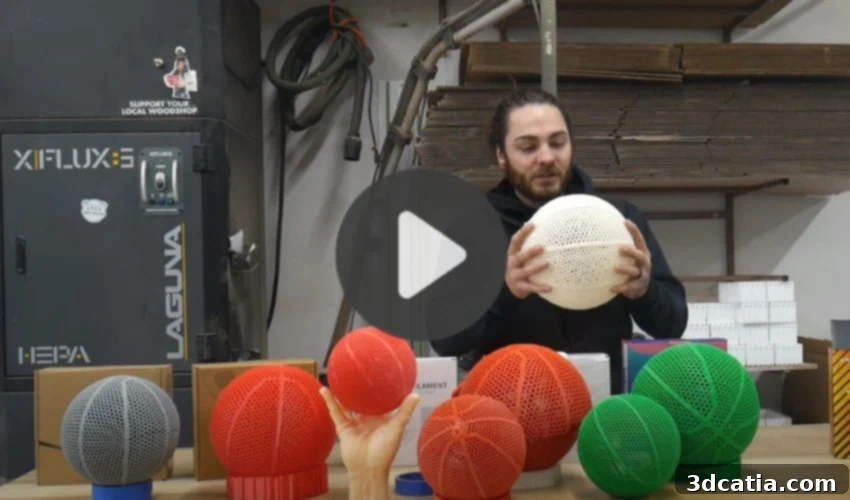
1. The Quest to Recreate Wilson’s $2,500 3D Printed Airless Basketball
In our first highlight, TwoMooseDesign takes on an extraordinary challenge: to recreate the distinctive bounce of Wilson’s highly coveted $2,500 3D printed airless basketball. This video offers an insightful look into the capabilities and limitations of hobbyist 3D printers when attempting to replicate a product engineered with advanced industrial processes and materials. The host embarks on a meticulous experimental process, testing various filaments and print parameters to mimic the original’s performance.
Throughout the project, the host encounters a series of common yet frustrating challenges familiar to many 3D printing enthusiasts, including persistent filament breakage and outright print failures. These hurdles underscore the complexities involved in achieving precise mechanical properties with consumer-grade equipment. Despite these difficulties, the exploration yields valuable insights. Flexible PLA and specific TPU (Thermoplastic Polyurethane) filaments emerge as the frontrunners, offering the most promising bounce characteristics. These materials, known for their elasticity and durability, demonstrate that with careful selection and optimized printing techniques, hobbyists can indeed get remarkably close to the desired performance.
The video thoughtfully acknowledges the inherent limitations of hobbyist 3D printers when compared to the sophisticated industrial machines and proprietary materials used by Wilson for the original airless basketball. Wilson’s product benefits from cutting-edge material science, precision engineering, and a scale of production that allows for exacting standards. The $2,500 price tag isn isn’t just for the innovative design; it also reflects the significant investment in research, development, and advanced manufacturing technologies that make such a unique product possible. While the host concludes that achieving a perfect, identical replication is incredibly difficult, the journey highlights the immense potential for innovation even within the hobbyist community, proving that dedicated experimentation can lead to impressive, albeit not identical, results. This endeavor beautifully illustrates the ongoing democratisation of additive manufacturing, inspiring others to push the boundaries of what can be achieved with accessible technology.
2. CNHTC’s Strategic Adoption of 3D Printing for Heavy-Duty Truck Innovation
Our second video showcases a monumental shift in heavy industry, as BigRep unveils how advanced industrial 3D printing is fundamentally revolutionizing heavy-duty truck innovation at CNHTC (China National Heavy Duty Truck Group Co., Ltd.). As China’s third-largest commercial vehicle manufacturer, CNHTC operates within a highly competitive and rapidly expanding global market. With domestic demand for commercial vehicles projected to continue its upward trajectory, the imperative for faster innovation and more efficient production methods has never been greater.
Under the expert guidance of Head Engineer Dr. Dong, CNHTC has strategically embraced industrial 3D printing as a cornerstone of its manufacturing strategy. This adoption is not merely incremental; it represents a significant leap forward in how the company approaches product development and production. By integrating additive manufacturing, CNHTC has been able to dramatically streamline its prototyping processes. Traditionally, developing prototypes for large, complex truck components can be a time-consuming and expensive endeavor, often involving multiple iterations of tooling and fabrication. 3D printing allows for rapid creation of functional prototypes, enabling engineers to test designs, identify flaws, and iterate quickly, significantly compressing the design cycle.
Beyond prototyping, 3D printing is also playing a crucial role in reducing overall production time for certain parts and enhancing the performance and aesthetics of final components. For instance, the ability to produce complex geometries that are impossible or cost-prohibitive with traditional manufacturing methods allows CNHTC to design lighter, stronger, and more aerodynamically efficient parts. This not only improves fuel efficiency and performance but also contributes to the longevity and reliability of their heavy-duty trucks. The insights from BigRep highlight how such strategic technological adoption empowers major manufacturers like CNHTC to stay ahead in a dynamic market, meeting the demands for increased innovation and efficiency while reinforcing their leadership position in the global commercial vehicle industry. This case study underscores the power of industrial 3D printing to transform large-scale manufacturing, proving its value far beyond niche applications.
3. TechTalkCentral Explores the Transformative Future of 3D Printing
Third in our lineup, TechTalkCentral offers a profound exploration into the transformative impact of 3D printing on the landscape of modern manufacturing and rapid prototyping. This insightful video meticulously highlights several key advantages that solidify additive manufacturing’s position as a game-changer across industries. Firstly, its unparalleled ability to accelerate the production process drastically reduces lead times from design to finished product. This speed is critical in today’s fast-paced markets, allowing businesses to respond to demands with unprecedented agility.
Secondly, 3D printing enables extraordinary levels of customization. Unlike traditional mass production, additive manufacturing can produce unique, tailor-made items without significant cost penalties, opening doors for personalized medical implants, bespoke consumer goods, and highly specialized industrial components. This inherent flexibility also means it can handle increased complexity with ease. Geometries that are impossible or extremely difficult to achieve with conventional subtractive or formative methods become readily producible through 3D printing, fostering innovative designs that optimize performance and functionality.
Beyond performance, 3D printing promotes significant sustainability. By building objects layer-by-layer, it minimizes material waste compared to subtractive manufacturing, where material is removed from a larger block. Furthermore, the potential for localized production reduces transportation costs and carbon footprints, making supply chains more resilient and environmentally friendly. This blend of efficiency and ecological responsibility makes additive manufacturing a critical technology for a sustainable future. The video then showcases AM’s expansive range of usability, extending its influence to critical sectors such as healthcare (e.g., prosthetics, surgical guides), automotive (e.g., lightweight components, tooling), aerospace (e.g., complex engine parts, interior structures), sports (e.g., customized gear, performance-enhancing equipment), and many more emerging fields.
The video concludes with insightful possibilities on how 3D printing will profoundly shape our everyday lives as its adoption continues to accelerate. From personalized consumer products and more efficient industrial processes to life-saving medical devices and eco-friendly manufacturing, 3D printing is not just a technology of the future; it’s a rapidly integrating force defining the present, promising a world where production is smarter, more responsive, and incredibly innovative.
4. Enhanced Comfort Through Revolutionary 3D Printed Mirror Saddles
In this compelling video from Performance Bicycle, the host takes us on an in-depth exploration of Specialized’s cutting-edge 3D printed mirror saddles. This innovative cycling technology stands out by leveraging sophisticated mirror technology and additive manufacturing to achieve unprecedented levels of customization and ergonomic perfection. The core of this innovation lies in its ability to precisely tailor every aspect of the saddle’s structure, allowing for optimal comfort and unparalleled support, whether riders are tackling long-distance road cycling or navigating challenging off-road terrain.
The “mirror technology” refers to a process where the saddle’s lattice structure is meticulously designed to mirror the rider’s anatomy, distributing pressure evenly and reducing hot spots that often lead to discomfort and numbness. This is achieved through complex computational design combined with the layer-by-layer precision of 3D printing, enabling the creation of intricate, variably dense zones within the saddle itself. The result is a saddle that adapts to the individual’s sit bones and soft tissue areas, providing targeted support and superior shock absorption.
While acknowledging the initial shock that often accompanies the price tag of such advanced equipment, the host passionately argues that investing in a high-quality saddle is unequivocally worthwhile. Given that the saddle is one of the three primary contact points between a rider and their bicycle, its impact on overall comfort, endurance, and performance cannot be overstated. A well-designed saddle can prevent discomfort, enhance power transfer, and allow riders to spend more time in the saddle without pain, making it a critical component for both amateur enthusiasts and professional athletes.
The video concludes with an infectious excitement for the future of cycling. With 3D printing technology revolutionizing not just saddles but bicycles and cycling accessories in general, the possibilities for enhanced comfort, performance, and personalization are boundless. From lightweight frames with optimized aerodynamics to custom-fit helmets and ergonomic handlebars, additive manufacturing is pushing the boundaries of what’s achievable in cycling, promising a future where every ride is more efficient, comfortable, and enjoyable than ever before. This truly exemplifies how specialized additive manufacturing applications can lead to significant improvements in consumer products.
5. Lincoln Electric Explores the Power of Wire Arc 3D Metal Printing
Rounding out our top 5, we turn our attention to industrial-scale additive manufacturing with Mandy Dodge, an accomplished engineer at Lincoln Electric Additive Solutions. In this insightful video, Dodge delves into the critical considerations for businesses contemplating the adoption of wire arc 3D metal printing, also known as Wire Arc Additive Manufacturing (WAAM), for various applications. Her discussion focuses on identifying when this specific form of metal 3D printing offers a superior solution compared to traditional manufacturing methods.
Dodge highlights that WAAM is particularly well-suited for the production of large-scale metal parts, ranging significantly in weight from tens to thousands of pounds. This capability positions it as an ideal technology for industries requiring substantial components, such as aerospace, heavy machinery, maritime, and defense. A key advantage emphasized is its suitability for printing low-volume parts with unique, complex geometries. For industries that need custom, one-off, or limited-run components that would be prohibitively expensive or time-consuming to produce with traditional casting, forging, or machining, WAAM offers a cost-effective and efficient alternative. It significantly reduces material waste and lead times, as it doesn’t require specialized tooling or molds for each unique part.
Furthermore, Dodge discusses how Lincoln Electric has strategically combined its extensive legacy in welding experience with proprietary additive manufacturing technology. This synergy has been instrumental in positioning them as undeniable leaders in the field of large-scale metal 3D printing. Their deep understanding of metallurgy, welding processes, and material science, cultivated over decades, provides a robust foundation for developing and refining WAAM techniques. This expertise allows them to control material properties, minimize defects, and produce parts with exceptional structural integrity.
Through these innovations, Lincoln Electric now boasts North America’s largest 3D metal printing capacity, supported by a robust 24/7 production infrastructure. This significant capacity means they can handle large-volume orders of large, complex parts, consistently delivering high-quality components for critical applications. Their investment in this technology not only showcases the industrial maturity of additive manufacturing but also demonstrates its transformative potential for supply chains, allowing for agile production of massive, intricate metal components that were once challenging or impossible to create efficiently. This case study from Lincoln Electric clearly illustrates the power of combining traditional industry expertise with cutting-edge 3D printing technology to create new market leaders and redefine manufacturing possibilities.
We hope you enjoyed this week’s journey through the exciting world of 3D printing innovations! From ambitious DIY projects to industrial giants revolutionizing their processes, the versatility and impact of additive manufacturing continue to astonish. Which of these groundbreaking videos resonated with you the most this week? Do you believe that, with further advancements in hobbyist 3D printing technology and material science, accurately printing a perfect replica of Wilson’s $2,500 3D printed airless basketball will soon become a feasible reality? Share your thoughts and predictions with us in the comments section below!
We love hearing from our community! Connect with us and join the conversation on our LinkedIn, Facebook, and Twitter pages for daily updates and discussions on the latest in additive manufacturing. Don’t miss out on any future innovations – be sure to sign up for our free weekly newsletter here to receive the freshest 3D printing news directly in your inbox. And for a comprehensive visual experience, you can always find all our captivating videos and more exciting content on our official YouTube channel. Stay curious, stay informed, and keep exploring the incredible potential of 3D printing!
*Cover Photo Credits: TwoMooseDesign