
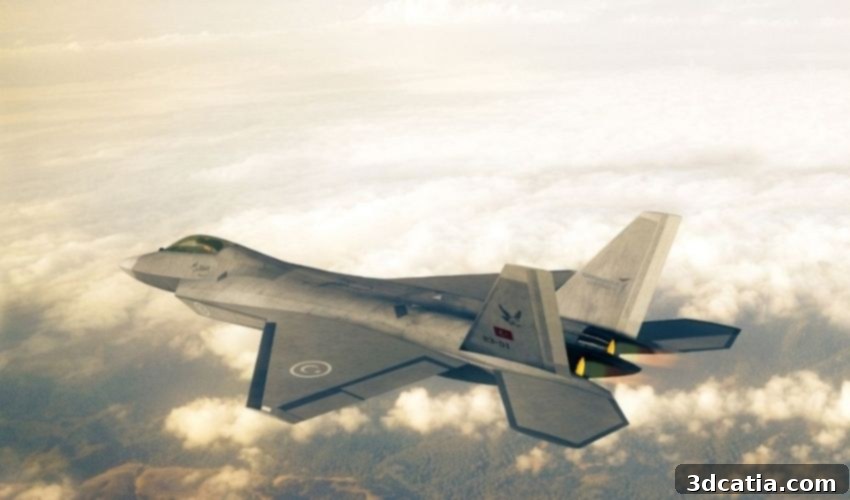
Turkish Aerospace Industries Acquires World’s Largest Sciaky EBAM 3D Printer for Next-Gen Titanium Aerostructures
In a groundbreaking development set to redefine large-scale aerospace manufacturing, American industry leader Sciaky, Inc. has officially announced the delivery of its cutting-edge, customized EBAM 300 Series Electron Beam Additive Manufacturing (EBAM) system to Turkish Aerospace Industries (TAI). This monumental acquisition means TAI will now operate the world’s largest electron beam directed energy deposition (DED) 3D printer. This strategic investment is poised to revolutionize TAI’s manufacturing capabilities, particularly enabling the creation of some of the industry’s largest and most complex titanium aerostructures. The collaboration between Sciaky and TAI will also encompass a series of joint projects specifically designed to optimize the machine’s utilization and push the boundaries of advanced additive manufacturing in critical aerospace applications.
This significant partnership underscores a growing global trend towards leveraging sophisticated additive manufacturing technologies for high-stakes applications in both defense and aerospace. Sciaky’s EBAM technology is globally recognized for its unique ability to produce large, high-quality metal parts with superior material properties, making it an ideal solution for the stringent requirements of aerospace components. TAI’s ambitious goal to produce large titanium aerostructures directly reflects the increasing importance of additive manufacturing in reducing lead times, minimizing material waste, and enabling innovative designs that were previously considered impossible or impractical with conventional manufacturing techniques.
Turkish Aerospace Industries: A Hub of Innovation and Strategic Independence
Turkish Aerospace Industries (TAI) is a distinguished Turkish-US joint investment company deeply ingrained in Turkey’s industrial fabric. Established in 1973 under the Ministry of Industry and Technology, its original mandate was to foster Turkey’s self-sufficiency and decrease its reliance on foreign suppliers within the defense sector. Over the past five decades, TAI has undergone remarkable growth and transformation. Since 2005, it has firmly established itself as “Turkey’s technology center for the development, modernization, manufacturing, system integration, and lifecycle support of its aviation and space programs.” This expansive mission now covers a vast range of activities, from the design and production of advanced fighter jets, helicopters, and unmanned aerial vehicles (UAVs) to the development of sophisticated satellite systems.
TAI’s unwavering commitment to innovation and technological advancement is clearly demonstrated by this latest acquisition. The global aerospace and defense sectors have enthusiastically embraced additive manufacturing (AM) for its unparalleled transformative potential. From bolstering supply chain resilience and accelerating component development to enabling the production of lighter, stronger, and more fuel-efficient parts, AM offers multifaceted advantages. In the United States alone, the military 3D printing sector is experiencing exponential growth, with projections reaching $1.7 billion by 2027, driven by significant adoption from entities like the U.S. Air Force for diverse applications ranging from spare parts to critical flight components. TAI’s substantial investment in Sciaky’s large-format DED printer positions it prominently at the vanguard of this global technological shift, empowering the company to achieve its ambitious manufacturing and overarching strategic objectives.
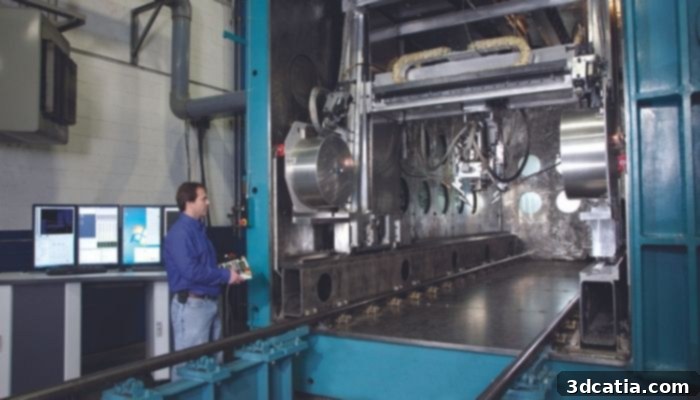
Turkish Aerospace Industries (TAI) is set to receive a customized Sciaky EBAM 300 3D printer, enabling the production of record-breaking titanium aerostructures (photo credits: Sciaky).
Unpacking the Sciaky EBAM 300: The World’s Largest Metal AM System
The Sciaky EBAM 300 is not merely a 3D printer; it represents a monumental achievement in additive manufacturing, currently holding the prestigious distinction of being the largest commercially available metal additive manufacturing system on the market. Its sheer physical scale is awe-inspiring, boasting overall dimensions of 300 inches (7620 mm) x 120 inches (3048 mm) x 120 inches (3048 mm). Crucially, its formidable build envelope provides an expansive range of 240 inches (6096 mm) wide x 47 inches (1194 mm) deep x 60 inches (1524 mm) high. These immense dimensions directly translate into unparalleled manufacturing capabilities, allowing TAI to fabricate exceptionally large, monolithic titanium aerostructures that would be exceedingly challenging, if not entirely impossible, to produce with other additive or conventional manufacturing methods. This capacity for large, single-piece structures drastically reduces the need for complex assemblies and improves overall structural integrity.
The Power and Precision of Electron Beam Directed Energy Deposition (DED)
At the technological heart of the EBAM 300 lies Directed Energy Deposition (DED) technology, a sophisticated additive manufacturing process uniquely suited for large-format metal 3D printing applications. DED systems operate by melting material (typically in wire or powder form) as it is precisely deposited onto a substrate, layer by layer, to incrementally build a part. Unlike powder bed fusion processes, DED offers a significantly greater range of build volumes and enhanced flexibility in both material selection and repair applications. Sciaky’s Electron Beam Additive Manufacturing (EBAM) system specifically leverages a powerful electron beam as its primary energy source, operating within a meticulously controlled vacuum chamber. This vacuum environment is absolutely critical, especially when processing reactive metals such as titanium, as it effectively prevents oxidation and contamination, thereby ensuring the production of incredibly high-quality, dense parts with superior mechanical properties and consistent performance.
The inherent advantages of EBAM technology extend far beyond its capacity to handle reactive metals and create large parts. Sciaky particularly highlights the machine’s precisely controlled beam geometry, a feature that enables exceptional energy distribution across the melt pool. This level of precise control is absolutely vital for achieving consistent material deposition and ensuring highly repeatable performance – an indispensable requirement in the rigorous aerospace industry where stringent part qualification, reliability, and traceability are paramount. The high deposition rates intrinsically associated with DED, and particularly Sciaky’s EBAM systems, translate into significantly faster production times for large-scale components, thereby substantially reducing manufacturing bottlenecks and accelerating overall product development cycles. Furthermore, the EBAM process offers excellent material utilization, minimizing waste compared to traditional subtractive manufacturing techniques, which proves beneficial for both cost-efficiency and environmental sustainability.
Integrated Electron Beam Welder (EBW): A Hybrid Manufacturing Advantage
A distinguishing and highly valuable feature of this customized Sciaky EBAM 300 3D printer is the seamless integration of an Electron Beam Welder (EBW). This strategic inclusion substantially enhances TAI’s overall manufacturing capabilities, enabling the effortless combination of advanced 3D printing and precision welding functionalities within a single, unified system. The powerful synergy between EBAM and EBW opens up entirely new avenues for innovative hybrid manufacturing processes. TAI can now not only efficiently 3D print large, intricate structures but also perform high-quality electron beam welding on these or other critical components. This dual capability is particularly advantageous for complex applications that require the joining of intricate assemblies, the precise repair of high-value parts, or the creation of advanced hybrid structures that thoughtfully combine different manufacturing methods to achieve optimal performance and structural integrity. The ability to perform both additive manufacturing and precision welding with such high accuracy and efficiency in a controlled vacuum environment provides TAI with an unparalleled advantage in creating robust, high-integrity aerostructures for its demanding programs.
Strategic Implications for Turkish Aerospace and Global AM Adoption
The acquisition of the Sciaky EBAM 300 will empower TAI to manufacture an extensive range of metal parts, from an impressive 8 inches up to over 20 feet (approximately 6 meters) in length, using state-of-the-art additive manufacturing. This transformative capability is especially impactful for the production of critical aerostructures such as fuselage frames, wing spars, landing gear components, and other large structural elements crafted from high-performance materials like titanium. By integrating such advanced manufacturing capabilities in-house, TAI gains unprecedented control over its supply chain, significantly reduces its reliance on external suppliers for large, specialized parts, and can dramatically accelerate its development cycles for new and existing aerospace platforms.
Scott Phillips, President of Sciaky, Inc., articulately summarized the profound significance of this collaboration: “Sciaky’s EBAM systems are the most widely sold, large-scale DED metal 3D printers in the world, having approved parts on land, sea, air, and space applications. We applaud TAI’s vision for innovation and their ambitious plans to 3D print some of the largest titanium aerostructures in the world.” Phillips’ statement not only underscores Sciaky’s established global leadership in the field of large-scale metal DED but also commendably highlights TAI’s forward-thinking and innovative approach. The crucial approval of parts across such diverse and demanding applications—from terrestrial vehicles and naval vessels to sophisticated aircraft and spacecraft—unequivocally demonstrates the reliability, robustness, and qualification readiness of Sciaky’s EBAM technology, instilling immense confidence in TAI’s ambitious future endeavors.
This pivotal move by TAI is strongly indicative of a broader and accelerating industry shift where defense and aerospace companies worldwide are increasingly recognizing additive manufacturing as a fundamental cornerstone of future innovation and a critical competitive advantage. The intrinsic ability to produce complex, lighter, and significantly more durable components with greatly reduced material waste and enhanced design freedom directly translates into improved operational performance, lower lifecycle costs, and accelerated time-to-market for next-generation aircraft and spacecraft. For Turkey, this strategic investment substantially strengthens its national defense capabilities and firmly positions TAI as a global leader in advanced manufacturing techniques, fostering invaluable domestic technological expertise and contributing significantly to the nation’s strategic autonomy.
The implications of TAI’s new EBAM 300 extend far beyond the mere manufacturing of parts; it fundamentally enables a paradigm shift in both design philosophy and engineering execution. Engineers can now conceptualize and design components with highly optimized geometries, integrating what were previously multiple distinct parts into a single, more robust, and lightweight structure. This consolidation reduces assembly complexity, minimizes potential failure points, and inherently enhances structural integrity. This newfound design freedom facilitates the creation of components that are not only considerably lighter but also exhibit superior performance under extreme operational conditions, which is absolutely crucial for the demanding aerospace sector. Furthermore, the potential for rapid prototyping and iterative design cycles will substantially shorten development timelines for new aircraft and space programs, providing TAI with a distinct and powerful competitive edge in the global arena.
This landmark delivery solidifies the growing partnership between American innovation and Turkish ambition, collectively pushing the boundaries of what is technologically possible in large-scale metal additive manufacturing. It sends a clear and resounding signal that large-scale, high-performance additive manufacturing is no longer a niche or experimental technology but rather a core strategic asset for leading aerospace and defense contractors across the globe. For more detailed information, the official press release can be found HERE.
Join the Conversation
What are your thoughts on Turkish Aerospace Industries (TAI) acquiring the state-of-the-art EBAM 300 from Sciaky? Do you believe this significant investment will further accelerate the adoption of advanced additive manufacturing within the Turkish defense and aerospace sectors? We invite you to share your valuable insights and comments below, or engage with us on our vibrant social media platforms: LinkedIn, Facebook, and Twitter! Don’t miss out on the very latest 3D printing news, breakthroughs, and innovations – sign up for our completely free weekly Newsletter here, delivered conveniently straight to your inbox. You can also explore all our informative videos and compelling content on our dedicated YouTube channel.
*Cover Photo Credits: Turkish Aerospace Industries (TAI)