
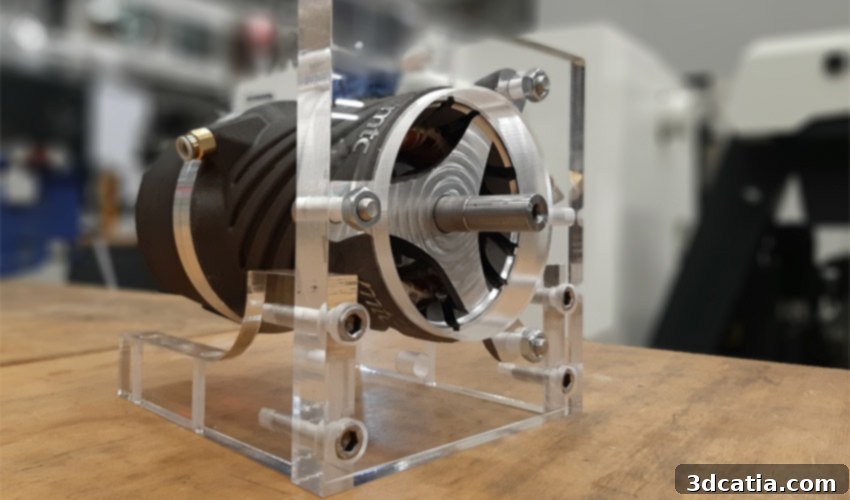
Revolutionizing Power: NCAM Unveils Groundbreaking 3D-Printed Electric Motor Innovation
In a significant leap forward for advanced manufacturing and the electric motor industry, the National Center for Additive Manufacturing (NCAM) in England has announced the successful design and production of what they proudly proclaim to be the first-of-its-kind 3D-printed electric motor. This innovative motor is not merely a prototype but a fully functional unit comprising multiple intricate 3D-printed components. Initial evaluations reveal that this revolutionary motor offers a compelling array of advantages over traditionally manufactured counterparts, including remarkably higher power output, significantly reduced assembly times, and a substantial decrease in the mass and overall size of its critical components. The team at NCAM believes this project transcends theoretical exploration, laying a robust foundation for the widespread commercialization of 3D-printed electric motors across various industrial sectors.
NCAM operates as a vital arm of the Manufacturing Technology Centre (MTC), strategically located in Coventry, England. The MTC itself is a cornerstone of the UK’s manufacturing landscape, dedicated to driving innovation and enhancing productivity through cutting-edge technologies. NCAM’s core mission aligns perfectly with this ethos: to accelerate the adoption and integration of additive manufacturing (AM) processes within industry. To achieve this ambitious goal, the center has invested heavily in state-of-the-art infrastructure. Its facilities are now equipped with an impressive array of approximately twenty advanced AM machines, showcasing a diverse range of capabilities from polymer-based systems for intricate plastic parts to sophisticated metal 3D printers for high-strength applications, and even specialized equipment for ceramic additive manufacturing. This extensive machinery includes top-tier brands such as Renishaw, Trumpf, AddUp, HP, XJet, and Photocentric. Complementing this formidable arsenal of printers, NCAM also boasts a comprehensive suite of post-processing solutions. This end-to-end capability allows the center to meticulously control every stage of the additive manufacturing value chain, from initial design and material selection to printing, finishing, and quality assurance. For a considerable period, the expert team at NCAM has channeled its collective expertise and resources toward the ambitious objective of designing a truly transformative electric motor.
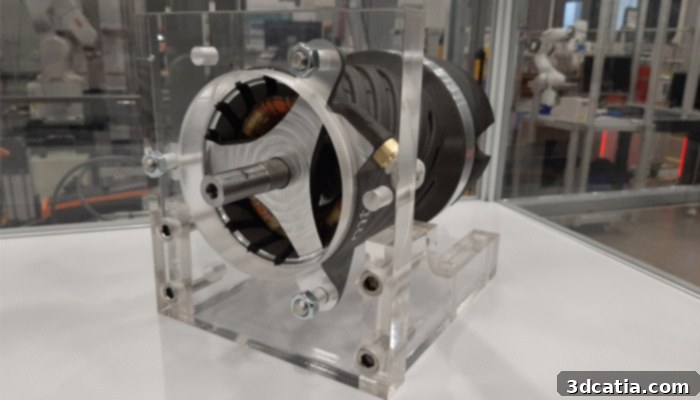
Photo Credit: MTC
The dedicated NCAM team meticulously utilized additive manufacturing to produce several critical parts of the innovative electric motor. While specific details regarding the proprietary processes and advanced materials employed are being kept confidential, the team has confidently shared that the tangible results speak volumes. The finished motor achieves a remarkable combination of being significantly lighter and more compact than conventional designs, while simultaneously delivering enhanced power output. This impressive feat underscores the transformative potential of additive manufacturing. By leveraging AM, NCAM has successfully streamlined the entire supply chain associated with motor production, leading to notable reductions in both manufacturing and assembly times, and consequently, substantial cost savings. Steve Nesbitt, Chief Technologist at MTC, emphasized the strategic importance of this development, stating: “Additive manufacturing is a key tool for developing the complex features and shapes essential to improving the performance and functionality of electric motors. The manufacturing process of these presents a number of challenges, including complex or manual assembly, difficulty to process and sometimes expensive materials, thermal management, and the need to lighten the assembly. By harnessing the capabilities of additive manufacturing through product redesign, major benefits can be achieved in terms of cost, reduced waste, performance, and ease of manufacture.” Nesbitt’s insights highlight how AM directly addresses critical pain points in traditional motor production. The ability to create intricate internal geometries, such as optimized cooling channels, or to consolidate multiple parts into a single, complex component, fundamentally changes the design paradigm. This not only enhances thermal efficiency and reduces weight but also simplifies assembly, minimizes material waste, and ultimately drives down overall production costs, paving the way for more sustainable and efficient manufacturing.
This recent achievement builds upon NCAM’s prior successes in applying additive manufacturing to electric motor components. Notably, the team had previously developed a 3D-printed electric motor housing, a part ingeniously designed to incorporate complex internal cooling channels. Such a sophisticated design, optimized for superior thermal management, would have been practically impossible to achieve using conventional subtractive or formative manufacturing methods. This earlier success demonstrated the unparalleled design freedom offered by additive manufacturing, pushing the boundaries of what is mechanically feasible. With the experience gained from printing individual components, NCAM’s ambitious next goal is to successfully print an entire, fully integrated electric motor. This monumental endeavor aims to unlock further efficiencies and performance gains that are unattainable with current manufacturing paradigms. Dan Walton, Senior Research Engineer at MTC, provided an optimistic outlook on the broader implications of their work: “Additive manufacturing is complex, but the possibilities for companies to improve their productivity, efficiency and cost savings—and therefore their competitiveness—are great. This project allowed us to identify a roadmap to help manufacturers implement additive manufacturing technologies for electric motors, which have the potential to transform the industry as we know it.” Walton’s statement perfectly encapsulates the dual nature of AM – its inherent complexities require specialized knowledge and investment, but the rewards in terms of enhanced productivity, operational efficiency, and substantial cost reductions are immense, ultimately boosting a company’s competitive edge. The “roadmap” identified by NCAM is crucial, as it will guide other manufacturers through the adoption process, demystifying the implementation of AM for electric motors and positioning it as a pivotal technology for future industrial transformation. This approach could redefine how electric motors are designed, produced, and deployed across sectors like automotive, aerospace, robotics, and renewable energy, fostering a new era of innovation and sustainability.
The development of this 3D-printed electric motor by NCAM represents a critical milestone, not just for the electric motor industry, but for the entire field of advanced manufacturing. It underscores the unparalleled potential of additive manufacturing to create products that are not only lighter, smaller, and more powerful, but also more cost-effective and environmentally sustainable to produce. This innovation will likely inspire further research and development, accelerating the integration of AM into mainstream industrial production and fostering a new generation of high-performance, custom-engineered electric drive systems. The ability to rapidly prototype, iterate, and ultimately produce complex components with unprecedented precision and material efficiency positions NCAM and the MTC at the forefront of this technological revolution. This groundbreaking work could significantly impact global efforts towards electrification, offering more efficient and powerful solutions for everything from electric vehicles and aerospace applications to industrial machinery and consumer electronics. The future of electric propulsion appears brighter and more innovative than ever, thanks to the pioneering efforts of centers like NCAM.
What are your thoughts on this revolutionary 3D-printed electric motor and its potential impact on future industries? We invite you to share your insights in a comment below or join the discussion on our Facebook and Twitter pages. To stay abreast of the very latest news and advancements in 3D printing technology, don’t forget to sign up for our free weekly newsletter, delivered directly to your inbox!