
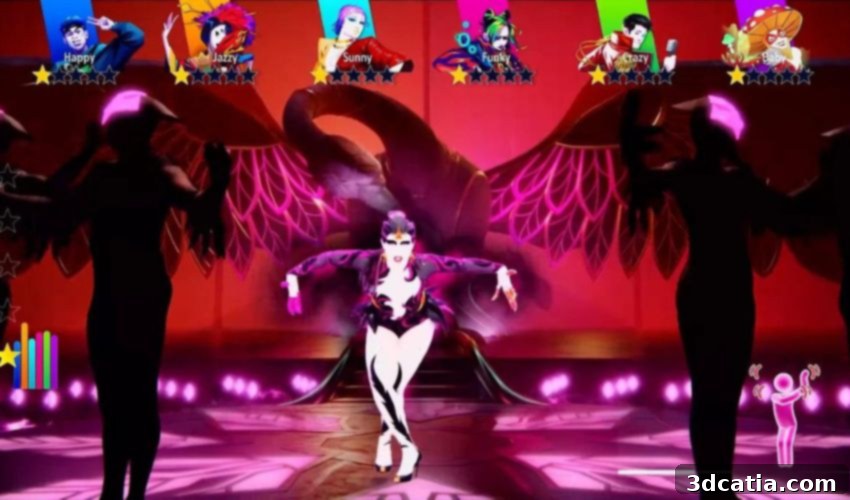
Ubisoft’s Innovative Use of 3D Printing for Just Dance Costumes: Blending Digital Art with Physical Craftsmanship
For over fourteen vibrant years, the rhythm-action phenomenon, Just Dance, has captivated millions globally, inviting players of all ages to move, groove, and express themselves through dance. What began its journey on the Nintendo Wii in 2009 has blossomed into a global sensation, with its latest iteration, the 14th version, now gracing modern platforms such as the Nintendo Switch, PlayStation 5, and Xbox Series X|S. This evolution hasn’t been confined to console compatibility alone; Ubisoft, the visionary developer behind this beloved franchise, has embraced cutting-edge technology to redefine the game’s visual artistry. In a groundbreaking move for its most recent releases, Ubisoft leveraged the transformative power of 3D printing to fabricate an array of astonishingly futuristic and intricate fashion pieces, directly impacting the in-game aesthetics and the immersive player experience. This innovative approach highlights a fascinating convergence of digital entertainment and advanced manufacturing, setting new benchmarks for creative production in the gaming industry and demonstrating the immense potential of additive manufacturing.
Ubisoft stands tall as one of the preeminent video game publishers and developers worldwide, renowned for an expansive portfolio of critically acclaimed titles. Beyond the infectious beats of Just Dance, their creative footprint extends across iconic franchises like the epic Assassin’s Creed series, the expansive worlds of Far Cry, and the whimsical antics of Rabbids, among many others. Just Dance, however, carves out a unique niche as one of their most popular and enduring offerings. At its core, the game challenges users to mirror the movements of an on-screen coach, guided by motion-sensing devices, striving for maximum accuracy and rhythm. These virtual mentors, while typically faceless and imbued with a digital mystique, share a common, striking characteristic: their extraordinarily elaborate and visually stunning costumes. It is precisely in the realm of these spectacular outfits that Ubisoft found an unparalleled partner in 3D printing, unlocking new dimensions of design and practical execution for their virtual dancers.
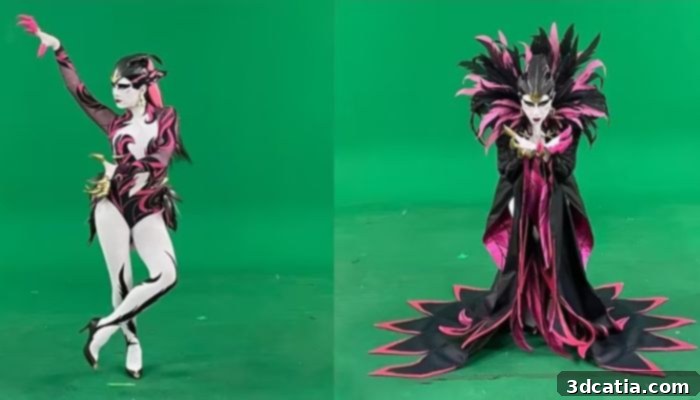
Ubisoft used 3D printing and laser cutting to create the intricate costume for Night Swan
3D Printing: Crafting Unforgettable Costumes for Just Dance’s Virtual Stages
As previously highlighted, the coaches within the Just Dance universe are celebrated for their flamboyant, often otherworldly, and exquisitely crafted attire. Far from being mere digital constructs born solely within a computer program, these costumes possess a tangible reality. To achieve the fluid, authentic, and precise movements that define the game’s core mechanics, Ubisoft employs a sophisticated motion capture process. This necessitates real-life dancers performing intricate choreographies in dedicated green screen studios. Crucially, during these sessions, the dancers must wear physical counterparts of their virtual characters’ outfits. This requirement presents a significant challenge, especially when designs call for elements that are complex, geometrically intricate, or structurally unique – aspects that traditional costume-making methods might struggle to replicate with the necessary fidelity or within practical timelines. This intricate interplay between physical performance and digital animation underscores the critical need for innovative solutions in costume fabrication and character design.
Faced with these creative and technical demands, Ubisoft decisively embraced 3D printing as an indispensable tool, particularly for crafting the magnificent ensemble of Night Swan, the captivating antagonist of Just Dance 2023. The character’s narrative as a formidable villain dictated a costume design that was equally grandiose and imposing. The design team conceived a breathtaking vision: a dramatic, flowing overcoat paired with an intricate bodysuit, both adorned with an astounding array of 300 individually movable, hand-placed feathers. Achieving this level of detail and dynamic movement through conventional means would have been an monumental, if not impossible, task. The solution lay in a powerful hybrid approach, seamlessly integrating additive manufacturing (the industrial term for 3D printing) with precision laser cutting. This combination allowed for the creation of lightweight yet robust feather structures that could be replicated consistently and accurately, ensuring that Night Swan’s imposing presence was perfectly translated from concept art to physical reality on the dance floor.
The choice of materials was paramount, especially considering the need for the costume to accommodate dynamic dance movements without restricting the performer or causing discomfort. While the specific 3D printing technology isn’t explicitly detailed, the utilization of polymers, particularly those offering flexibility and a softer feel, was crucial for Night Swan’s attire. Hard, rigid materials would have impeded the dancer’s performance and potentially caused injury, highlighting the importance of material science in costume design. This attention to detail in material selection allowed Ubisoft to push the boundaries of costume complexity while maintaining the ergonomic requirements for professional dancers. The ability of 3D printing to work with a wide range of flexible and biocompatible polymers opened doors to designs that were once purely theoretical, bringing them into tangible, wearable existence and enhancing the overall aesthetic.
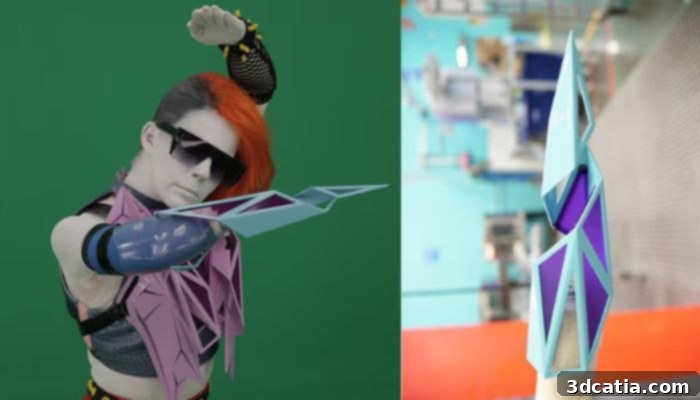
For Just Dance 2021, Ubisoft turned to 3D printing to create a futuristic prosthetic for one of the dancers
It’s important to note that Ubisoft’s foray into 3D printing for costume design is not a recent development, but rather a testament to their continuous pursuit of innovation. The team had previously embraced these transformative technologies for Just Dance 2021, where they designed and fabricated a striking 3D-printed prosthetic and a complementary chest plate. These elements were instrumental in achieving a distinct “retro-futuristic” aesthetic for one of the game’s dancers, seamlessly blending vintage sci-fi influences with advanced technological execution. This earlier application showcased the versatility of 3D printing not just for intricate embellishments, but for creating significant structural components of a costume that convey a specific thematic identity, opening new creative avenues for game designers and costume artists alike.
While Benjamin Jouffret, Costume Designer and Character Lead, has not publicly specified the exact 3D printing technologies employed for either the Night Swan costume or the Just Dance 2021 pieces, certain characteristics of the designs offer strong indicators. The use of polymers is confirmed, with a particular emphasis on softer materials for items like Night Swan’s feathers to ensure dancer comfort and safety. Given the visual complexity, smooth finishes, and often delicate details observed in these costumes, it is highly probable that processes such as Stereolithography (SLA) or Material Jetting were instrumental. These photopolymerization methods are renowned for their exceptional resolution, ability to produce intricate geometries, and capacity to create parts with remarkably smooth surface finishes – qualities that are critical for achieving high-fidelity visual props and wearables. SLA, for instance, allows for the creation of highly detailed and accurate models with various resin properties, while Material Jetting can produce multi-material parts with varying durometers, potentially enabling the softer, flexible elements crucial for seamless dancer movement and comfort.
The prevalence of these technologies extends beyond video game costume design, finding widespread application in industries where aesthetic precision and creative freedom are paramount. For example, in the movie industry, 3D printing has become an indispensable tool for fabricating elaborate props, detailed set pieces, and character prosthetics that often need to look incredibly lifelike or fantastically imaginative. The same principles of rapid prototyping, intricate detail, and customizability make them ideal for creating the visually stunning elements required by a high-profile game like Just Dance, where the virtual characters’ allure is significantly enhanced by their physical counterparts and the overall visual spectacle. This synergy between digital design and physical realization is a game-changer for entertainment production.
Reflecting on these innovative endeavors, Benjamin Jouffret eloquently captures the essence of this technological embrace, stating, “It’s been a huge opportunity to work with 3D-printing techniques because we can create an outfit with a lot of detailed elements that makes the finished product look and perform in a really high-quality way. Additionally, once we decide on a final shape and material for the 3D-printed objects, we can change the way the computer renders them. For example, we can make the objects appear like they’re made of metal or plastic on-camera, in order to fit with our initial vision.” This insight from Jouffret underscores a critical advantage of 3D printing: the unparalleled design freedom it offers. It’s not merely about creating complex shapes; it’s about translating digital concepts into physical forms with an unprecedented level of fidelity, ensuring that the physical costume perfectly matches its virtual representation. The ability to manipulate the final aesthetic of the 3D-printed elements, even after physical production, through digital rendering, further blurs the lines between the tangible and the virtual, empowering designers with ultimate creative control to realize their artistic visions without compromise. This symbiotic relationship between physical fabrication and digital enhancement allows for an iterative design process, where real-world testing of physical prototypes can inform and refine the final digital appearance, leading to a more cohesive and visually stunning end product.
This forward-thinking approach by Ubisoft not only streamlines the production of highly complex costumes but also unlocks new avenues for artistic expression within the game. By moving beyond the limitations of traditional manufacturing, designers can conceive of shapes, textures, and structural elements that were once impractical or impossible to bring to life. From organic, flowing forms to sharp, geometric constructions, 3D printing provides the means to materialize any creative whim. It empowers the costume design team to experiment with novel material combinations and structural intricacies, fostering an environment of innovation that directly translates into richer, more immersive visual experiences for the Just Dance community. This commitment to leveraging advanced technologies positions Ubisoft at the forefront of combining high-tech production with artistic creativity in the gaming landscape, demonstrating a clear path for future interactive entertainment. You can delve deeper into Ubisoft’s official perspective on this exciting blend of 3D printing and neoretro-futuristic fashion by visiting their website HERE.
Ubisoft’s strategic integration of 3D printing into the costume design process for Just Dance 2021 and 2023 represents a significant leap forward in game development aesthetics. It showcases how innovative manufacturing techniques can overcome creative barriers, enabling the realization of breathtakingly intricate and futuristic fashion pieces that enhance the overall player experience. This fusion of advanced technology with artistic vision not only brings virtual characters to life with unprecedented realism but also underscores the burgeoning role of additive manufacturing in the broader entertainment industry. As games continue to push the boundaries of visual fidelity and immersion, such pioneering applications of 3D printing are likely to become increasingly commonplace, offering endless possibilities for creative expression and technical execution in the digital and physical realms.
What are your thoughts on Ubisoft’s ingenious use of 3D printing to bring the fantastical costumes of Just Dance 2021 and 2023 to life? We’d love to hear your perspective! Share your comments below or engage with us on our LinkedIn, Facebook, and Twitter pages. For the very latest updates in the world of 3D printing delivered directly to your inbox, don’t forget to subscribe to our free weekly Newsletter here! You can also explore all our compelling video content on our dedicated YouTube channel, where innovation comes to life.
*All Photo Credits: Ubisoft