
Top 5 Must-Watch 3D Printing Videos: Exploring Groundbreaking Innovations in Additive Manufacturing
Welcome to our weekly roundup of the most captivating videos in the world of 3D printing and additive manufacturing! This week, we dive deep into how this transformative technology is rapidly reshaping various facets of our society, from revolutionizing medical practices and enhancing automotive performance to pioneering new frontiers with living organisms. Additive manufacturing continues to infiltrate diverse sectors, offering unprecedented solutions and capabilities. Our hand-picked selection will keep you informed about the latest innovations, featuring insights into HP’s cutting-edge MJF technology, the burgeoning role of 3D printing in the fashion industry, and much more. If you enjoy these captivating glimpses into the future, remember you can find even more compelling 3D printing videos on our YouTube channel. Get ready to explore the exciting advancements defining the landscape of modern manufacturing!
Top 1: Creating Hyper-Realistic Medical Models with Advanced 3D Printing
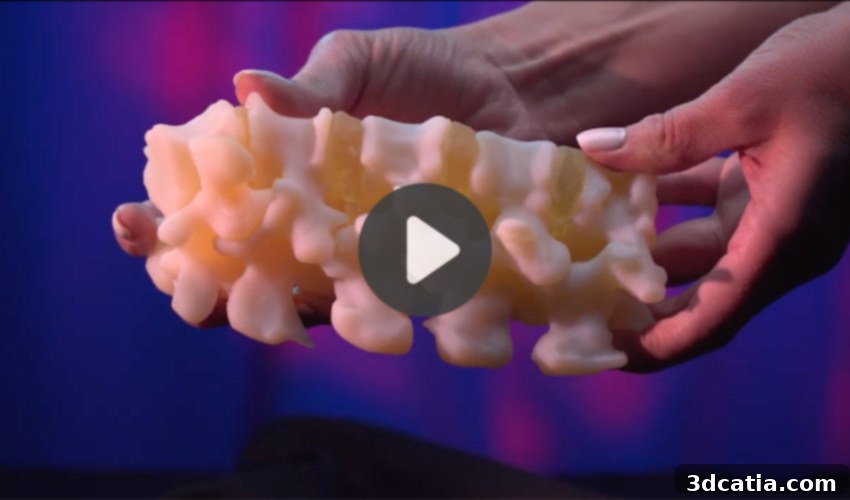
The medical field is constantly seeking innovative ways to improve surgical planning, medical education, and patient outcomes. Stratasys, a leading manufacturer in the additive manufacturing space, has developed a groundbreaking solution specifically designed to meet this critical need: the J750 Digital Anatomy 3D printer. This sophisticated system allows medical professionals to create incredibly realistic anatomical models by combining multiple materials with varying mechanical properties. Unlike traditional models, the J750 Digital Anatomy can accurately replicate the look, feel, and even the biomechanical response of human organs, bones, and vascular structures. This innovative capability sets a new standard for medical modeling, offering an unparalleled level of fidelity.
Institutions like the Jacob Institute have been leveraging Stratasys machines for years, recognizing their potential to transform medical training and research. This advanced additive manufacturing system empowers researchers and surgeons to achieve unparalleled biomechanical accuracy for every part of the body. The models produced can precisely reproduce the exact behavior of human organs and tissues, for instance, by integrating liquids to simulate circulating blood flow or by manipulating wall thicknesses to represent the fragility or resilience of specific tissues. This capability is truly revolutionizing surgical understanding, allowing practitioners to practice complex procedures, test new devices, and thoroughly comprehend challenging anatomies in a risk-free environment before ever operating on a patient. It’s an invaluable tool for enhancing surgical precision, developing personalized treatment plans, and ultimately, improving patient safety and care. The integration of such realistic models significantly elevates the quality of medical training and pre-surgical planning.
Top 2: Revolutionizing Motorsport with Additive Manufacturing and HP Technology
In the hyper-competitive world of motorsport, innovation is not just an advantage; it’s an absolute necessity. Teams are relentlessly pursuing every possible edge to enhance performance, reduce weight, and improve durability, all while facing tight deadlines. This is precisely where additive manufacturing, particularly advanced 3D printing solutions like those offered by HP, emerges as a game-changer. The technology allows for the creation of intricate, lightweight, and high-performance components that can withstand extreme temperatures and stresses, all within remarkably short production cycles. This speed, design freedom, and flexibility are crucial in a sport where rapid iteration, custom-made parts, and bespoke solutions are paramount for achieving peak performance.
HP’s industrial 3D printing solutions, including their renowned Multi Jet Fusion (MJF) technology, are adept at designing and producing a wide array of parts and specialized tooling that directly contribute to enhancing a race car’s performance and meeting the specific, often unique, demands of a professional racer. For example, a significant application involves crafting custom molds for producing ergonomic silicone steering wheels. These custom-fit steering wheels are designed to prevent a racer’s gloves from slipping during high-speed, high-stress races, offering improved grip, comfort, and precise control. This level of customization and ergonomic optimization, often impossible or cost-prohibitive with traditional manufacturing methods, provides a tangible competitive advantage. Beyond steering wheels, 3D printing is extensively used for optimizing aerodynamic components, creating bespoke cooling ducts, manufacturing lightweight brackets, and even producing complex jigs and fixtures for assembly, maintenance, and repair, proving invaluable across the entire motorsport ecosystem. This integration helps teams push the boundaries of automotive engineering.
Top 3: Introducing the Markforged Metal X: Accessible Metal 3D Printing for Industrial Applications
For those who closely follow the dynamic landscape of additive manufacturing, the name Markforged is undoubtedly familiar. This innovative American manufacturer initially made waves with its pioneering development of 3D printers capable of creating incredibly strong composite parts, combining engineering plastics with continuous carbon fiber, fiberglass, and Kevlar reinforcement. Building on this success and recognizing the rapidly growing demand for robust, functional metal components in various industries, Markforged made a significant leap into the metal 3D printing market with the introduction of its revolutionary Metal X system. This expansion solidified their position as a leader in industrial additive manufacturing solutions.
The Markforged Metal X printer democratizes metal additive manufacturing, making it more accessible and cost-effective for a wider range of industries and applications than ever before. Utilizing a process known as Bound Metal Deposition (BMD), which shares principles with Fused Deposition Modeling (FDM), the Metal X prints intricate metal parts embedded in a plastic binder. The process involves three key steps: printing, debinding, and sintering. First, the “green” part is precisely printed layer by layer. Next, it undergoes a chemical debinding process to remove the majority of the plastic binder. Finally, the part is sintered in a high-temperature furnace, where the metal particles fuse together to form a dense, strong, and functional metal component. This video provides a comprehensive overview of the entire process, showcasing how the Metal X transforms metal powder and binders into high-quality, end-use metal parts ready for demanding industrial applications. It opens up new possibilities for creating tooling, fixtures, functional prototypes, and even end-use production parts with materials like stainless steel, tool steel, and copper, at a fraction of the cost and complexity of traditional metal additive manufacturing methods such as DMLS or SLM.
Top 4: Pioneering Bio-Integrated 3D Printing with Living Organisms at MIT and Beyond
Beyond traditional materials like plastics and metals, 3D printing is venturing into entirely new and fascinating realms, including the direct integration and manipulation of living organisms. An interdisciplinary team of visionary researchers at MIT, along with collaborators from other esteemed institutions, has developed a groundbreaking method for 3D printing objects that can predictably control living organisms. This cutting-edge technique represents a significant leap forward in the fields of bioprinting and bio-integrated systems, pushing the boundaries of what is possible with additive manufacturing and bioengineering. This novel approach holds immense promise for various scientific and medical advancements.
This innovative approach typically involves embedding microbial cells, bacteria, or even more complex biological components within a hydrogel matrix during the 3D printing process. By carefully designing the spatial arrangement, density, and internal architecture of these printed structures, researchers can dictate how the living cells interact, grow, and perform specific functions. The ability to precisely control and integrate living organisms within 3D-printed constructs has immense implications across numerous fields. Potentially, this technique could lead to the development of highly customized biomedical tools and devices that are tailored precisely to an individual’s physical body and unique biomarkers. Imagine medical implants that not only fit perfectly but also release drugs on demand, intricate biosensors that detect specific biological changes, or even synthetic organs that closely mimic the functionality of their natural counterparts. Furthermore, this research could pave the way for advancements in soft robotics, environmental monitoring systems, and the creation of novel drug delivery platforms. While still in its early stages, this transformative work highlights the incredible potential of combining advanced 3D printing technologies with biological sciences to engineer intelligent, responsive systems that interact directly with living matter, offering solutions to some of humanity’s most pressing challenges.
Top 5: Mastering 3D Printer Nozzles: A Comprehensive Guide for Optimal Prints
For enthusiasts and professionals engaged in Fused Deposition Modeling (FDM) 3D printing, the nozzle is arguably one of the most critical, yet often overlooked, components influencing print quality, reliability, and overall success. With a bewildering array of nozzle types available on the market, selecting the right one for your specific printer, filament type, and project can be a daunting but crucial task. The choice of nozzle directly impacts everything from print resolution and speed to material compatibility and the structural integrity of your final printed part. Many questions naturally arise: What diameter is best for my needs? Which material should my nozzle be made of? How do these choices affect my print results, and how can I avoid common printing issues?
Understanding the different aspects of nozzles is essential to achieving desired outcomes and troubleshooting common printing problems. Nozzle diameter, for instance, dictates the width of the extruded filament line and, consequently, the level of detail achievable. Smaller diameters (e.g., 0.2mm, 0.3mm) enable finer details and higher resolution, ideal for aesthetic models or miniature parts, but they significantly increase print time. Conversely, larger diameters (e.g., 0.6mm, 0.8mm, 1.0mm) allow for much faster printing and stronger parts due to thicker layer lines and better inter-layer adhesion, perfect for functional prototypes, large objects, or parts where speed and strength are paramount over fine detail. Equally important is the nozzle material itself. Brass nozzles are the most common and affordable, suitable for printing standard, non-abrasive filaments like PLA, PETG, and ABS. However, for abrasive materials such as carbon fiber-filled, glass fiber-filled, or glow-in-the-dark filaments, hardened steel or ruby-tipped nozzles are indispensable to prevent premature wear, maintain print consistency, and extend the lifespan of the nozzle. In this insightful video, Vector3D meticulously explores all these different aspects of 3D printer nozzles, providing comprehensive information and practical advice to help you make informed decisions, ensuring you get the best possible results from every print job. This guide empowers users to troubleshoot common issues like clogging, stringing, and poor layer adhesion by making the right nozzle selection for their specific FDM 3D printing applications.
We hope you enjoyed this week’s exploration into the cutting-edge world of 3D printing and additive manufacturing! The innovations showcased in these top 5 videos underscore the immense potential and rapid evolution of this technology across diverse sectors. From life-saving medical applications and high-performance automotive parts to the fascinating frontier of bio-integrated systems and the fundamental mechanics of printer nozzles, 3D printing continues to push boundaries and inspire new possibilities in engineering, design, and science. What did you think of our selection? We’d love to hear your thoughts and insights! Drop a comment below or join the conversation on our Facebook and Twitter pages. Your feedback is valuable to us. And to ensure you never miss out on the latest advancements, breaking news, and exclusive content from the dynamic 3D industry, don’t forget to sign up for our free weekly Newsletter, delivered straight to your inbox!