
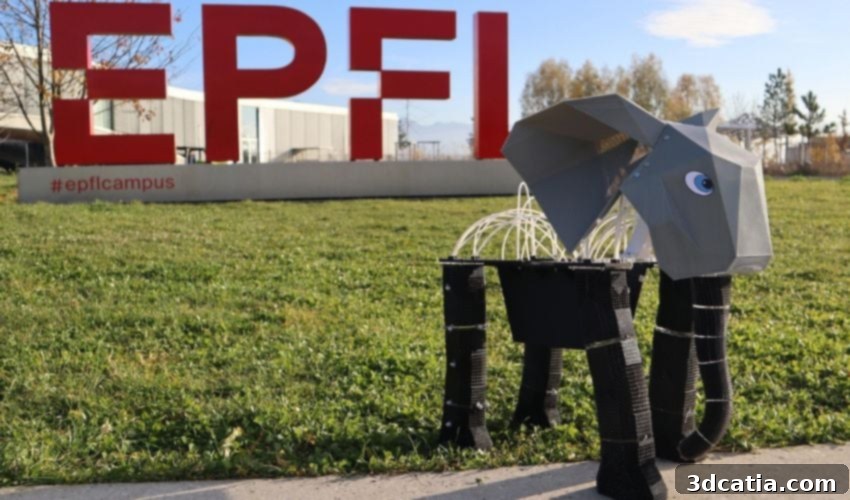
EPFL’s 3D-Printed Elephant Robot: Revolutionizing Adaptive Robotics with Versatile Lattice Structures
The future of robotics is being reshaped by groundbreaking innovations in material science and additive manufacturing. Leading this charge, researchers at the École Polytechnique Fédérale de Lausanne (EPFL) in Switzerland have unveiled a truly remarkable and versatile robotic technology: a lifelike elephant robot crafted entirely through advanced 3D printing. This ingenious creation stands out not only for its captivating appearance but, more importantly, for its underlying structural innovation. The robot’s entire body, from its highly flexible trunk to its robust, jointed limbs, is fabricated from a specialized 3D-printable lattice structure made from simple, yet precisely engineered, foam material. This allows it to emulate the mechanical properties of both soft, muscular tissues and rigid skeletal structures, offering an unprecedented degree of adaptability and biomimicry in a single system. True to its inspiration, this adorable elephant robot can perform intricate tasks, such as delicately picking up flowers with its sophisticated trunk, and exhibits movements that strikingly resemble a real elephant, all while possessing an undeniably cute aesthetic.
The true genius behind this robotic marvel lies in its meticulously designed internal architecture: a sophisticated network of tiny, interconnected units known as cells, which form the robot’s lattice structure. The EPFL researchers leveraged two foundational models for these cellular units: the body-centered cubic (BCC) and the X-cube. These aren’t just arbitrary shapes; they represent fundamental geometric building blocks known for their robust mechanical properties. By seamlessly blending these two primary structures and introducing additional modifications like rotating or shifting individual cells within the matrix, the team achieved an almost infinite spectrum of mechanical responses. This innovative approach allows for precise control over the material’s stiffness, flexibility, and overall mechanical behavior at a microscopic level. For instance, a small lattice cube composed of just four cells can generate approximately 4 million unique configurations, each offering distinct mechanical characteristics. Expanding this to five cells dramatically amplifies the possibilities, yielding over 75 million potential arrangements. This exponential increase in design flexibility is what empowers the robot to mimic the complex, graded stiffness found in biological systems. PhD candidate Benhui Dai, a key member of the project, elaborated on this, stating, “This approach enables the continuous spatial blending of stiffness profiles and allows for an infinite range of blended unit cells. It’s particularly suited for replicating the structure of muscular organs like an elephant trunk, which exhibit complex, spatially varying stiffness distributions.” This ability to create a continuum of stiffness within a single, homogeneous material marks a significant leap forward in soft robotics and adaptive material design.
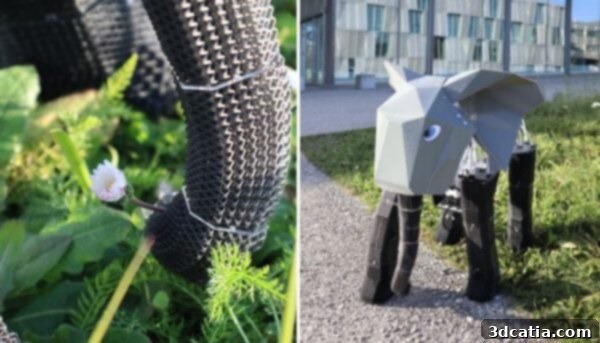
The elephant robot’s trunk can, among other things, grasp a flower, showcasing its impressive dexterity.
Engineering the Continuum: Interplay Between Flexible and Rigid Printed Parts in Robotics
Harnessing this unprecedented flexibility in material design, the roboticists successfully constructed an elephant robot that exhibits remarkable mechanical diversity within a single, continuous structure. This means that different segments of the robot can possess vastly different mechanical properties, all derived from the same base material and printing process. For example, certain regions of the elephant’s trunk are engineered with intricate spiral, twisting, and bending sections. These regions are designed to be highly compliant, enabling the soft, flowing, and incredibly dexterous movements characteristic of a real elephant’s trunk. In stark contrast, other parts of the robot, such as its legs or internal support structures, are deliberately fabricated to be significantly stiffer, effectively mimicking the load-bearing function of bones or the tension-bearing properties of tendons. This sophisticated level of localized mechanical control, achieved through precise lattice design, holds immense promise for various engineering fields, especially in medical engineering. Imagine the possibilities for manufacturing advanced prosthetics that are not only lighter and more comfortable but also perfectly tailored to replicate the dynamic stiffness and flexibility of natural biological tissues. The EPFL team meticulously replicated several complex joint types: sliding planes, analogous to the intricate bone structures found in the human foot; uniaxial bends, akin to the hinging motion of a knee joint; and even complex biaxial movements, mirroring the nuanced articulation of toe joints. This ability to integrate varying degrees of stiffness and movement within a singular material system paves the way for a new generation of biomedical devices that can interface more seamlessly and naturally with the human body.
The researchers, led by Dr. Josie Hughes at EPFL’s CREATE Lab, emphatically highlight that this innovative approach heralds the advent of a completely new class of mechanically adaptive robots. These robots are distinguished by their intrinsic ability to dynamically alter their physical properties – such as stiffness, shape, and even damping – in response to environmental stimuli or task requirements. The combination of an exceptionally light weight with unprecedented variable stiffness characteristics makes this technology uniquely suited for the development of future mobile robotic systems. Consider, for instance, amphibious robot projects where the capacity for seamless mobility in diverse fluid environments, from water to air, is absolutely critical. Dr. Hughes elaborated on the profound advantages of their material choice: “Like honeycomb, the strength-to-weight ratio of the lattice can be very high, enabling very lightweight and efficient robots. This inherent efficiency translates to lower energy consumption and extended operational times, crucial for autonomous systems. Furthermore, the open foam structure is exceptionally well-suited for motion in fluids, offering reduced drag and enhanced maneuverability. Beyond these mechanical benefits, the porous nature of the foam even offers tantalizing potential for embedding other functional materials, such as sophisticated sensors, directly within the structure. This integration could provide further intelligence to these ‘smart’ foams, allowing for real-time environmental sensing, proprioception (awareness of its own body position), and even active stiffness control to fine-tune performance on the fly.” Such capabilities promise robots that are not only physically agile but also intelligently responsive to their surroundings.
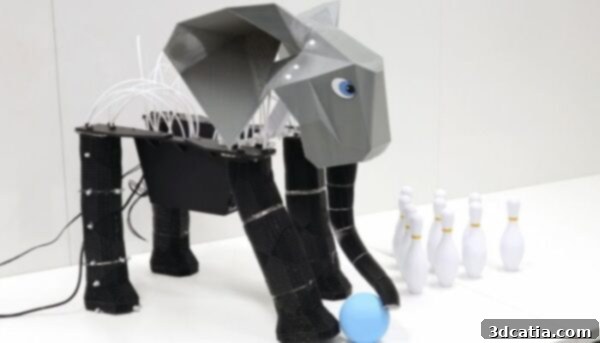
Thanks to its innovative 3D printing technology, the robot is able to mimic complex and nuanced biological movements with high fidelity.
Bio-Inspired Dexterity: Its Capabilities Mirror the Real Thing
The functional demonstrations of the EPFL elephant robot are nothing short of impressive, showcasing a level of biomimicry that transcends mere aesthetics. Its soft, highly articulate trunk is capable of an astonishing range of motions, from delicate grasping and precise twisting to fluid bending. This dexterity rivals the capabilities of many human-designed grippers, yet with the inherent compliance that makes it safer and more adaptable. Concurrently, its robust, rigid legs provide essential stability and enable powerful, controlled movements, allowing the robot to navigate its environment with purpose. While direct, immediate practical applications for a full-sized elephant robot might still be in development, the profound implications of this research, meticulously detailed in its publication in Science Advances, are poised to inspire and catalyze innovation across a multitude of fields. We can envision immediate translation to soft robotic arms designed for delicate tasks in medicine, where precision and compliance are paramount – think of surgical assistants or advanced prosthetics that intimately integrate with biological systems. Beyond medical applications, this technology could revolutionize robotic platforms designed to adapt seamlessly to changing loads or unpredictable environments, from intelligent grippers in manufacturing to resilient exploration robots navigating challenging terrains. The ability to tailor mechanical properties at such a fine grain opens up possibilities for customized, high-performance robotic components that are currently unattainable with conventional manufacturing methods.
This pioneering research from EPFL represents a pivotal stride forward in the realm of bio-inspired robotics. It moves beyond merely replicating the external shape of biological organisms to fundamentally mimicking their intrinsic mechanical function, all driven by ingenious structural design at the material level. The concept that a single, readily available foam material can be engineered to become an adaptive, sophisticated system – simultaneously exhibiting muscle-like flexibility and bone-like rigidity – is a testament to the power of advanced additive manufacturing. This capability brings robotics impressively close to replicating the elegant efficiency and adaptability of its living counterparts, paving the way for machines that are more resilient, versatile, and seamlessly integrated into complex tasks. For those eager to delve deeper into the specifics of this groundbreaking project and its scientific underpinnings, additional comprehensive information can be found HERE.
What are your thoughts on this highly important research and the fascinating, adorable elephant robot? We invite you to share your insights and comments below, or engage with us on our LinkedIn or Facebook pages! Furthermore, to stay at the forefront of additive manufacturing news, don’t forget to sign up for our free weekly Newsletter to receive the latest 3D printing industry updates directly in your inbox. You can also explore all our compelling videos and interviews on our dedicated YouTube channel for more in-depth content.
Photo Credit: EPFL / Alain Herzog