

3D Printing Hybrid Living Materials: Pioneering Bio-Integrated Medical Devices and Smart Materials with MIT
The convergence of biology, engineering, and advanced manufacturing is ushering in a new era of materials science, giving rise to groundbreaking innovations like Hybrid Living Materials (HLMs). These remarkable composites are ingeniously formed by integrating living biological components, such as cells or microorganisms, with non-living synthetic structures. This unique combination effectively blends the distinct properties of both worlds, resulting in materials that are not only robust and functional but also dynamic, responsive, and even self-repairing.
At the forefront of this pioneering research is the Mediated Matter group at MIT’s Media Lab. Under the guidance of visionary scientists, researchers are meticulously exploring how advanced 3D printing technologies can be leveraged to precisely control the behavior and functionality of these novel hybrid materials. The ultimate vision driving much of this work is profoundly impactful: by intricately managing the behavior of live bacteria embedded within HLMs, scientists foresee the development of next-generation medical devices that can inherently incorporate therapeutic agents, offering unprecedented solutions for healthcare and beyond. This represents a paradigm shift from passive materials to active, intelligent systems.
Unveiling Bio-Integrated Functionality: MIT’s Innovative Approach to HLMs
The pivotal research leading to these exciting discoveries was spearheaded by MIT Media Lab Associate Professor Neri Oxman, in collaboration with a dedicated team of brilliant graduate students. Their innovative methodology involved a sophisticated layering technique during the additive manufacturing process. A specialized hydrogel, infused with living engineered bacteria, was meticulously coated onto objects as they were being 3D printed. To orchestrate the desired biological responses and ensure the bacteria performed specific functions, the team ingeniously incorporated various chemical signals directly into the fabrication workflow. These chemicals served as specific cues for the biologically engineered bacteria, which in this particular study were genetically modified *E. coli* strains, chosen for their well-understood genetic manipulability, rapid growth, and safety in controlled environments.
The experiments yielded fascinating and visually striking results. Researchers observed distinct and localized changes in color and fluorescence in specific areas of the 3D printed objects. These changes were a direct and measurable response by the embedded bacteria to the introduced chemical signals, demonstrating a successful integration and communication pathway between the synthetic material and the living microorganisms. Through repeated iterations of this intricate process, the team was able to consistently produce intricate colored patterns across a diverse array of 3D printed objects. This rapid and repeatable formation of predictable patterns provided undeniable evidence: living cells had been successfully and functionally incorporated onto the surface of the 3D printed materials, actively responding to their chemical environment in a predictable and, crucially, controllable manner. This level of precision opens vast possibilities for creating materials with tailored biological functionalities.
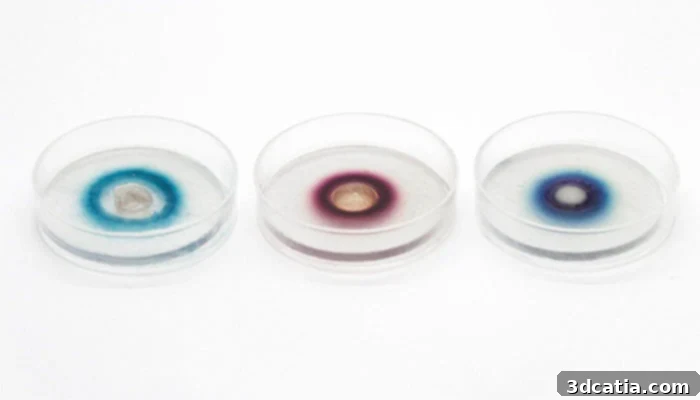
Intricate patterns emerged on various 3D printed objects where the Hybrid Living Materials had been strategically placed and activated, demonstrating successful bio-integration. | Credits: The Mediated Matter group
The Fabrication of Hybrid Living Materials: A Fusion of Additive Manufacturing and Biotechnology
The successful creation and manipulation of these advanced Hybrid Living Materials necessitated the development of a highly specialized fabrication pipeline that seamlessly integrates traditional 3D printing with biotechnological processes. The MIT team opted for a commercially available multimaterial Binder Jetting 3D printer, a technology renowned for its ability to produce complex geometries and utilize a wide range of materials with high resolution. However, to meet the unique demands of bio-integration, significant customization of both hardware and software was required. The researchers meticulously developed bespoke combinations of resins and specific chemical signals, which were then utilized during the 3D printing process. These custom resins formed the structural foundation of the HLM, dictating its mechanical properties and overall form.
Once the foundational object was precisely 3D printed, the crucial “living layer” was introduced. This biolayer consisted of a hydrogel, a biocompatible polymer network known for its water retention capabilities and gentle environment for cells, that was thoroughly infused with the biologically engineered bacteria. This bio-infused hydrogel was then precisely spray-coated onto the surface of the 3D printed object, ensuring even distribution and strong adhesion without compromising the viability of the living cells. Rachel Soo Hoo Smith, one of the brilliant graduate students contributing to this project, elucidated the unprecedented precision achievable with this method: “We can define very specific shapes and distributions of the hybrid living materials and the biosynthesized products, whether they be colors or therapeutic agents, within the printed shapes.” This statement underscores the unprecedented level of control scientists now have over the placement, concentration, and function of living components within manufactured goods. Following the application of the living layer, the developed colors, indicative of bacterial activity, typically took a few hours to become visible, allowing sufficient time for the embedded bacteria to grow, metabolize, and respond to their programmed chemical environment.
The Future of Smart Materials: Therapeutic Medical Devices and Beyond
The implications of these advancements are profound and far-reaching, with potential to revolutionize numerous sectors, particularly the medical field. This innovative 3D printing platform allows for the creation of objects with highly varied material properties within a single, monolithic structure. For instance, certain sections of a medical device could be engineered to be stiff and provide robust structural support where rigidity is critical, while adjacent areas could be designed to be flexible and pliable for patient comfort or dynamic movement. Similarly, some parts could be highly absorbent, ideal for localized drug delivery or fluid management, while others might be liquid-repellent for protective layers or sterile interfaces. This unparalleled ability to integrate such diverse functionalities into one cohesive object holds immense promise for the development of sophisticated and highly effective medical devices.
Imagine biomedical devices that are not only structurally sound and mechanically optimized but also biologically active and responsive. The research team elaborated on this extraordinary potential, suggesting that devices designed using HLMs could offer crucial strength and structural support where needed, while simultaneously maintaining a soft, pliable nature in areas requiring direct contact with the human body. This capability would significantly enhance patient comfort, reduce the risk of irritation, and minimize damage to delicate tissues, which is particularly vital for prosthetics, wearables, and internal implants. Beyond structural and mechanical properties, the embedded living components could be programmed to perform a myriad of biological tasks: to continuously release therapeutic agents at controlled rates, to detect pathogens or biomarkers in real-time, or even to initiate self-repair processes in response to biological cues from the body.
The transformative scope of Hybrid Living Materials extends well beyond immediate medical applications. These responsive and bio-integrated materials could find groundbreaking uses in various other fields. For environmental monitoring, for example, HLMs could be developed into sensors that detect pollutants by changing color or fluorescence, providing immediate visual cues. In the realm of infrastructure, we could see self-repairing materials that heal cracks or degrade contaminants. Furthermore, HLMs could lead to dynamic architecture that reacts to environmental changes, or smart textiles that adapt to body temperature or release beneficial substances. The ability to create materials that are not just strong or flexible, but also intelligent and biologically interactive, truly opens up an entirely new dimension in engineering and design.
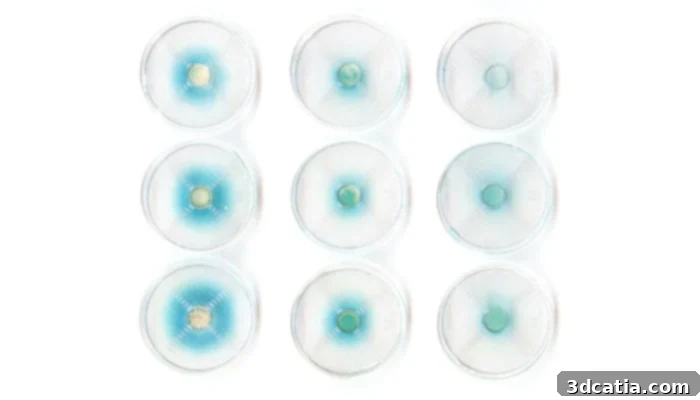
The MIT team demonstrated remarkable control, defining precise shapes and distributions of the hybrid living materials to achieve desired functionalities and intricate patterns. | Credits: The Mediated Matter group
A Glimpse into the Bio-Augmented Future: Vision and Overcoming Hurdles
Looking ahead, the potential applications of Hybrid Living Materials are truly visionary, promising a future where our built environment and personal devices actively contribute to our well-being. Neri Oxman herself articulated a compelling future where HLMs transcend mere aesthetics: “In the future, the pigments included in the masks can be replaced with useful chemical substances for human augmentation such as vitamins, antibodies or antimicrobial drugs.” This perspective envisions HLMs not merely as passive carriers but as active, integrated bio-factories, seamlessly incorporated into everyday objects and delivering personalized health benefits. Imagine clothing that actively releases essential vitamins, bandages that continuously dispense targeted antibiotics to wounds, or even environmental sensors that adapt to changing conditions and provide real-time biological feedback.
While the promise of HLMs is immense and inspiring, their widespread adoption and commercialization will undoubtedly face a number of significant challenges. Key among these are scalability – the complex process of moving from carefully controlled lab-scale prototypes to mass production – and navigating the stringent pathways of regulatory approval, especially for medical applications where strict safety and efficacy standards must be met. Furthermore, ensuring the long-term viability, stability, and predictable behavior of living components within hybrid materials remains a significant area of ongoing research. Issues such as bacterial longevity, susceptibility to contamination, and maintaining predictable function in diverse and challenging environments must be thoroughly addressed to fully realize their potential. However, the foundational work by the MIT Media Lab team provides a robust and innovative framework for tackling these intricate challenges, propelling materials science into an exciting, bio-integrated future. For those interested in delving deeper into the specifics of this groundbreaking research, the full study is available HERE.
Engage with the Future: Share Your Thoughts on Bio-Integrated 3D Printing
The advancements in Hybrid Living Materials represent a pivotal moment in science and technology, blurring the lines between the living and the manufactured. This groundbreaking research not only pushes the boundaries of 3D printing innovation but also lays the essential groundwork for a future where materials are active participants in our health, environment, and daily lives. We are eager to hear your perspective on this fascinating study and the transformative potential of bio-integrated 3D printing. What exciting applications do you envision for HLMs? How do you think these smart materials will shape our future? Share your thoughts and insights in a comment below or join the vibrant conversation on our Facebook and Twitter pages!
To stay at the forefront of additive manufacturing and bio-materials research, don’t miss out on the latest updates. Be sure to sign up for our free weekly Newsletter, delivering all the breaking news and essential insights in the rapidly evolving world of 3D printing directly to your inbox!