

Pioneering Lunar Construction: Luyten’s Project Meeka and the Dawn of Moon-Based 3D Printing
The ambition to explore and ultimately settle beyond Earth has never been more vibrant, signaling a palpable resurgence in the global space race. Recent years have witnessed an acceleration of major lunar projects from both public and private entities across the globe, each pushing the boundaries of what’s possible in extraterrestrial environments. From specialized lunar landers like the Griffin lunar lander developed by Agile Space Industries, to forward-thinking companies such as ICON, which aims to 3D print entire buildings on the Moon, and even China’s strategic plans to establish a 3D-printed lunar base, the focus on sustainable lunar presence is intensifying. Amidst this flurry of innovation, Australian 3D printer manufacturer Luyten has boldly announced its own ambitious venture to conquer the final frontier. In a significant collaboration with the University of New South Wales, Sydney (UNSW), Luyten is spearheading a project named Meeka, with the profound goal of constructing essential structures on the Moon, laying the groundwork for future lunar outposts.
Project Meeka: A New Era for Lunar Habitation and Infrastructure
Luyten’s Project Meeka represents a pivotal step in humanity’s journey toward establishing a permanent presence on the Moon. This initiative is not merely about landing on the lunar surface but about building sustainable, resilient infrastructure that can withstand the Moon’s harsh conditions. The partnership with UNSW brings together cutting-edge engineering expertise and visionary architectural design, crucial elements for successful extraterrestrial construction. The ultimate vision for Meeka extends beyond basic shelters, encompassing a comprehensive approach to lunar habitats, research facilities, and operational bases that will support long-duration missions and potentially even future lunar mining or tourism. By leveraging advanced additive manufacturing techniques, Project Meeka aims to address key challenges such as material transport costs and the need for immediate, on-site construction capabilities, thereby making lunar colonization a more viable and cost-effective endeavor.
Introducing the Platypus Galacticus: Revolutionizing Lunar 3D Printing
Central to Luyten’s audacious space ambitions is the development of a revolutionary 3D printer known as the Platypus Galacticus. This specialized machine is meticulously engineered to utilize regolith – the loose, unconsolidated rock and dust found abundantly on the Moon’s surface – as its primary building material. The ability to source materials locally dramatically reduces the logistical complexities and exorbitant costs associated with transporting construction materials from Earth, offering unparalleled benefits for sustainable lunar development. The Platypus Galacticus is more than just a printer; it is a cornerstone for the future of off-world construction, designed to operate autonomously or semi-autonomously in an extreme environment. Its robust design and innovative features are set to transform how humanity approaches building beyond Earth, paving the way for self-sufficient lunar outposts.
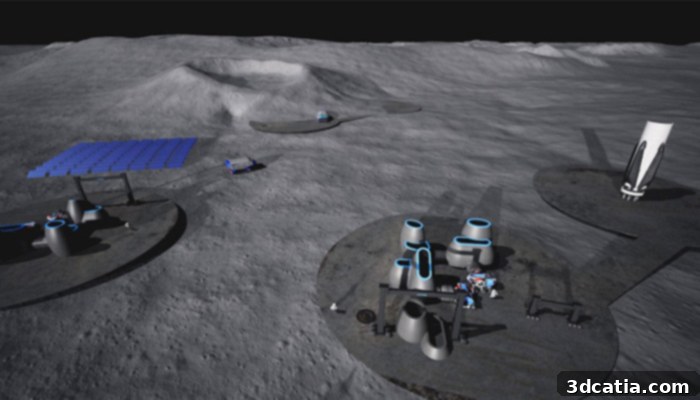
Photo Credit: Luyten
Advanced Characteristics and Operational Strategy of the Platypus Galacticus
The Platypus Galacticus is a testament to cutting-edge engineering, constructed from advanced composite materials to ensure durability and optimal performance in the harsh lunar environment. This compact yet powerful 3D printer incorporates Luyten’s proprietary extrusion technology, aptly named Luyten Turisops. This innovative system is designed to process lunar regolith efficiently, transforming it into robust and stable structures. According to Luyten, the Platypus Galacticus boasts impressive capabilities, able to print structures up to 12 meters (approximately 39 feet) in length and 9 meters (around 30 feet) in height. Such dimensions are critical for constructing sizeable habitats, landing pads, and other vital infrastructure on the lunar surface. To ensure successful construction, Luyten envisions a synchronized operation where specialized rovers will accompany the Platypus Galacticus. These rovers will perform crucial preliminary tasks, including penetrating the lunar soil to assess buildable areas, mapping the terrain, and most importantly, harvesting and processing regolith to feed the 3D printer. This integrated approach ensures a streamlined and efficient construction process, maximizing the potential for autonomous lunar development.
Regolith: The Moon’s Abundant and Versatile Building Resource
The strategic decision to utilize regolith as the primary building material for Project Meeka is a game-changer for lunar construction. Regolith, a blanket of loose, fragmented debris covering the Moon’s bedrock, is readily available across the lunar surface, making it an ideal candidate for in-situ resource utilization (ISRU). This eliminates the need to transport heavy construction materials from Earth, a process that is both prohibitively expensive and logistically complex. While rich in minerals, regolith presents unique challenges due to its fine, abrasive, and often electrostatically charged nature. However, advancements in additive manufacturing, like Luyten’s Turisops technology, are demonstrating the feasibility of transforming this lunar soil into durable and functional building components. Matthias Hank Haeusler, one of the key managers of the Meeka project, eloquently articulated the broader implications of their work: “This information can become part of the Computational Design script and the design will respond to the specific material properties identified on-site. The knowledge we generate for building on the moon can be translated directly into building housing for extreme climates such as heat or for addressing housing issues in remote indigenous communities – both topics we investigate in parallel.” This highlights the profound potential for lunar construction research to yield innovative solutions for terrestrial challenges, particularly in creating resilient housing for extreme climates and remote regions.
Additive Manufacturing’s Growing Footprint in Space Exploration
While the full realization of ambitious projects like Meeka may seem futuristic, the rapid pace of innovation in additive manufacturing (AM) firmly places it at the forefront of space exploration. The capabilities of AM are increasingly recognized and adopted across the aerospace industry, demonstrating its transformative potential. For instance, NASA’s decision to utilize 3D printing for manufacturing thrusters for its lunar missions, partnering with Agile Space Industries, underscored AM’s efficiency, design flexibility, and ability to produce complex, high-performance components. This example, from early in the year, showcased the burgeoning capabilities of additive manufacturing in mission-critical applications. Since then, an increasing number of companies and space agencies are integrating 3D printing into their strategies for various space-related endeavors. This includes 3D printing advanced rocket components, experimenting with 3D printing in microgravity environments to understand its behavior and potential for in-space manufacturing, and even developing entire systems for on-demand tool production aboard spacecraft. The versatility of AM extends to rapid prototyping for new designs, creating lightweight structures, and enabling the efficient repair of equipment in remote space locations, reducing reliance on Earth-based resupply missions.
Beyond Habitats: Diverse Applications of 3D Printing Off-World
The scope of 3D printing in space extends far beyond simply building lunar habitats. Additive manufacturing is proving indispensable for a multitude of applications vital for long-term space missions and future colonization efforts. This includes the ability to print custom tools on demand, repair critical spare parts for spacecraft and ground equipment, and even manufacture complex rocket engine components with intricate geometries that are difficult or impossible to achieve with traditional methods. The capacity to produce items locally in space, whether on a spacecraft, a lunar base, or eventually a Martian outpost, drastically reduces dependency on Earth-based logistics. This not only cuts down on launch mass and costs but also provides crews with unprecedented autonomy and resilience. Projects like Meeka, focusing on large-scale construction, are complemented by smaller-scale in-space manufacturing initiatives, collectively propelling humanity towards a future where resource utilization and creation in space are commonplace. Additive manufacturing is therefore not just a technology; it’s an enabler for truly sustainable and expansive space exploration.
Challenges and the Promise of a Lunar Future
Establishing a permanent presence on the Moon comes with formidable challenges, including extreme temperature fluctuations, harmful radiation, the pervasive and abrasive lunar dust, and the vacuum of space. However, additive manufacturing, particularly with solutions like the Platypus Galacticus, offers innovative ways to mitigate these obstacles. By constructing thick-walled habitats from regolith, bases can provide natural shielding against radiation and micrometeorites, ensuring the safety of future lunar inhabitants. Furthermore, the ability to build custom structures that are specifically designed for the lunar environment allows for optimized thermal management and structural integrity. Projects like Meeka are no longer isolated dreams; they are becoming increasingly numerous and tangible, indicating a clear trajectory toward a lunar future. The vision of self-sustaining lunar bases, serving as scientific outposts, resource hubs, or even a stepping stone for missions to Mars and beyond, is closer than ever before. It would be no exaggeration to say that additive manufacturing is poised to play an indispensable and transformative role in realizing humanity’s long-held aspirations for extensive lunar exploration and off-world colonization. You can learn more about the Meek project HERE.
What are your thoughts on Luyten’s groundbreaking Project Meeka and the future of lunar 3D printing? We’d love to hear your insights! Share your comments below or connect with us on our Linkedin, Facebook, and Twitter pages! Don’t miss out on the latest advancements in additive manufacturing – sign up for our free weekly Newsletter here to get the freshest 3D printing news delivered straight to your inbox. You can also explore all our fascinating videos on our dedicated YouTube channel.
Cover Photo Credit: Luyten