
Revolutionizing Ulcerative Colitis Treatment: Triastek’s 3D Printed Colon-Targeting Drug T21 Achieves First-In-Human Success
The landscape of healthcare is continually evolving, with groundbreaking technologies pushing the boundaries of what’s possible. Among these, 3D printing, also known as additive manufacturing, is increasingly making its mark, especially within the pharmaceutical sector. This innovative technology holds immense promise for developing highly customized and effective drug delivery systems. A leader in this nascent field, Chinese pharmaceutical manufacturer Triastek, has recently announced a significant milestone: the successful completion of a First-In-Human (FIH) study for its third 3D printed drug product, T21. This achievement marks a pivotal moment, as T21 has been proven capable of precisely delivering medication directly to the colon, offering a targeted treatment for moderate to severe ulcerative colitis (UC). According to Triastek, this is the first time their advanced colon-targeting platform has been validated through human trials, underscoring the revolutionary potential of 3D printed pharmaceuticals.
For many, ulcerative colitis remains a poorly understood condition. It is a chronic inflammatory bowel disease (IBD) that primarily affects the large intestine, or colon. As explained by the Mayo Clinic, UC leads to inflammation and ulcers in the innermost lining of the colon and rectum. Patients often experience a range of debilitating symptoms including abdominal pain, persistent diarrhea (often with blood or pus), rectal pain, fatigue, and weight loss. While there is currently no cure for ulcerative colitis, effective treatment is absolutely crucial to manage symptoms, induce and maintain remission, and prevent severe, life-threatening complications. These complications can include a perforated colon, severe bleeding, increased risk of blood clots, and profound dehydration, making targeted and efficient treatment a medical necessity. The chronic nature of UC significantly impacts patients’ quality of life, often requiring lifelong management and frequent medical interventions.
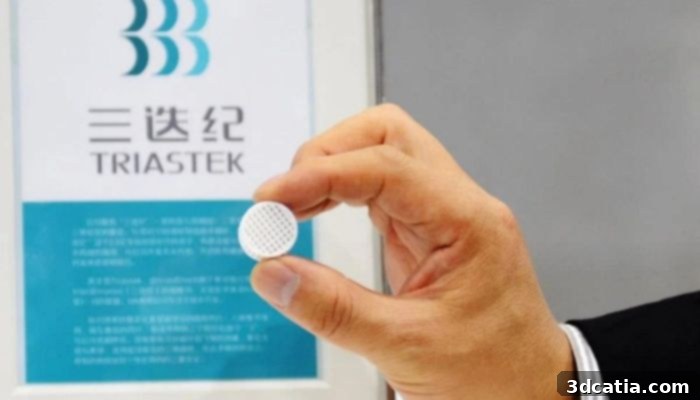
Triastek is one of the leading manufacturers of 3D printed drugs, pioneering advanced pharmaceutical solutions (photo credits: Triastek)
Ulcerative colitis typically manifests in adulthood, though it can occur at any age. Its prevalence is significant, with estimates ranging from 156 to 291 new cases per 100,000 persons annually. This translates to an estimated 600,000 to 900,000 individuals living with this challenging disease in the United States alone. Traditional treatment often involves orally administered medications, which are generally preferred for patient convenience. However, a major hurdle in treating gastrointestinal (GI) diseases like UC with oral drugs is the highly variable effectiveness among patients. The complex and dynamic nature of the human digestive system plays a critical role here; factors such as differing digestive environments, varying pH levels along the GI tract, and individual mucosal transport mechanisms can substantially alter how a drug is absorbed and released. This variability often leads to sub-optimal outcomes, where the medication may be released too early in the stomach or small intestine, failing to reach its intended target in sufficient concentration. Consequently, achieving precise drug delivery to specific locations within the GI tract has historically been a significant challenge for pharmaceutical developers. This is precisely the critical issue that Triastek aims to solve with T21, an innovative oral colon-targeted delivery drug that has already demonstrated its potential by receiving Investigational New Drug (IND) clearance from the FDA, paving the way for human clinical trials.
Triastek’s Breakthrough: The 3D Printed Drug T21 Precisely Targets the Colon for Ulcerative Colitis Treatment
The development of T21 represents a significant leap forward in pharmaceutical innovation, leveraging Triastek’s proprietary 3D printing technology. To create T21, Triastek utilized its self-developed platform, ingeniously named 3D Microstructure for Colon Targeting (3DµS-CT). This advanced process enabled the creation of a sophisticated 3D printed prototype that integrates multiple release control mechanisms. Through extensive testing, Triastek was able to fine-tune the effects of both time and pH on drug release, allowing for unprecedented precision in delivering medication directly to the colon. A key advantage of this method is its ability to significantly reduce the impact of individual variations in gastrointestinal physiology, which often hinder the efficacy of conventional oral drugs. The 3DµS-CT technique builds upon Triastek’s core Melt Extrusion Deposition (MED) proprietary 3D technology, a method that has also been instrumental in the creation of other advanced 3D printed drug products from the company. The MED process involves a specially designed 3D printer that takes powdered raw pharmaceutical ingredients, precisely mixes and fuses them into a movable semi-solid material. This semi-solid is then extruded layer by layer, accurately following a digital blueprint to construct three-dimensional drug tablets with complex internal structures and controlled release profiles. This meticulous layer-by-layer manufacturing ensures unparalleled control over the drug’s physical form and release characteristics.
The T21 tablet, which has now successfully undergone First-In-Human testing, is meticulously engineered with multiple layers, each serving a specific purpose to achieve its precise colon-targeting objective. Triastek’s design features three distinct layers: an enteric layer, a delay layer, and a drug core. The outermost layer is the enteric layer, which acts as a protective shield. Its primary function is to maintain the structural integrity of the tablet while it traverses the highly acidic environment of the stomach. This layer is pH-dependent, meaning it remains intact in the low pH of the stomach but begins to rapidly erode once the tablet passes through the pylorus and enters the higher pH environment of the small intestine. Once the enteric layer is breached, the delay layer is exposed. This crucial layer is time-dependent and is engineered to erode at a consistent, predetermined rate as the tablet continues its journey through the intestinal tract. The erosion rate of this delay layer is precisely controlled and can be adjusted by altering the thickness and composition of the pre-selected polymer materials used in its construction. This allows for potential customization to adapt to individual patient transit times, ensuring optimal timing for drug release. Finally, upon entering or within the ascending colon, the tablet is designed to fully erode, thereby releasing the drug core. This innermost core contains the active pharmaceutical ingredients (APIs), which are then delivered directly to the targeted area of inflammation in the colon. This localized delivery maximizes the therapeutic impact of the drug, potentially enhancing efficacy while minimizing systemic side effects, a critical advancement for patients suffering from ulcerative colitis.
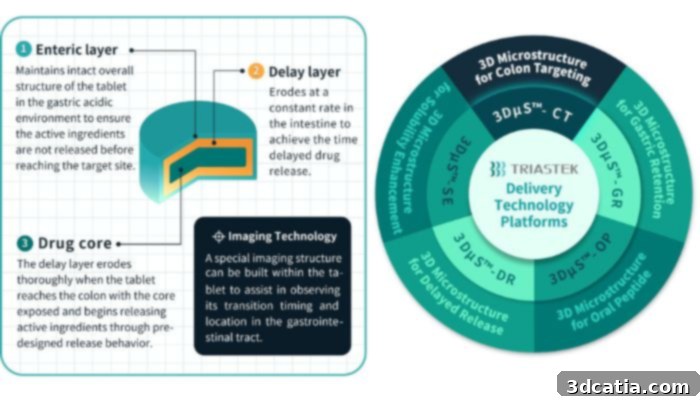
Triastek’s innovative 3D printing processes (right) and the intricate design of the T21 tablet (left) illustrate precision in drug development (photo credits: Triastek)
The successful First-In-Human (FIH) study for T21 unequivocally proves the effectiveness of this innovative 3D printed tablet in precisely targeting the desired area within the colon. This achievement is not merely a triumph for Triastek but represents a significant milestone for the entire 3D printed drug market, particularly in the realm of treating challenging gastrointestinal diseases. The implications are far-reaching, promising more effective and personalized treatment options for patients. Professor Xiaoling Li, co-founder and chief scientific officer of Triastek, eloquently summarized the significance of this breakthrough, stating, “The first in human study data with T21 verifies the precise colon delivery capability of the MED process, and this platform is poised to become the novel drug delivery system of choice for colon targeted new product with either local efficacy or systemic absorption. We hope to continue showcasing how Triastek’s 3D printing processes can bring technical solutions to pharmaceutical companies for efficient product development of optimized drug delivery, ultimately leading to the ability to provide patients with more clinically valuable medicines.” This statement highlights not only the validation of Triastek’s proprietary Melt Extrusion Deposition (MED) technology but also its potential as a versatile platform for future drug development. The ability to precisely control drug release kinetics and target specific areas of the body opens up new avenues for treating a wide range of conditions, improving drug efficacy, and reducing side effects. This advancement brings us closer to an era of truly personalized medicine, where dosages and release profiles can be tailored to individual patient needs, optimizing therapeutic outcomes. Triastek’s success with T21 sets a new standard for pharmaceutical innovation and underscores the transformative power of additive manufacturing in healthcare. You can delve deeper into the details of this groundbreaking announcement by reading Triastek’s official press release HERE.
We value your insights and feedback! Let us know your thoughts on this exciting development in the comments below, or connect with us on ourLinkedIn,Facebook, andTwitter pages! To stay updated with the latest advancements in 3D printing and additive manufacturing, don’t forget to sign up for our free weeklyNewsletter here, delivering the freshest news straight to your inbox! Additionally, you can explore all our engaging videos and educational content on our dedicatedYouTube channel.
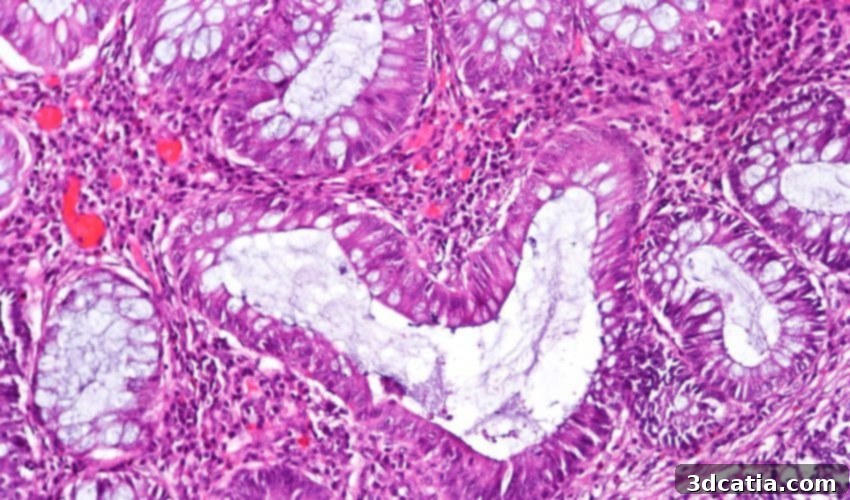
*Cover Image: Chronic inactive ulcerative colitis in a resection specimen (photo credits: CoRus13, CC BY-SA 4.0 via Wikimedia Commons)