

TPM3D: Pioneering Large-Format SLS 3D Printing for Industrial Transformation
Selective Laser Sintering (SLS) 3D printing is rapidly gaining traction as a transformative technology across various industrial sectors. This advanced form of additive manufacturing offers unparalleled advantages, especially when implemented through robust and innovative solutions. A prime example of this innovation comes from TPM3D, a leading Chinese manufacturer of industrial SLS 3D printers. TPM3D has consistently demonstrated how its sophisticated machinery can revolutionize traditional production workflows, making them not only simpler but also significantly more efficient. The inherent capabilities of the SLS process allow for the swift creation of highly optimized, complex parts tailored for a diverse array of applications and industries, driving forward a new era of manufacturing agility and performance.
Having firmly established its presence and expertise within its domestic market, TPM3D has successfully broadened its horizons, achieving global recognition. The company is particularly celebrated for its advanced large-scale additive manufacturing solutions, which are adept at handling high-volume production with exceptional precision. A key differentiator for TPM3D is its comprehensive portfolio of SLS 3D printing materials. This includes versatile polymers like Polyamide (PA), known for its strength and durability; Thermoplastic Polyurethane (TPU), prized for its flexibility and elasticity; and Polyetherketoneketone (PEKK), a high-performance polymer ideal for demanding applications. Through these offerings, TPM3D has uniquely positioned itself, especially with its groundbreaking large-format, dual-laser industrial SLS systems that push the boundaries of what’s achievable in additive manufacturing.
At the forefront of TPM3D’s innovative product line is its flagship model, the S600DL industrial SLS 3D printer. This formidable machine boasts an extraordinary build volume of 600 × 600 × 800 mm, setting it apart as one of the largest available in the market. This considerable size is a significant advantage, as many conventional SLS 3D printers are typically limited by smaller build capacities, restricting the dimensions of parts that can be manufactured. The S600DL’s expansive build chamber directly addresses this limitation, enabling the production of larger components or multiple smaller parts in a single batch, thereby enhancing throughput and efficiency. This model is not merely a testament to TPM3D’s commitment to streamlining production processes through advanced SLS technology; it also profoundly showcases the company’s remarkable capabilities and impact within critical industries such as the medical and automotive sectors.
TPM3D’s Impact: Revolutionizing Production in the Automotive Industry
The automotive industry stands as a testament to the transformative power of TPM3D’s SLS 3D printing solutions. With a proven track record of serving diverse clients across multiple continents, TPM3D has delivered innovative applications that significantly enhance efficiency and performance. Two compelling examples include the creation of components for a self-driving micro police car and the dramatic improvement of automotive jigs and fixtures.
A particularly noteworthy case originates from Dubai, involving the development of a self-driving micro police car. In this project, the advanced TPM3D S600DL SLS system was instrumental, utilizing high-performance glass-filled PA12 material to produce critical components. These included intricate car body parts, structural elements, and various internal components. The application vividly showcased the inherent value of TPM3D’s SLS 3D printing technology in streamlining production, making it both more efficient and considerably simpler than conventional manufacturing routes. Traditionally, fabricating such components would necessitate a complex array of equipment, including cutting machines, followed by extensive welding processes. This multi-step, labor-intensive approach inevitably led to prolonged lead times and resulted in heavy parts; the front section alone of the mini car weighed an astonishing 27 kg, a significant drawback for a vehicle designed for agility and efficiency.
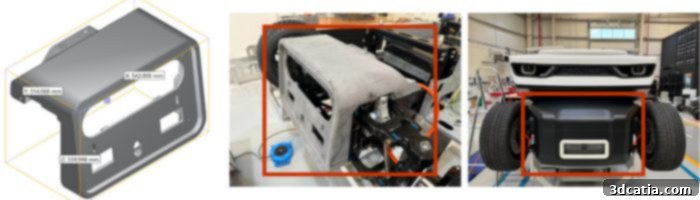
The different stages of developed for the police car from design (left) to the final part (right) with the 3D printed parts highlighted
By embracing SLS additive manufacturing with TPM3D’s solutions, the project team achieved a profound simplification of the entire manufacturing workflow. The process was condensed to merely design optimization followed by the direct 3D printing of parts. This radical shift reduced the lead time from weeks to an impressive two days, representing a remarkable 50% decrease. Furthermore, the inherent design freedom offered by 3D printing allowed for significant optimization of the parts’ geometry, leading to a dramatic weight reduction. The weight of the front section plummeted to just 4 kg, an astounding 82% reduction, making the micro police car considerably lighter, more efficient, and better performing.
Similar transformative benefits were observed in a separate case study from South Korea, focusing on the production of automotive jigs and fixtures. Once again, the robust TPM3D S600DL solution, combined with durable glass-filled PA12 material, was employed to manufacture essential tools, including a car light fixture, a dashboard fixture, and a bump fixture. These tools are critical for precision assembly and quality control in automotive production.
The traditional method for producing these jigs and fixtures involved a highly inefficient aluminum casting process. This cumbersome workflow began with 3D printing a sand mold, which then served as the template for casting the aluminum part. Following the casting, the mold had to be laboriously broken away, and the cast part cleaned. Critical machining operations were then required to achieve the necessary dimensional accuracy and surface finish. Finally, the finished part underwent rigorous three-coordinate measuring and extensive testing before anodizing to enhance its durability and appearance.
The compounded challenges of this conventional process were significant. The qualification rate for these parts typically ranged from a suboptimal 70% to 80%, primarily due to frequent issues such as sand mold printing failures, casting errors, and inconsistencies like air pockets or holes. Adding to these technical difficulties, the traditional method demanded a substantial workforce, leading to exceptionally high labor costs and further impacting overall production efficiency. However, by strategically transitioning to SLS 3D printing with TPM3D’s technology, it became possible to profoundly simplify the entire manufacturing process, dramatically improve overall efficiency, boost pass rates, and achieve substantial cost reductions.
The shift to TPM3D’s SLS 3D printing streamlined the process dramatically. Manufacturing now involves simply printing the fixtures, followed by a depowdering step. Optional CNC machining can be performed for ultra-high precision requirements, after which parts undergo three-coordinate measuring and painting. This significantly simplified workflow reduces the number of steps where errors can occur, inherently increasing the pass rate and ensuring higher quality outcomes. The table below illustrates a comprehensive comparison, highlighting the substantial savings in both cost and time achieved by adopting TPM3D’s SLS solutions over conventional aluminum casting methods for producing automotive jigs and fixtures.
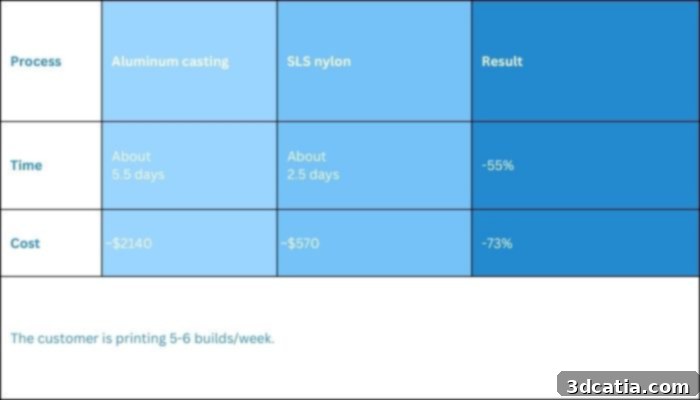
A comparison of cost and time in aluminum casting vs. SLS 3D printing with TPM3D using nylon
Transforming Patient Care: SLS 3D Printing for the Medical Sector
Beyond automotive, the medical sector presents another compelling area where TPM3D’s capabilities have brought about significant advancements in simplified and efficient production. A prime illustration of this is the remarkable improvement in the manufacturing of orthotic braces for patients suffering from scoliosis. Scoliosis is a complex medical condition characterized by an abnormal, sideways curvature of the spine. Its severity can vary greatly, depending on the degree of curvature and whether it progresses over time. In more severe cases, orthotic braces become an indispensable part of treatment, helping to prevent further curvature progression and often reducing the need for surgical intervention.
Despite their critical role, traditional scoliosis braces have long been associated with a myriad of manufacturing and user-related challenges. The conventional production process is notoriously complex, involving numerous laborious steps such as plaster molding to capture the patient’s torso shape, extensive repair and refinement of the mold, precise attachment of thermoplastic plates, careful cutting and grinding to achieve the desired fit, and finally, the meticulous installation of inner linings for comfort. This multi-stage process not only consumes significant time and resources but also frequently results in a product that is bulky, conspicuous, and often considered unattractive, impacting patient self-esteem. Given that these braces are typically worn for extended periods—between 13 and 16 hours a day—their cumbersome nature can significantly affect a patient’s daily life and adherence to treatment.
This is precisely where the advantages of SLS 3D printing become revolutionary. By leveraging the TPM3D S360 solution in conjunction with biocompatible PA12 material, it became possible to produce scoliosis braces with unprecedented speed and efficiency. This drastically reduced the time required from initial design to the final, ready-to-use product, offering a stark contrast to the sluggish and cumbersome nature of traditional production methods. The ability to rapidly iterate on designs and produce custom-fit braces on demand has fundamentally changed the paradigm of orthotic manufacturing.
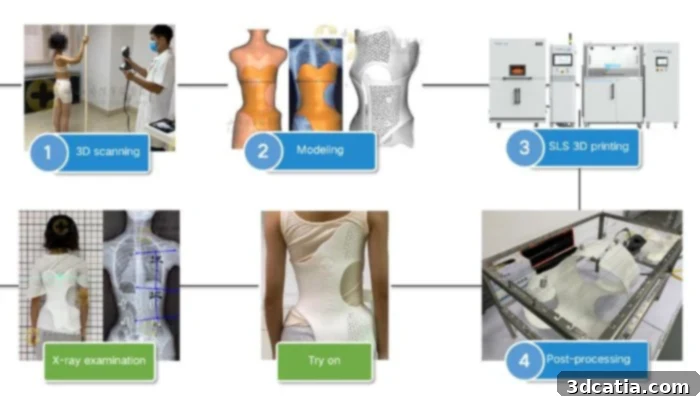
SLS 3D printing greatly simplifies the process for making braces for scoliosis, as can be seen in this image
Moreover, the utilization of additive manufacturing led to significant enhancements in the brace itself. The design freedom afforded by SLS technology allowed for the creation of smaller, lighter, and more anatomically precise braces that are easier to conceal beneath clothing. This reduced visibility and improved comfort have a profound positive impact on the patient’s psychological well-being and daily routine, fostering greater compliance with treatment. Crucially, these 3D printed braces also delivered superior therapeutic outcomes. With optimized designs and precise fit, patients experienced a remarkable improvement in their scoliosis condition, demonstrating a correction rate of over 50%. This not only highlights the efficiency of TPM3D’s technology but also its capability to directly enhance patient quality of life and clinical efficacy.
Broadening Horizons: Additional Sectors Benefiting from TPM3D’s Solutions
The cases from the automotive and medical sectors represent just a fraction of the vast potential and proven applications of SLS 3D printing. TPM3D’s versatile solutions extend their reach across numerous other industries, including aerospace, educational research, and consumer electronics. In these diverse sectors, clients have similarly discovered that integrating additive manufacturing with TPM3D’s industrial systems has not only improved their operational efficiency but also significantly simplified complex production methodologies, paving the way for innovation and cost savings.
TPM3D’s extensive portfolio of successful implementations underscores the wide-ranging adaptability of SLS 3D printing. This includes the rapid production of advanced UAV drones, contributing to the growth and resilience of the national market. In education and research, TPM3D technology aided in the intricate task of restoring a 3D printed Megantereon skull, facilitating deeper study into this ancient beast. Furthermore, the company’s solutions have been pivotal in manufacturing components for electric tools, low-voltage electrical appliances, and even specialized sports equipment, among a multitude of other applications. These varied instances undeniably demonstrate the broad utility and transformative capabilities that TPM3D brings to the table through its innovative SLS 3D printing platforms.
Indeed, TPM3D offers a comprehensive ecosystem designed to empower users with seamless and highly efficient additive manufacturing. This includes their renowned S-Series line of industrial printers, complemented by state-of-the-art auxiliary machines that ensure cleaner and safer printing environments. Beyond hardware, a crucial aspect of TPM3D’s offering is its extensive and diverse range of materials. This wide selection enables users to precisely choose the desired characteristics for their final parts, catering to specific functional, mechanical, or aesthetic requirements. By providing such an integrated and adaptable set of solutions, TPM3D has made additive manufacturing more accessible, simpler, and profoundly more efficient for industries worldwide. This holistic approach to advancing manufacturing capabilities is precisely what a large segment of the global manufacturing sector urgently requires for sustained growth and innovation.
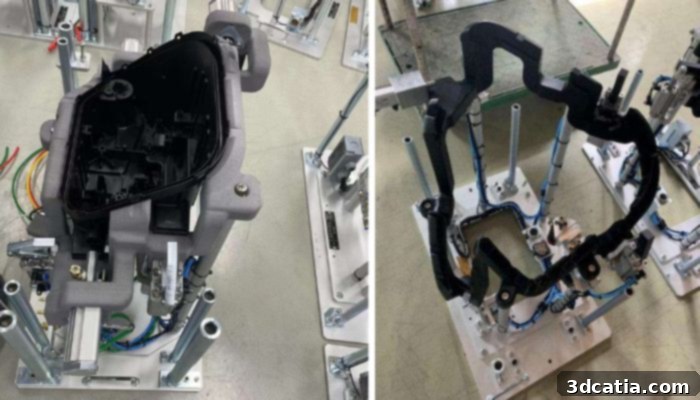
On the left, the jig made with 3D printing compared to the traditional one on the right.
We invite your thoughts on TPM3D and its groundbreaking 3D printing solutions. Share your insights in the comments section below or connect with us on our social media platforms: LinkedIn, Facebook, and Twitter! To stay updated with the very latest in 3D printing news, don’t forget to sign up for our free weekly newsletter here, delivered directly to your inbox! You can also explore our extensive video library on our YouTube channel.
*All Photo Credits: TPM3D