
Weekly Innovations: Exploring the Top 5 Advancements in 3D Printing
The world of additive manufacturing continues to evolve at an astonishing pace, fundamentally reshaping how products are designed, produced, and consumed across countless industries. From enhancing efficiency in industrial processes to creating highly personalized consumer goods and life-saving medical devices, 3D printing technology has truly infiltrated numerous sectors. This week, we delve into five remarkable instances where 3D printing is pushing the boundaries of what’s possible, showcasing its transformative power. Our curated selection highlights groundbreaking applications, including innovative uses of HP’s Multi Jet Fusion (MJF) technology, the surprising integration of 3D printing into the fashion industry, and much more. Join us as we explore these cutting-edge developments and witness how 3D printing is not just a technology, but a catalyst for societal change and innovation. For those eager to discover even more, be sure to visit our Youtube channel for a comprehensive library of 3D printing videos. We hope you enjoy this insightful journey into the future of manufacturing!
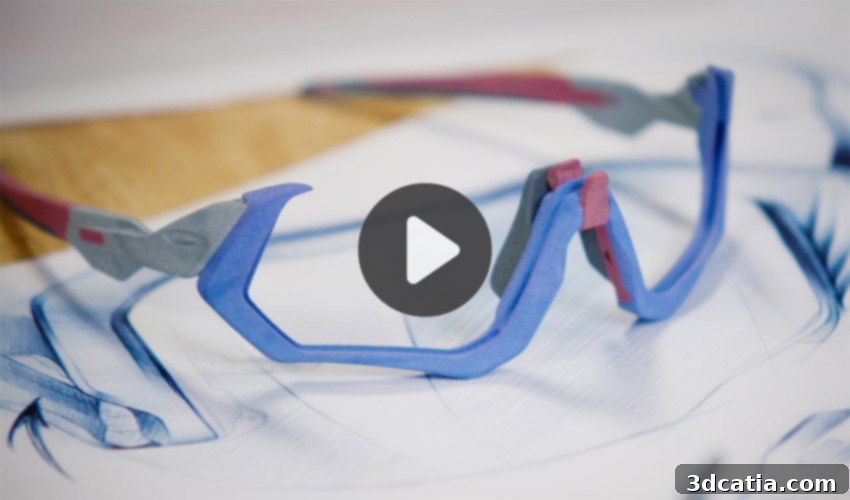
Top 1: Oakley Leverages HP’s Multi Jet Fusion for Rapid Prototyping
Oakley, a globally recognized leader in high-performance sports eyewear and apparel, has long been synonymous with innovation, particularly in the intricate design and engineering of its products. To further accelerate its product development cycle and enhance design capabilities, Oakley has made a strategic investment in HP’s advanced Multi Jet Fusion (MJF) technology. This adoption includes state-of-the-art color 3D printers, enabling the company to produce highly realistic and functionally accurate prototypes. This integration has dramatically revolutionized Oakley’s prototyping process, allowing them to create lightweight, full-color models with unprecedented speed and precision. Historically, developing a single prototype using traditional methods could take anywhere from two to three days. With HP MJF, this timeline has been drastically reduced to just 24 hours. This incredible efficiency gain not only accelerates the iterative design process but also allows Oakley’s designers to test and refine concepts much faster. Furthermore, the capability of color 3D printing offers significant advantages, providing realistic visual feedback on material contrasts, finishes, and overall aesthetic appeal. Designers can experiment with various color combinations and textures directly on the prototype, gaining a clear understanding of the final product’s appearance well before mass production. This detailed visualization facilitates quicker decision-making and ensures that the final product perfectly matches their vision for performance and style.
Top 2: Kimya’s Comprehensive Approach to 3D Printing Materials and Services
The Armor Group, a prominent industrial player, has demonstrated a strong commitment to the future of manufacturing by establishing its dedicated additive manufacturing brand, Kimya, several years ago. Kimya has since evolved into a holistic provider of 3D printing solutions, structured around three core activities designed to meet the diverse and demanding needs of industrial clients worldwide. The first pillar is the **Kimya Lab**, a specialized research and development unit focused on designing tailor-made material formulations. This bespoke service allows industries to obtain filaments precisely engineered to their specific application requirements, ensuring optimal performance characteristics such as mechanical strength, thermal resistance, and chemical compatibility. Building upon this expertise, the **Kimya Materials** activity offers a comprehensive range of technical and high-performance 3D printing filaments. This standardized portfolio includes advanced materials like ABS Carbon, known for its rigidity and lightweight properties, and PEKK-A, celebrated for its high-temperature resistance and superior mechanical performance. These materials empower manufacturers to tackle challenging applications that demand more than conventional plastics. Finally, the **Kimya Factory** operates as a professional service bureau, providing invaluable assistance to manufacturers. This service guides clients through the entire additive manufacturing workflow, from initial part design and material selection to the actual 3D printing of complex components. By offering this end-to-end support, Kimya ensures that industries can effectively integrate 3D printing into their production lines, optimizing both design and material utilization for superior results. This integrated approach, encompassing R&D, material production, and manufacturing services, positions Kimya as a vital partner in the industrial adoption of additive manufacturing.
Top 3: Pioneering Sustainable Outdoor Gear with a 3D Printed Kayak
Imagine the freedom of paddling in a kayak that was not only custom-designed to your specifications but also manufactured using sustainable 3D printing techniques. This visionary concept is at the heart of an innovative project spearheaded by RISE (Research Institutes of Sweden), in collaboration with Chalmers University of Technology, Wood Region, and the renowned kayak manufacturer Melker of Sweden. Their collective goal is to push the boundaries of customized outdoor product manufacturing, with a strong emphasis on environmental responsibility. The ingenious idea behind this project empowers customers to actively participate in the design process of their own kayak. Utilizing an intuitive digital tool, users can visualize and modify their ideal kayak, from shape and size to specific features. Once the design is finalized and the order is placed, the digital file is seamlessly transmitted to a specialized manufacturing network. What truly sets this initiative apart is its commitment to sustainability: the final product is 3D printed using either an ecological bio-composite material or recycled plastic. This approach significantly reduces the environmental footprint associated with traditional kayak manufacturing, which often involves considerable waste and the use of virgin plastics. By embracing on-demand additive manufacturing and sustainable materials, this project not only offers unparalleled product personalization but also champions a circular economy model, where materials are reused and waste is minimized. It represents a significant step towards a future where consumer products are both highly customized and environmentally friendly, proving that performance and ecological responsibility can go hand-in-hand.
Top 4: Revolutionizing Fashion with 3D Printing for Original and Sustainable Designs
The Spanish brand Zer Collection is at the forefront of a fashion revolution, employing 3D printing technology to craft original, durable, and significantly more sustainable clothing. With an impending launch of its first collection aimed at the general public, Zer Collection is set to introduce a unique aesthetic that is futuristic, distinctly urban, and infused with a sporty sensibility. The brand’s visionary designers utilize FDM (Fused Deposition Modeling) 3D printers from BCN3D to create intricate components for their garments, primarily using a flexible TPU (Thermoplastic Polyurethane) filament. This integration of additive manufacturing into textile design offers compelling advantages over traditional methods. A key benefit highlighted by the designers is the drastic reduction in material waste. Conventional garment manufacturing processes often result in 20 to 30% material loss due to cutting patterns and fabric scraps. In contrast, 3D printing allows for precise, on-demand deposition of material, virtually eliminating this waste. This not only makes their production process more efficient but also significantly greener. Furthermore, the garments produced by Zer Collection are inherently more environmentally friendly because they are designed with end-of-life in mind. The TPU material used can be recycled and reprocessed into new printing filament, fostering a truly circular economy within the fashion industry. This innovative approach not only unlocks new creative possibilities for complex geometries and textures previously unachievable but also sets a new standard for sustainable and responsible fashion, proving that high design can coexist with ecological stewardship.
Top 5: Advancing Patient Care with Personalized 3D Printed Orthotics
In the medical field, additive manufacturing has emerged as a truly revolutionary technology, particularly due to its unparalleled ability to personalize solutions for individual patients. While prostheses are designed to replace a missing part of the body, orthoses serve a distinct yet equally critical purpose: they are medical devices crafted to stabilize, relieve pain, immobilize, guide, or correct a specific part of the body. Given that every patient’s anatomy, condition, and needs are uniquely different, 3D printing proves to be exceptionally well-suited for the production of these types of personalized medical devices. The conventional manufacturing of orthoses often involves labor-intensive manual processes, leading to inconsistencies and less-than-perfect fits. However, with 3D printing, medical professionals can utilize advanced scanning techniques to capture the exact contours of a patient’s body part. This precise digital model then informs the 3D printer, which builds the orthosis layer by layer. This results in a device that offers a perfect, custom fit, significantly improving patient comfort, compliance, and ultimately, treatment outcomes. Beyond customization, 3D printing allows for intricate designs that optimize airflow for breathability, integrate specific flex zones for comfort, and maintain rigidity where support is most needed. Furthermore, the ability to rapidly produce these personalized devices reduces lead times, ensuring patients receive their much-needed orthoses faster. This blend of precision, personalization, and efficiency underscores why 3D printing is transforming the landscape of orthopedic care, making highly effective and comfortable medical devices more accessible than ever before. Learn more about this life-changing application below!
We hope you found this week’s exploration into the top 5 3D printing innovations both insightful and inspiring! The rapid advancements in additive manufacturing continue to amaze us, showcasing its potential to redefine various sectors from sports and industrial materials to sustainable fashion and critical medical applications. What were your thoughts on these groundbreaking developments? We invite you to drop a comment below and share your perspectives, or join the conversation on our Facebook and Twitter pages. Don’t miss out on any future innovations; sign up for our free weekly Newsletter to receive all the latest news and updates from the dynamic 3D printing industry delivered straight to your inbox!