
Weekly 3D Printing Showcase: Top 5 Innovations Shaping Our Future
Welcome to our weekly roundup, where we delve into the most captivating advancements and applications of 3D printing technology. This week, we’ve scoured the digital landscape to bring you the TOP 5 videos showcasing how additive manufacturing is continuously pushing boundaries across diverse sectors. From industrial ingenuity to medical breakthroughs, and from culinary artistry to educational empowerment, these examples highlight the incredible versatility and impact of 3D printing. We invite you to explore these fascinating developments, share your thoughts and videos in the comments below, or connect with us on 3Dnatives’ Facebook or Twitter account. Prepare to be inspired by the future unfolding before our eyes!
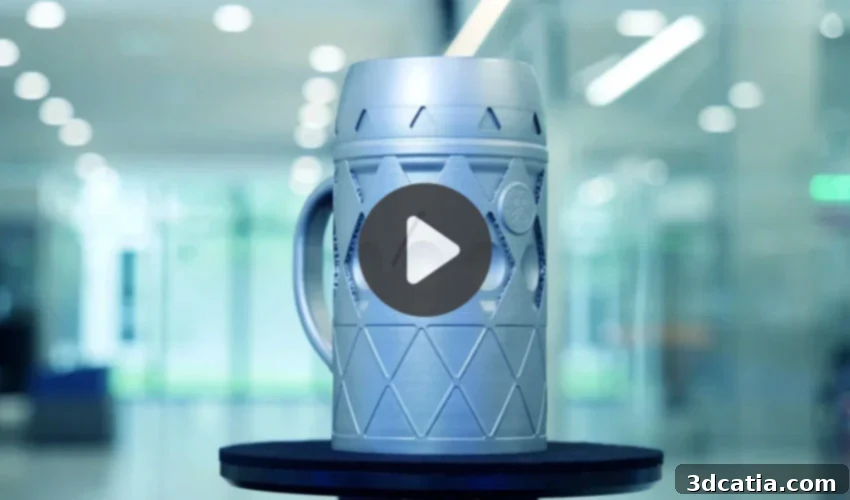
Top 1: Oktoberfest Celebrations Enhanced by Additive Manufacturing
As Oktoberfest takes center stage, imagine enhancing the festivities with bespoke, highly durable drinking vessels. This year, GE Additive’s AddWorks team, stationed at their Customer Experience Center in Munich, took on the unique challenge of redesigning a traditional beer mug using advanced additive manufacturing techniques. The goal was to create a mug capable of withstanding the lively atmosphere of Oktoberfest while embodying the precision and innovation of modern engineering. By combining robust materials like stainless steel and titanium with sophisticated 3D printing technology, the team crafted not just a mug, but a statement piece that perfectly blends heritage with innovation. This project beautifully demonstrates how industrial-grade additive manufacturing can transform everyday objects into extraordinary, high-performance items, offering unparalleled design freedom and material efficiency. It’s a testament to the fact that 3D printing isn’t just for prototypes; it’s for creating lasting, functional products that can stand up to real-world celebrations and demanding environments.
Top 2: Revolutionizing Sports Injury Treatment with Bioprinting
The medical sector is a hotbed of innovation, and 3D printing is playing a crucial role in its advancement, particularly in regenerative medicine. This week, we highlight groundbreaking research from a UNM scientist who is pioneering new methods for treating sports injuries. Their team is focused on creating functional ligaments using a sophisticated combination of electrospinning and 3D bioprinting technologies. Ligament injuries are notoriously difficult to heal due to their complex structure and limited blood supply, often requiring lengthy recovery periods and sometimes imperfect surgical repairs. By developing hybrid bone-ligament tissue, researchers aim to replicate the intricate biological and mechanical properties of natural ligaments. This method involves carefully depositing biomaterials and cells in a precise, layered fashion to encourage the growth of new, healthy tissue. If successful, this innovative approach could dramatically alter how surgeons address a wide array of sports injuries, offering patients faster, more complete recoveries and potentially preventing long-term complications. It represents a significant leap forward in tissue engineering and holds immense promise for improving the quality of life for athletes and individuals suffering from debilitating ligament damage.
Top 3: Accelerating Drone Manufacturing through Additive Techniques
The drone industry is experiencing exponential growth, driven by applications in everything from logistics and surveillance to entertainment and defense. As these unmanned aerial vehicles become more sophisticated, so too does the demand for advanced, lightweight, and complex components. Traditional manufacturing processes, which often involve machining parts from solid blocks of raw material, can be slow, wasteful, and limited in design complexity. This is where additive manufacturing steps in, offering a transformative alternative. We turn our attention to Clogworks Technologies, an innovative SME that is leveraging 3D printing to enhance and evolve its drone designs. By utilizing additive manufacturing, Clogworks can rapidly produce intricate test components and functional prototypes that would be impossible or prohibitively expensive to create with conventional methods. This ability allows for swift iteration, optimizing aerodynamics, reducing weight, and integrating multiple parts into a single, stronger component. The benefits extend beyond prototyping, enabling the creation of customized, high-performance parts that give their drones a competitive edge. This shift underscores how 3D printing is not just improving existing processes but fundamentally changing the way high-tech products like drones are conceptualized, designed, and brought to market.
Top 4: 3D Printing Redefines Culinary Art in Fine Dining
Prepare to have your perception of food revolutionized, as 3D printing brings a new dimension of artistry and precision to the culinary world. What was once confined to industrial applications is now making its way into upscale kitchens, transforming the future of fine dining. Our fourth highlight takes us to Restaurant Smink in the Netherlands, a renowned establishment that has fully embraced 3D technology to craft visually stunning and gastronomically innovative dishes. Here, 3D printed elements are not just garnishes; they are integral components of the entire menu, meticulously designed to create unique textures, shapes, and flavor combinations. This technology empowers chefs to achieve unprecedented levels of customization and aesthetic perfection, creating edible works of art that delight both the eye and the palate. Imagine intricate geometric patterns, delicate structures, or personalized food items that would be impossible to create by hand. Beyond aesthetics, food 3D printing also opens doors for precise portion control, personalized nutrition based on dietary needs, and even the potential to utilize alternative ingredients sustainably. Restaurant Smink exemplifies how 3D printing is not merely a gadget but a powerful tool enabling culinary artists to push the boundaries of creativity and sensory experience, promising a truly unforgettable dining adventure.
Top 5: Empowering the Next Generation with 3D Printing Education
The integration of 3D printing into education is rapidly gaining importance, equipping students with essential skills for the future workforce. For our final spotlight, we celebrate Towson University, where the College of Fine Arts & Communication has taken a leading role in teaching the next generation through its interdisciplinary object design program. This forward-thinking curriculum goes beyond traditional art and design, immersing students in a comprehensive learning experience that covers studio practice, advanced manufacturing techniques, and cutting-edge design principles. Students learn to navigate the entire product development lifecycle, from initial concept and digital modeling to physical prototyping using 3D printers and other emerging technologies. This hands-on approach ensures that graduates are not only creative thinkers but also proficient in the technical skills demanded by industries ranging from engineering and architecture to fashion and product design. By fostering a deep understanding of additive manufacturing, Towson University is preparing its students to be versatile innovators, ready to enter diverse professional fields and contribute meaningfully to a world increasingly shaped by technological advancements. This initiative highlights the critical role of education in bridging the gap between artistic vision and practical application, ensuring a skilled workforce capable of harnessing the full potential of 3D printing.
We hope you enjoyed this week’s journey through the exciting world of 3D printing, from the celebratory spirit of Oktoberfest to life-changing medical advancements, efficient drone manufacturing, exquisite culinary art, and impactful educational programs. These videos are just a glimpse into the vast potential of additive manufacturing and how it continues to evolve and transform industries worldwide. The innovation showcased this week underscores 3D printing’s capacity to inspire, heal, create, and educate across countless applications. What were your favorite highlights, and what future applications of 3D printing are you most excited about? We’d love to hear your thoughts! Drop a comment below or connect with us on our Facebook and Twitter pages. And to ensure you never miss out on the latest news, breakthroughs, and top videos in the 3D industry, don’t forget to sign up for our free weekly Newsletter!