
Discover the Future of Production: Top 5 Revolutionary 3D Printing Videos You Must See
This week, we’ve curated a compelling collection of the top five videos showcasing the dynamic world of 3D printing and how additive manufacturing is fundamentally reshaping global production paradigms. This transformative technology has permeated an incredible array of sectors, demonstrating its versatility and profound impact. From groundbreaking advancements in medical applications that save lives and improve healthcare, to critical innovations within the automotive industry driving efficiency and customisation, 3D printing is at the forefront of a technological revolution. Our carefully selected videos provide an insightful glimpse into these cutting-edge innovations, ensuring you stay well-informed about the latest developments. If you find these videos as fascinating as we do, remember you can explore an even broader range of captivating 3D printing content on our dedicated YouTube channel. We hope you thoroughly enjoy this curated journey into the exciting future of manufacturing and have a fantastic Sunday!
Top 1: Empowering Communities – 3D Printing in Libraries for Critical Supplies
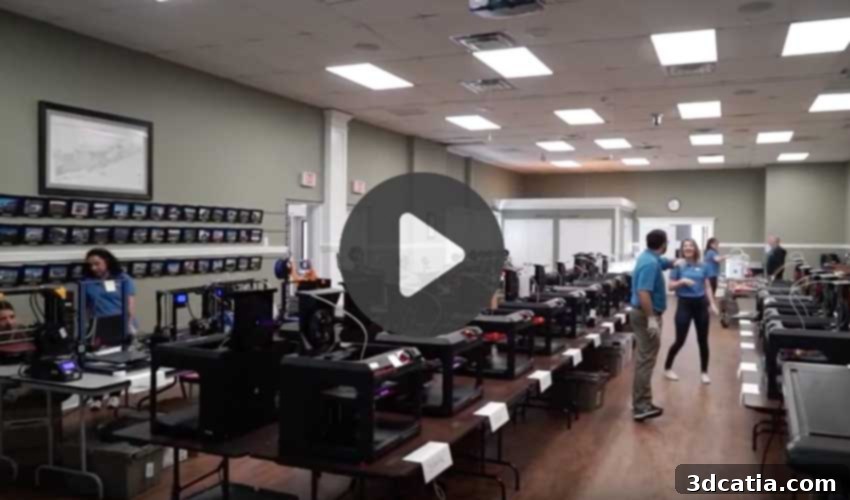
In an inspiring demonstration of community resilience and technological adaptation, a network of public libraries across the United States, particularly in New York, rapidly mobilised their resources to tackle a pressing need. These libraries harnessed the power of 3D printing to produce essential face shields, providing crucial full protection for frontline workers. This initiative highlights the incredible agility of additive manufacturing during times of crisis. The protective devices are meticulously crafted using FDM (Fused Deposition Modeling) machines, specifically models from leading brands such as Makerbot, Ultimaker, and Prusa. These user-friendly yet powerful printers were instrumental in scaling production quickly. Once manufactured, the face shields are promptly dispatched to healthcare workers who are on the front lines, facing daily challenges. The libraries swiftly deployed their entire fleet of 3D printers, transforming into vital production hubs. This effort vividly illustrates how distributed manufacturing, enabled by accessible 3D printing technology, empowers everyday citizens and local institutions to make a tangible difference in global challenges like public health crises. It underscores the notion that with the right tools and a collaborative spirit, everyone can contribute significantly to humanitarian efforts and local support initiatives.
Top 2: Revolutionizing Industrial Production with Metal Additive Manufacturing
ARC Specialties has recently pioneered and developed a groundbreaking metal 3D printing process, building upon the advanced principles of Directed Energy Deposition (DED). This innovative method utilizes a sophisticated robotic arm, which precisely deposits an aluminum alloy, specifically 5356, layer by meticulous layer. This approach allows for unprecedented control over material deposition and part geometry. The result is an extraordinary capability to design and produce highly complex aluminum components, featuring intricate internal structures, novel shapes, and diverse orientations that were previously unattainable with traditional manufacturing techniques. Beyond its impressive design capabilities, a standout feature of this DED process is its remarkable capacity for part repair. It can effectively restore and reinforce existing manufactured parts, extending their lifespan and significantly reducing waste and replacement costs, particularly for expensive or critical components. This innovative repair functionality offers substantial benefits across various industries, from aerospace to heavy machinery, where component integrity is paramount. Witness this cutting-edge technology in action and see how ARC Specialties is pushing the boundaries of what’s possible in metal additive manufacturing.
Top 3: Cultivating Future Innovators – 3D Printing in Education
At the esteemed Rochester Institute of Technology (RIT) in New York, students are gaining invaluable hands-on experience in the rapidly evolving field of additive manufacturing. Their curriculum places a strong emphasis on mastering both metal and carbon composite 3D printing technologies. This practical education is largely facilitated through the use of advanced Markforged 3D printers, renowned for their expertise in handling these complex materials and processes. Students are actively engaged in carrying out their design and engineering projects on these state-of-the-art machines, providing them with comprehensive exposure. This immersive approach allows them to delve deep into the intricacies of 3D software for design and preparation, as well as the crucial techniques involved in post-processing 3D printed parts. This comprehensive training equips them with a holistic understanding of the additive manufacturing workflow, from initial concept to final product. It’s a complete educational tool that provides students with all the necessary skills and knowledge, ensuring they are not only theoretically proficient but also highly operational and competitive in the job market upon graduation. This initiative by RIT is instrumental in preparing the next generation of engineers and innovators to drive the future of manufacturing and design.
Top 4: The Critical Role of Simulation in Optimizing 3D Printing
Paul Heiden, the insightful CEO of Ultimaker, shares his company’s compelling vision in the video below: to champion and promote local production through the transformative power of additive manufacturing. He delves into the expansive Cura ecosystem, which stands as the most widely adopted 3D slicer software in the market today. He highlights its robust features and discusses how it seamlessly integrates with other essential 3D software solutions, creating a cohesive and efficient production chain. A central theme of his discussion revolves around the paramount importance of the quality of the STL file within this production process. He passionately explains why simulation solutions are not just beneficial, but absolutely vital for achieving successful and predictable 3D prints. These advanced simulation tools offer an unparalleled opportunity to gain deeper insights into every aspect of the printing process. They enable users to comprehensively understand the topology of the part, predicting how different geometries will behave under various printing conditions. Furthermore, simulation is crucial for analyzing the behavior of the materials used, allowing for optimization of print settings to prevent common issues like warping, delamination, or structural weaknesses. By leveraging simulation, manufacturers can significantly reduce trial-and-error iterations, save material costs, minimize print failures, and ultimately accelerate the development cycle of innovative products. It’s a key technology for ensuring reliability and efficiency in additive manufacturing.
Top 5: Personalizing Protection with WASP’s 3D Printed Face Mask
WASP, a pioneering manufacturer recognized for its large-scale construction 3D printers, has unveiled an ingenious and highly customizable solution for personal protection: a 3D printed face mask featuring a replaceable filter. What makes this innovation particularly remarkable is its bespoke nature, as each mask is obtained directly from a precise 3D scan of the wearer’s face, ensuring an optimal and comfortable fit. This project is proudly presented as open-source, embodying a spirit of collaboration and rapid dissemination of critical technology. The process of generating a personalized mask is remarkably straightforward and accessible. The wearer can be accurately scanned using photogrammetry, a technique that utilizes a standard smartphone camera from a distance of approximately 1 meter. A series of photos taken from various angles are then reprocessed by specialized software to create a highly detailed 3D mesh of the individual’s face. This mesh is subsequently saved as an STL file, which is immediately ready for 3D printing. This streamlined workflow allows for quick, on-demand production of custom-fitted masks, significantly enhancing their effectiveness and comfort compared to generic alternatives. This initiative not only showcases the practical applications of 3D scanning and printing for personalized medical devices but also highlights WASP’s commitment to leveraging additive manufacturing for impactful, community-focused solutions. You can delve deeper into the specifics of this innovative open-source project and its methodology HERE.
We’re eager to hear your thoughts on these groundbreaking applications of 3D printing! Each video offers a unique perspective on how additive manufacturing is not just a technology, but a catalyst for change across diverse industries and communities. Do you have a favorite among these, or perhaps another inspiring 3D printing story you’d like to share? Drop a comment below to join the conversation, or engage with us directly on our vibrant Facebook and Twitter pages! We love hearing from our community of innovators, enthusiasts, and professionals. And to ensure you never miss out on the latest advancements, breaking news, and exclusive insights from the dynamic world of additive manufacturing, don’t forget to sign up for our free weekly Newsletter. Get all the essential updates delivered straight to your inbox, keeping you at the forefront of the 3D printing revolution!