
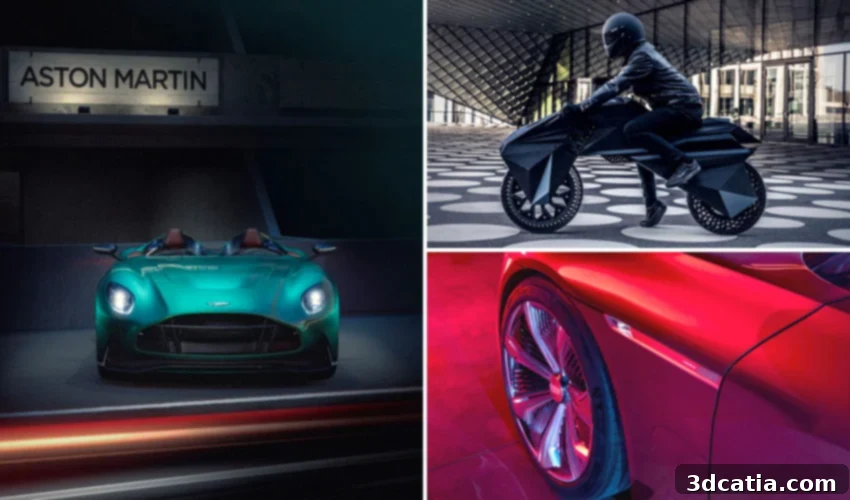
Revolutionizing the Road: How 3D Printing is Accelerating Automotive Innovation
Additive manufacturing, widely known as 3D printing, is no longer a niche technology; it’s a driving force rapidly reshaping the automotive sector. From high-performance sports cars and luxury sedans to practical pickup trucks and cutting-edge motorcycles, an increasing number of vehicles are being designed, prototyped, and even produced with 3D technologies. This innovative approach offers unprecedented benefits, including significant weight reduction, enhanced customization options, and the ability to create complex geometries impossible with traditional manufacturing methods. The integration of 3D printing is fundamentally altering production paradigms across the entire automotive industry, pushing the boundaries of design and engineering. To illustrate this profound shift in mobility manufacturing, we’ve compiled a comprehensive list showcasing some of the most innovative and impactful projects where vehicles have been completely or partially brought to life using 3D printing. Join us as we explore the best examples of 3D printed vehicles, highlighting groundbreaking designs and pioneering applications.
3D Printing for Luxury Cars: The Aston Martin DBR22
British car manufacturer Aston Martin, globally renowned for its exquisite luxury vehicles and unparalleled performance, has recently embraced additive manufacturing in its design and production processes. The DBR22 model, a stunning two-seater roadster, was unveiled to celebrate the 10th anniversary of the company’s bespoke division, ‘Q by Aston Martin’. A standout feature of this exceptional vehicle is its 3D-printed rear subframe. Utilizing advanced additive manufacturing techniques, Aston Martin fabricated the subframe with multiple aluminium parts, which were then meticulously bonded together to form a robust and lightweight structure. This innovative application of 3D printing allowed the firm to achieve significant weight savings without compromising the structural rigidity or integrity essential for a high-performance luxury car. The DBR22 made its grand debut at the prestigious Pebble Beach Concours d’Elegance in California, an event that brings together some of the world’s most exclusive automobiles. By leveraging the design freedom and material efficiency of additive manufacturing, Aston Martin has not only created an iconic sports car but has also demonstrated the technology’s immense potential in the realm of ultra-luxury automotive engineering, setting a new benchmark for innovative production.
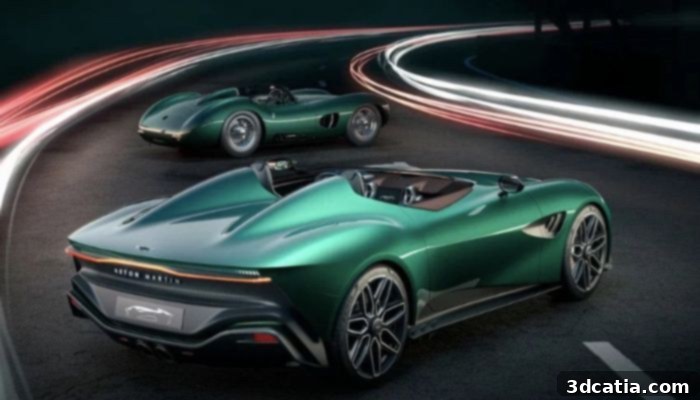
Photo Credits: Aston Martin
Porsche’s Advanced Use of Metal 3D Printing for the GT2 RS
Porsche, a legendary name in sports car manufacturing, has been a pioneer in integrating additive manufacturing for several years, applying the technology across a diverse range of applications, from rapid prototyping to the direct production of finished, performance-critical parts. A particularly noteworthy recent project involves the implementation of 3D printed pistons for its flagship 911 model, the GT2 RS. In a collaborative effort with leading technology partners Trumpf and Mahle, the German automotive giant successfully manufactured pistons that are an impressive 10 percent lighter than their conventionally produced counterparts. Furthermore, these 3D printed pistons incorporate intricate, integrated cooling channels within the crown – a complex design feature that would be utterly unachievable using traditional subtractive manufacturing methods. This significant weight reduction directly translates into several performance advantages, allowing Porsche to decrease the heat load on the pistons and substantially optimize combustion processes. The result is not only enhanced engine efficiency but also the potential for increased power output and improved fuel economy. To validate the reliability and durability of this innovative approach, six 3D printed pistons were meticulously installed in an engine and subjected to rigorous testing for over 200 hours, successfully demonstrating their capability to withstand extreme conditions and meet Porsche’s exacting standards for high-performance components. This project underscores the transformative power of metal 3D printing in pushing the boundaries of engine design and performance.
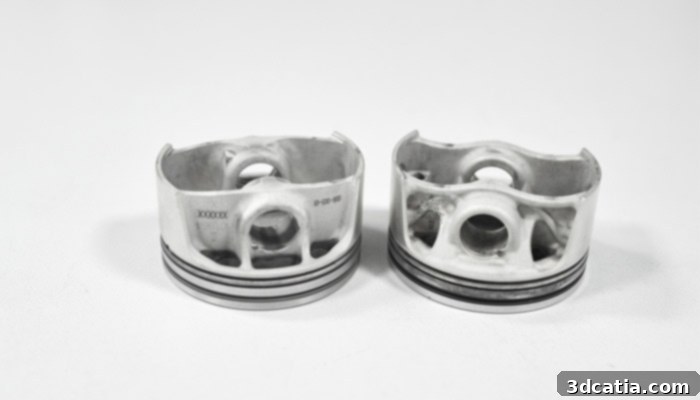
Photo Credits: Porsche
The Ford Maverick: Empowering Customization with 3D Printing
When considering influential American car manufacturers, Ford undeniably stands out, having revolutionized the industry with the first mass production on a moving assembly line. Over a century later, the company continues its legacy as a trailblazer, particularly with its aptly named Ford Maverick® pickup truck. This innovative vehicle has been specifically engineered to empower its owners with creative freedom, thanks to its ingenious Ford Integrated Tether Systems (FITS). These FITS comprise a series of strategically placed slots located at the rear of the center console and within the under-seat storage bins. The brilliant simplicity of this system lies in its ability to allow for extensive customization of accessories. Owners can leverage their own 3D printers to create bespoke accessories, or choose from a growing ecosystem of third-party designs. Essentially, these slots serve as versatile receivers for matching mounts, accommodating virtually any accessory a customer might desire, from cup holders and phone mounts to organizational dividers and specialized tools. Ford further facilitates this personalization by providing open-access 3D files, enabling owners to design and print their own custom parts, fostering a unique sense of ownership and individuality. This approach not only enhances the utility and adaptability of the Maverick but also deepens customer engagement by inviting them into the co-creation process, truly democratizing vehicle customization.
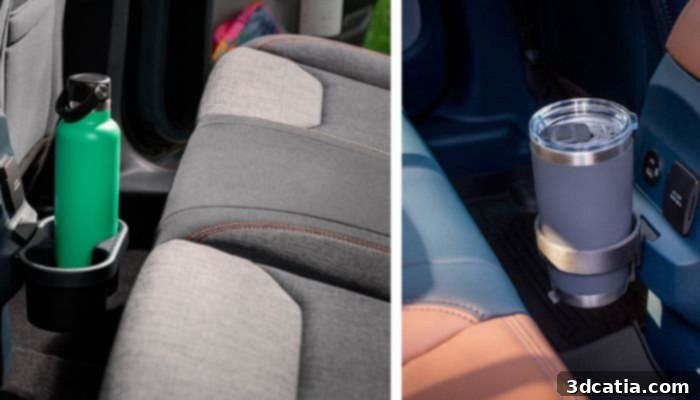
Ford allows users to customize the accessories in their Maverick® pickup truck thanks to FITS (photo credits: Ford)
Campsite Carbon: Innovative 3D Printed Parts for Jeeps
No discussion about iconic automotive brands would be complete without mentioning Jeep, a name synonymous with adventure and rugged capability. To the delight of its loyal customer base, the brand is also witnessing the integration of additive manufacturing into its vehicle ecosystem, most notably for the legendary Jeep Wrangler. Specifically, a company named Campsite Carbon is making waves by utilizing advanced carbon fiber 3D printing to fabricate an array of innovative parts designed for the exterior, interior, and even under the hood of the JL and JK Wranglers, as well as the JT Gladiator. Carbon fiber 3D printing offers a compelling combination of high strength, durability, and a remarkably low weight, making it ideal for enhancing the performance and functionality of off-road vehicles. While these specialized products must be purchased directly from Campsite Carbon, they have rapidly gained popularity among Jeep enthusiasts. A prime example is their easy-to-install convex mirrors, which can be seamlessly attached to the vehicle even when the doors are in place. These mirrors offer improved visibility, a crucial advantage for off-roading and trail driving, while their 3D printed construction ensures a perfect fit and robust performance in challenging environments. Campsite Carbon’s offerings demonstrate how additive manufacturing can cater to specific market demands, providing highly specialized, performance-enhancing accessories that deepen the connection between drivers and their iconic vehicles.
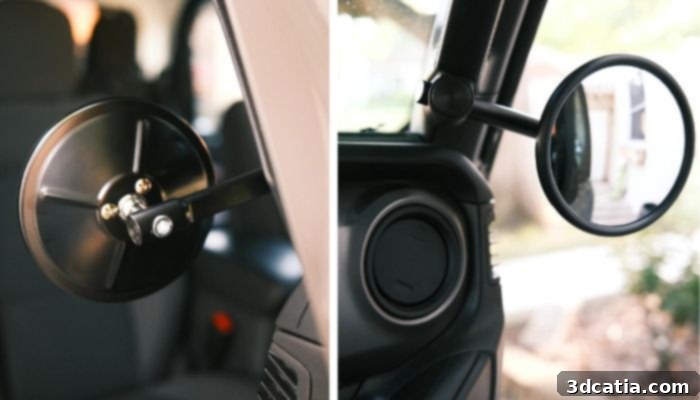
Campsite Carbon has a number of 3D printed parts for Jeeps including these mirrors (photo credits: Campsite Carbon)
Cadillac Celestiq and its Extensive 3D Printed Components
General Motors (GM) is certainly no stranger to the transformative capabilities of additive manufacturing, having previously leveraged the technology to produce an astonishing 60,000 parts in just five weeks for various applications. Building on this expertise, GM has strategically integrated AM into its ultra-luxury brand, Cadillac, for the development of its flagship electric vehicle, the Celestiq. GM made a significant investment of approximately $81 million in the production facility for this vehicle, underscoring its commitment to advanced manufacturing. The Cadillac Celestiq is positioned as an ultra-luxury vehicle, distinguished by its avant-garde design, cutting-edge technology, and exceptional performance. What truly sets it apart is its unprecedented number of 3D-printed components – more than any other vehicle previously produced by GM. The Celestiq incorporates over 100 installed 3D-printed parts, crafted from both advanced polymers and high-strength metals. These components are found in a variety of critical areas, contributing to both the structural integrity and the aesthetic appeal of the vehicle. While the manufacturer has not disclosed specific details about each individual part, it is understood that these range from lightweight structural brackets and complex functional components to intricate cosmetic elements that enhance the vehicle’s bespoke feel. The extensive adoption of 3D printing in the Celestiq highlights GM’s strategic vision for leveraging additive manufacturing to achieve unparalleled design freedom, reduce tooling costs, accelerate development cycles, and deliver highly personalized, top-tier luxury experiences to its discerning clientele.
Ducati and the Strategic Use of 3D Printing for Sport Motorcycles
In the intensely competitive arena of the 2022 MotoGP season, the Ducati Corse team, renowned for its relentless pursuit of performance and innovation, strategically turned to additive manufacturing to enhance its championship-caliber sports bikes. The esteemed Italian company, an integral part of the Volkswagen Group, partnered with Roboze, another innovative Italian manufacturer specializing in the development of high-performance 3D printers and advanced materials. This collaboration proved instrumental in leveraging 3D printing technology to create critical parts for its Desmosedici GP series of motorcycles. Notably, the partnership enabled Ducati to 3D print components using high-performance polymers instead of their traditional metal counterparts. These polymer components included crucial elements like the external coating and various heat shields. The advantages of using 3D printed polymers in this high-stress environment are multifaceted: they offer significant weight reduction, improved thermal management properties, greater design flexibility for aerodynamic optimization, and faster iteration cycles during development. The successful integration of additive manufacturing by a brand as distinguished and performance-focused as Ducati represents a watershed moment in the world of MotoGP, signifying a “before and after” in how racing teams approach design, material science, and the quest for marginal gains that define competitive success.
Peugeot and its Innovative 3D Printed Accessories
The esteemed French car manufacturer Peugeot has been actively exploring and implementing additive manufacturing in connection with its vehicles for several years, recognizing its potential beyond just structural components. A prime example of this innovative approach is evident in the new Peugeot 308. In this instance, 3D printing was not primarily utilized for core engine or chassis parts, but rather for enhancing the vehicle’s interior with highly functional and customizable accessories – a strategy reminiscent of Ford’s FITS system. Peugeot leveraged 3D printing for the production of essential interior items such as bespoke cup holders, sunglasses holders, and dedicated compartments for telephones and credit cards. The overarching objective of this initiative was to equip the Peugeot 308 with a suite of innovative, user-centric products, achieved through a collaborative effort with industry leaders like HP Inc., Mäder, and ERPRO. Beyond mere functionality, the design brief emphasized creating products that offered a superior tactile experience, ensuring they were pleasant to the touch, remarkably solid, and exceptionally easy to use, thereby significantly contributing to an elevated “feel-good factor” within the vehicle’s interior. To achieve these demanding criteria, the project employed HP Multi Jet Fusion (MJF) technology, utilizing a flexible polymer as the primary material. MJF technology, known for its ability to produce complex geometries with excellent surface finish and robust mechanical properties, coupled with a flexible polymer, proved ideal for creating interior parts that are durable, ergonomic, and aesthetically pleasing, further enhancing the overall user experience.
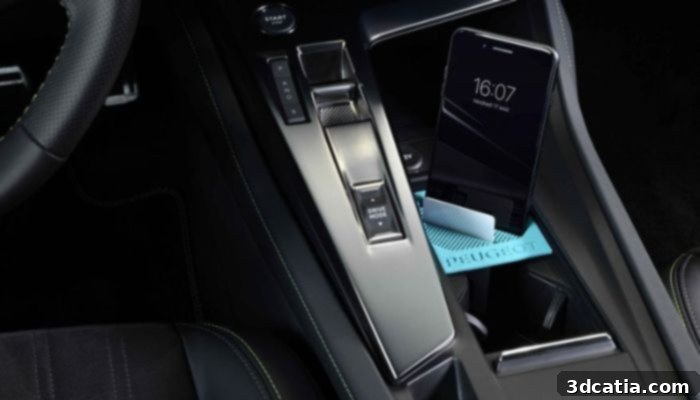
A 3D printed phone holder (photo credits: Peugeot)
Toyota and Stratasys Collaborate for 3D Printed Vehicle Parts
Demonstrating a strong commitment to integrating cutting-edge manufacturing techniques into high-performance automotive applications, Stratasys, a global leader in polymer 3D printing, forged a significant cooperation agreement with Toyota Racing Development (TRD) in June 2022. This strategic partnership outlined the deployment of Stratasys machines to produce crucial parts for the new Toyota GR86, specifically designed for the demanding American GR Cup competition. TRD has systematically integrated several advanced Stratasys 3D printers into its facilities in Salisbury, N.C., and Costa Mesa, California. These include the robust Stratasys Fortus® 450mc, the versatile F370, and the F370®CR, all utilized for the direct production of end-use parts. For instance, TRD internally prints a hood scoop for the car’s air intake using FDM® Nylon 12CF, a material known for its strength, stiffness, and resistance to high temperatures, making it ideal for performance applications. Furthermore, a GR86 clamp, another critical component, is produced by Stratasys Direct using the Stratasys H350™ 3D printer, which is powered by innovative SAF™ technology. This process employs Stratasys High Yield PA11 sustainable material, highlighting an emphasis on both performance and environmental responsibility. Beyond these specific examples, the collaboration extends to the customization of the vehicle’s interior with various 3D printed parts, offering greater design flexibility and the potential for personalized driver experiences. This partnership underscores how additive manufacturing is enabling rapid iteration, optimized performance, and efficient, on-demand production of specialized components in the competitive world of motorsport.

Photo Credits: Toyota
Nera: The Entirely 3D Printed Motorcycle From BigRep
Pushing the boundaries of what is conceivable with additive manufacturing, BigRep, a pioneering Germany-based company known for its large-format 3D printers, has conceptualized and brought to life an entirely 3D printed electric motorcycle. This groundbreaking prototype, aptly named NERA (New-Era), was meticulously designed by the company’s innovative NOWlab division. According to Daniel Büning, the managing director of NOWlab, the NERA project was conceived to demonstrate the extreme limits of engineering creativity and design freedom offered by large-scale 3D printing. Indeed, the motorcycle boasts a suite of truly astonishing features, including revolutionary airless tires that eliminate the risk of punctures, an integrated flexible bumper for enhanced safety and aesthetics, and an overall futuristic design that reimagines motorcycle aesthetics. With the sole exception of its essential electronic components, every single part of the NERA motorcycle is fabricated using BigRep’s FDM (Fused Deposition Modeling) technology. The selection of materials was critical to achieving its innovative features and structural integrity. For the design of the bike, a combination of PLA (Polylactic Acid) was used for general structures, alongside Pro FLEX, a highly flexible TPU-based material ideal for parts like the bumper and airless tires, and ProHT filament, specifically chosen for its capability to withstand high temperatures in critical areas. The NERA stands as a powerful testament to the potential of large-format additive manufacturing, showcasing its capacity to create complex, functional, and aesthetically captivating end-use products.
The First 3D Printed Supercar: The Blade From Divergent Technologies
In 2015, Divergent Technologies, a visionary California-based startup, unveiled the Blade – a sensational concept car that captivated the automotive world with its groundbreaking incorporation of 3D printed parts within its chassis. This initial success paved the way for a strategic partnership with Peugeot, aimed at significantly enhancing Divergent’s production capacity through the advanced capabilities of additive manufacturing. Over the subsequent years, Divergent has dramatically expanded its volume of 3D printed components, with the Blade being a primary beneficiary of this technological evolution. Today, virtually all of the car’s structural and aesthetic components are meticulously designed and produced using sophisticated 3D printing technology. Beyond hardware, Divergent has also pioneered proprietary software and an automated assembly system, creating a holistic approach to designing and manufacturing lightweight, high-performance vehicle parts. In 2022, the company successfully secured a substantial $160 million in funding, a clear indicator of investor confidence in its transformative technology. This capital infusion is earmarked to further scale the production of the Blade and to expand its innovative manufacturing capacity on an international level. Furthermore, Kevin Czinger, the brilliant founder of Divergent Technologies, also established Czinger Vehicles. In 2022, Czinger unveiled its first production car, the 21C – an astounding 3D printed hypercar that stands as a testament to the real-world application and commercial viability of Divergent’s revolutionary additive manufacturing ecosystem, pushing the boundaries of vehicle design, performance, and sustainability.
BMW Continues its Use of Additive Manufacturing with the iX5 Hydrogen
BMW, a leading innovator in the automotive industry, continues to integrate additive manufacturing into its advanced vehicle development, notably with the groundbreaking BMW iX5 Hydrogen. This avant-garde Sports Activity Vehicle (SAV) is distinguished by numerous components produced in a climate-friendly manner at BMW’s Additive Manufacturing Campus in Bavaria, showcasing the company’s commitment to sustainable production practices. While the exact details of which specific parts are 3D printed remain undisclosed, it is understood that additive manufacturing plays a crucial role in optimizing complex geometries, reducing weight, and enabling rapid iteration for performance-critical elements. What makes the iX5 Hydrogen truly unique globally is its high-performance fuel cell and an optimized energy battery within its drive system, representing a significant leap in alternative fuel technology. This modern luxury-class SAV seamlessly blends pioneering drive technology with the robust proportions and versatile functionality characteristic of a BMW X model. The vehicle achieves an impressive output of up to 125 kW/170 hp through the efficient conversion of hydrogen into electricity. This innovative powertrain ensures the ability to maintain consistently high speeds over extended distances, while its only emission is clean water vapor, underscoring its environmental credentials. Furthermore, kinetic energy is smartly recuperated and stored in an electricity battery during thrust and braking processes. This stored energy allows for a powerful system output of 275 kW/374 hp, which is particularly attractive for the spirited and sporty driving maneuvers that are a hallmark of the BMW brand. The integration of additive manufacturing in such a cutting-edge, sustainable vehicle highlights its vital role in developing the next generation of eco-friendly, high-performance automobiles.
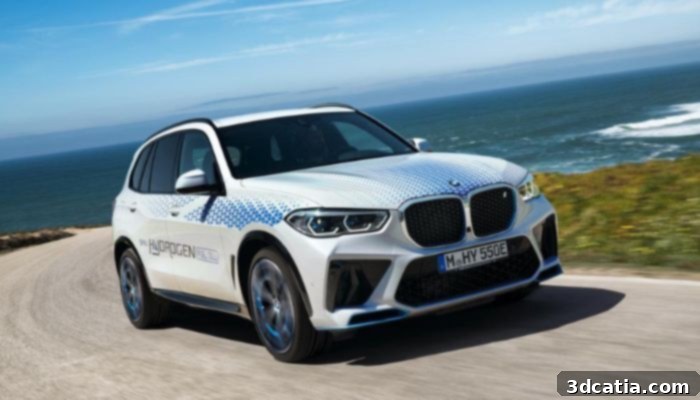
Photo Credits: BMW
Jane by Viba: A Motorcycle Redefining Craftsmanship with AM
The French company Viba exemplifies a deep appreciation for additive manufacturing, strategically employing it to produce certain crucial components for its exquisitely refined motorcycles. Their acclaimed model, the Viba Jane, stands as a testament to this philosophy, notably featuring a striking 3D-printed aluminum fuel tank. This intricate part was meticulously designed and fabricated on a laser fusion machine, specifically one of the advanced systems from SLM Solutions. The fuel tank’s internal honeycomb structure is a brilliant application of design for additive manufacturing (DfAM), enabling a significant reduction in the total weight of the component while rigorously maintaining the necessary structural rigidity and strength crucial for a motorcycle. This approach not only optimizes performance but also contributes to the bike’s overall agility and handling. Beyond the innovative fuel tank, the Viba motorcycle is further enhanced with a 3D-printed mudguard and a custom front rack, both showcasing the design freedom and functional benefits that additive manufacturing provides. The integration of 3D printing by Viba represents a harmonious blend of traditional motorcycle craftsmanship with cutting-edge technological innovation, allowing for the creation of unique, performance-optimized, and visually stunning components that elevate the motorcycle’s engineering and aesthetic appeal.
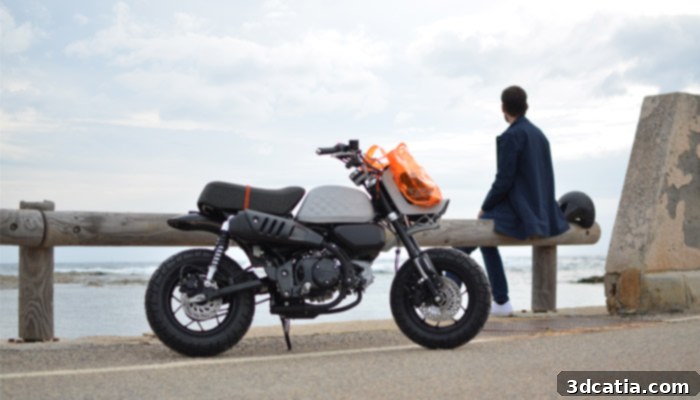
The rapid evolution of 3D printing is undeniably transforming the automotive landscape, opening doors to unprecedented levels of innovation, customization, and performance. From luxury brands like Aston Martin and Cadillac pushing the boundaries of design to performance powerhouses like Porsche and Ducati optimizing critical components, and even mainstream brands like Ford and Peugeot empowering consumer customization, additive manufacturing is proving its versatility and value. Companies like Divergent Technologies are redefining vehicle architecture with entirely 3D printed supercars, while specialized firms like Campsite Carbon cater to niche markets with robust, custom parts. As highlighted by projects from BMW and Toyota, 3D printing is not just about creating novel designs but also about enhancing efficiency, reducing waste, and contributing to a more sustainable future for mobility. The examples showcased here are just a glimpse into the profound impact of this technology, underscoring its role in shaping the vehicles of today and tomorrow. What are your thoughts on these groundbreaking 3D-printed vehicles? Share your insights and comments below, or connect with us on our Facebook and Twitter pages. Don’t forget to sign up for our free weekly newsletter to stay updated with all the latest news and developments in 3D printing, delivered directly to your inbox!