

Fizik Argo Adaptive: Revolutionizing Cycling Comfort with 3D Printed Saddles
Fizik, a distinguished Italian bicycle equipment brand renowned for its high-performance saddles and cycling shoes, and a proud member of the esteemed Selle Royal group, has recently unveiled a groundbreaking advancement in bicycle component design. The company has introduced an innovative concept of modular saddles for its acclaimed Argo series, capturing significant attention within the cycling community. What makes this new offering particularly noteworthy is its entirely 3D-printed shell, meticulously crafted using the cutting-edge Digital Light Synthesis (DLS) process developed by the pioneering additive manufacturing company, Carbon. Available in various configurations, the Argo Adaptive saddle leverages an advanced lattice structure, a hallmark of 3D printing capabilities, to deliver an unparalleled combination of comfort and performance to cyclists. This innovative design also achieves significant weight optimization, making it an attractive option for serious riders. For instance, the 140 mm wide version, equipped with lightweight carbon rails, boasts an impressive weight of merely 190 grams, setting a new benchmark for high-performance cycling saddles.
The past few years have witnessed an extraordinary acceleration in projects integrating additive manufacturing into bicycle design, particularly for crucial components like the saddle. The bicycle saddle is arguably one of the most vital elements for any cyclist, directly impacting comfort, stability, and overall riding efficiency. By embracing advanced 3D printing technologies for the design and production of this fundamental component, leading brands like Fizik are able to offer superior seating solutions that translate into enhanced stability and greatly improved comfort for riders across all disciplines. This significant leap forward is largely attributable to the intelligent application of topology optimization. This sophisticated design methodology allows engineers to meticulously minimize the amount of material used in a component based on the specific load distribution and forces exerted upon it. Consequently, it enables a dramatic reduction in the weight of a particular part while simultaneously maximizing its structural strength and durability, resulting in a product that is both lighter and more resilient than traditionally manufactured alternatives.
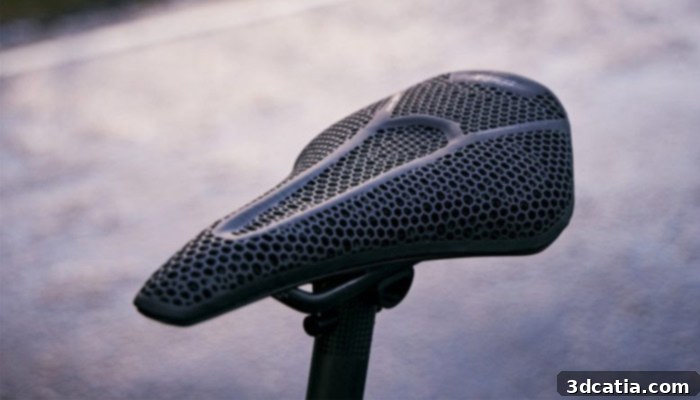
Photo Credits : Fizik
Unlocking Superior Comfort and Performance: Features of the Fizik Argo Adaptive Saddle
For the development of its revolutionary Argo Adaptive saddle, Fizik strategically opted to utilize Carbon’s state-of-the-art photopolymerization technology, specifically its Digital Light Synthesis (DLS) process. This choice was a natural progression of a long-standing collaboration between the two innovative companies, which began in 2019. Together, Fizik and Carbon embarked on a mission to create the Argo Adaptive, a bike saddle that masterfully fuses Fizik’s extensive expertise in cycling ergonomics and design with the advanced functional capabilities of Carbon’s Design Engine software. This sophisticated online platform acts as an automated generator for complex lattice structures, enabling rapid and efficient creation of highly optimized designs. The synergistic partnership allowed the design teams to engineer a saddle featuring optimal, finely tuned zonal damping, precisely tailored to absorb and distribute loads exerted by the rider in various positions.
The intrinsic brilliance of this design lies in its adaptability. Regardless of the rider’s posture—whether aggressively leaned forward in an aerodynamic position, upright during a climb, or cruising—or the specific position of their sit bones, the unique lattice structure of the saddle intelligently conforms to provide consistent support and comfort. This dynamic adaptation ensures that the Argo Adaptive saddle effectively relieves pressure points, a common issue for cyclists, particularly during strenuous uphill efforts and prolonged periods in aerodynamic tucks. By mitigating these pressure points, the saddle significantly enhances blood flow, reduces numbness, and ultimately contributes to greater endurance and a more enjoyable riding experience. The precise control over material properties at a microscopic level, afforded by DLS technology and lattice design, allows for regions of varying stiffness and compliance, providing targeted support where it’s most needed and flexibility where shock absorption is paramount.
Delving deeper into the specifications of this innovative saddle, Fizik offers two distinct models within the Argo Adaptive range: the R1 and the R3. Each model caters to slightly different preferences regarding weight, material, and price point, ensuring a broader appeal to various types of cyclists. The R1 model, positioned as the lighter, performance-oriented option, features premium carbon rails. Carbon fiber is renowned for its exceptional strength-to-weight ratio, making it an ideal choice for riders seeking to minimize every possible gram. The R1 is available in two popular width options: 140 mm and 150 mm, accommodating a range of anatomical preferences. Cyclists can expect approximate weights of around 190 grams for the 140 mm version and a mere 196 grams for the 150 mm variant, underscoring its ultra-lightweight design.
In contrast, the R3 model is equipped with Kium rails. Kium is a proprietary alloy developed by Fizik, offering an excellent balance of strength, durability, and a more accessible price point compared to carbon. While slightly heavier than its carbon-railed counterpart, the R3 still represents a highly competitive option in terms of performance and comfort, particularly given the benefits of its 3D-printed shell. The 140 mm version of the R3 weighs 224 grams, and the 150 mm version comes in at 230 grams. This marginal increase in weight is often a worthwhile trade-off for many cyclists who prioritize durability and value. Regarding pricing, the premium R1 model is available for €299, reflecting its advanced materials and cutting-edge technology. The R3 model, offering a superb blend of performance and affordability, is priced at €259, making the innovative Argo Adaptive technology accessible to a wider audience of riders. These distinct options allow cyclists to choose the saddle that best aligns with their budget, performance aspirations, and specific riding requirements, all while benefiting from the unparalleled comfort and ergonomic advantages of 3D printing.
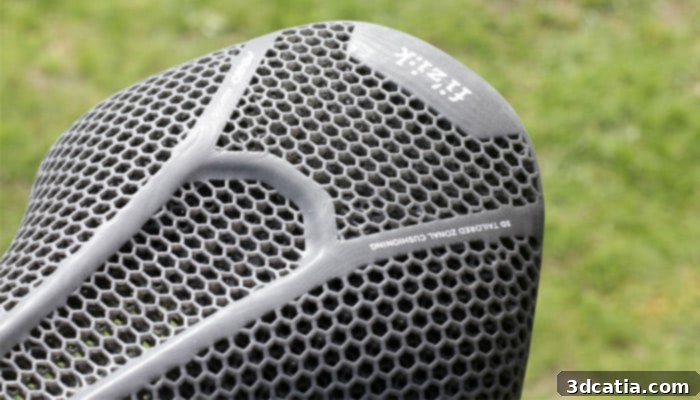
The saddle was made using a 3D printing process with optimal zone damping (photo credits : Fizik)
The Fizik Argo Adaptive saddle stands as yet another compelling example of the transformative possibilities offered by additive manufacturing. This technology is not merely an incremental improvement but a paradigm shift, enabling engineers to overcome the traditional constraints of conventional manufacturing methods. With 3D printing, complex geometries like the lattice structures employed in the Argo Adaptive become not only feasible but also highly optimized, leading to products that are inherently superior in terms of function, weight, and customization potential. The rapid pace of innovation in additive manufacturing promises a future where cycling components are not just mass-produced but are increasingly personalized, tailored to the unique biomechanics and preferences of individual riders.
This ability to create bespoke components will revolutionize how professional athletes and even recreational riders approach equipment selection, moving towards truly optimized setups. Furthermore, the iterative design process facilitated by 3D printing allows for quicker prototyping and testing cycles, significantly reducing the time from concept to market for groundbreaking products. The environmental benefits are also noteworthy; additive manufacturing often results in less material waste compared to subtractive methods, contributing to more sustainable production practices. The Fizik Argo Adaptive is a testament to this evolution, showcasing how design freedom, material science, and manufacturing innovation converge to deliver tangible benefits for cyclists everywhere, setting a new standard for comfort and performance in the cycling world.
We highly encourage you to explore the full range of Fizik’s innovative products and discover the perfect saddle that will elevate your cycling experience by visiting the official Fizik website. What are your thoughts on the revolutionary Argo Adaptive saddle and the role of 3D printing in modern cycling? We invite you to share your insights and comments below, or engage with us on our vibrant social media platforms: LinkedIn, Facebook, and Twitter! Don’t miss out on the latest advancements and news from the world of 3D printing; make sure to sign up for our free weekly Newsletter here, delivering the most up-to-date information directly to your inbox! For more visual content and in-depth discussions, you can also find all our videos on our dedicated YouTube channel.