

Navigating the Labyrinth: EU Regulatory Challenges for Medical 3D Printing Innovation
The landscape of healthcare is being rapidly transformed by medical 3D printing, a technology that promises unprecedented customization, efficiency, and innovation in device manufacturing and patient care. This burgeoning market has experienced exponential growth in recent years, particularly within the European Union. Forecasts indicate that the overall healthcare additive manufacturing (AM) market in the EU is projected to achieve a robust Compound Annual Growth Rate (CAGR) of 15.4% through 2029. This impressive trajectory is not merely speculative; concrete data from the European Patent Office last year revealed that international patent families related to 3D printing technologies grew at a remarkable annual rate of 26.4% in the region. Significantly, nearly one-fifth of these patents filed between 2001 and 2020 were specifically within the healthcare sector, underscoring the profound impact and potential of AM in medicine.
Despite this undeniable momentum and technological promise, certain underlying factors appear to be impeding the full realization of medical 3D printing’s potential within the EU. New research sheds light on these critical hurdles. Dr. Marc Mimler, a Senior Lecturer in Law at The City Law School, along with a team of collaborators from diverse backgrounds—including university hospitals and mechanical engineering departments—has published a significant article titled “Core Legal Challenges for Medical 3D Printing in the EU.” This comprehensive study delves into the intricacies of existing EU legislation and case law, particularly focusing on the Medical Device Regulation (MDR), and its implications for 3D printed devices. The research meticulously examines issues pertaining to both pre-market approval and post-market liability for these innovative medical tools. The findings suggest that persistent ambiguities and ‘gray areas’ within the current regulatory framework are indeed acting as significant inhibitors to the sustained growth and wider adoption of medical 3D printing, highlighting an urgent need for greater clarity and updated guidance.
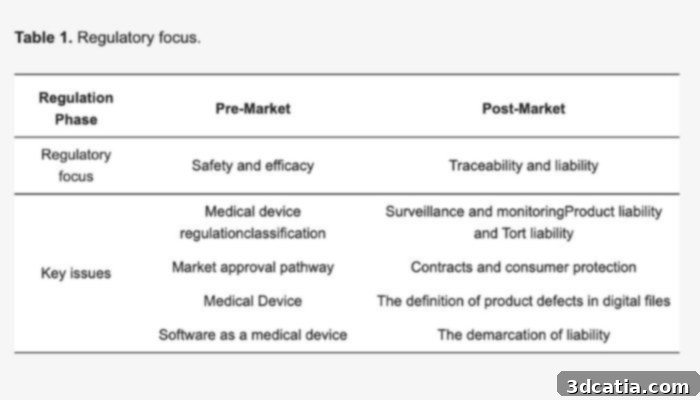
The research specifically investigates the complexities of pre-market approval and post-market liability within EU regulations for 3D printed medical devices (image credits: Mimler et al.).
Unpacking EU Regulations: A Double-Edged Sword for Medical 3D Printing
The detailed results of Dr. Mimler’s study, as disseminated in a press release from The City Law School, are systematically categorized by their relevance to either pre-market or post-market regulatory status. This clear division allows for a focused analysis of the specific challenges encountered at each stage of a medical device’s lifecycle. Understanding these distinctions is crucial for policymakers, innovators, and healthcare providers alike.
Pre-Market Approval: The Conundrum of Customization
When examining pre-market regulations, the researchers placed particular emphasis on the EU’s ‘Custom Device Exemption.’ This exemption is designed to streamline the process for medical devices that are manufactured specifically according to a written prescription from an authorized healthcare professional. Theoretically, this provision allows such devices to bypass certain stringent requirements, including the prominent CE marking. At first glance, this exemption appears to be a significant advantage for the additive manufacturing sector, which excels in producing highly personalized items. However, a closer look reveals a substantial ‘gray area’ that complicates matters for 3D printed medical devices.
The core issue arises because ‘patient-matched’ devices—those uniquely created for an individual patient based on their specific anatomy or medical needs—do not unequivocally fall under the ‘Custom Device Exemption.’ This distinction is critical because while the exemption is intended for truly bespoke devices, the nuanced definition often leaves room for interpretation. This lack of clear inclusion creates considerable uncertainty regarding the regulatory pathway for a vast number of 3D printed medical products. The problem is further exacerbated by the fact that this specific distinction is not uniformly applied to ‘mass-customized’ devices, which might be produced in larger batches but still offer a degree of personalization based on pre-defined parameters. This inconsistency adds another layer of complexity, making it challenging for manufacturers to navigate the regulatory landscape and predict compliance requirements for their innovative products.
Consequently, regulatory compliance for devices produced using additive manufacturing remains shrouded in ambiguity. This uncertainty directly impacts research and development, investment decisions, and ultimately, the speed at which these innovative solutions can reach patients. The confusion is further compounded by another critical exemption: the MDR’s ‘Health Institution Exemption.’ While this provision allows industrial manufacturing of 3D printed devices within health institutions and hospitals to be exempt from certain aspects of the MDR, its scope is limited. Crucially, this exemption does not extend to other companies, particularly smaller enterprises or specialized additive manufacturing service bureaus that play a vital role in the medical supply chain. This creates a significant competitive disadvantage and regulatory hurdle, making it exceptionally difficult for independent institutions and smaller companies to effectively navigate the complex regulatory environment necessary for producing tailored 3D printed devices. The result is a fragmented regulatory scene where large healthcare systems might have an easier path, while smaller, agile innovators face prohibitive compliance burdens, potentially stifling a broader ecosystem of innovation.
Post-Market Regulations: Navigating Liability in a Decentralized World
Beyond the complexities of pre-market approval, the study also highlights significant ambiguities in post-market regulations for 3D printing within the healthcare sector. The EU’s Medical Device Regulation (MDR) adopts a particularly rigorous approach to the surveillance and monitoring of medical devices once they have entered the market. This includes stringent requirements for post-market surveillance, vigilance, and field safety corrective actions. However, when applied to 3D printed devices, these rigorous standards introduce considerable confusion, especially concerning product liability.
The core of this confusion lies in the blurred boundary between medical negligence and product defect. In traditional manufacturing, the identity of the manufacturer is typically clear, and liability can be assigned accordingly. For 3D printed devices, however, the process is often highly decentralized and collaborative. A device might be designed by one entity, printed by another (perhaps even in-house at a hospital), with materials supplied by a third party, and implanted by a surgeon who also might have modified the design. This distributed nature makes it exceedingly difficult to definitively identify ‘the manufacturer’ in the event of a defect or adverse outcome. If a device fails post-implantation, determining whether it was due to a design flaw, a material defect, an error in the printing process, or a surgical misstep becomes a complex legal and technical challenge. This uncertainty surrounding liability creates a significant deterrent for all parties involved in the 3D printing ecosystem.
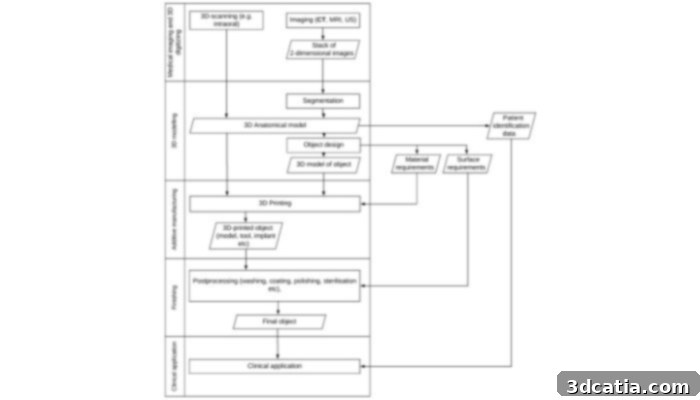
The inherently decentralized nature of the manufacturing process for many 3D printed medical devices (as illustrated above) introduces significant complexities and potential issues for effective post-market regulation and liability assignment (image credits: Mimler et al.).
The authors convincingly argue that this pervasive uncertainty directly stifles innovation within the field. Without clear guidelines on who bears responsibility, various stakeholders—including surgeons, third-party manufacturers, in-house hospital manufacturers, material suppliers, and software developers—face an elevated and ill-defined risk of being held liable for any defects or complications following the implantation of a 3D printed device in a patient. This heightened risk discourages investment in new technologies, slows down the development cycle, and can make innovators hesitant to bring their products to market. Furthermore, the confusion extends beyond liability. Ambiguities surrounding data protection laws, particularly concerning sensitive patient-specific data used in personalized device design, and intellectual property rights in a collaborative and iterative design process only serve to complicate the regulatory landscape further. Who owns the design? Who is responsible for ensuring data privacy during the entire workflow?
The Call for Clarity: Reforming MDR for Future Innovation
In summation, the researchers’ findings underscore a critical need to re-evaluate what they identify as overly conservative and ambiguous requirements within the existing Medical Device Regulation, particularly as these apply to 3D printed devices. They contend that the current regulatory system, in its present form, is inadvertently hindering the very innovation it should be fostering. The extensive documentation requirements and the lack of clarity are demonstrably delaying the time-to-market for promising new medical technologies, consequently postponing access to potentially life-changing care for patients across the EU. This regulatory friction means that many medical actors and innovators struggle to effectively navigate the intricate landscape for tailored devices, often leading to prolonged development cycles, increased costs, and a reluctance to fully embrace the transformative potential of additive manufacturing in healthcare.
The study serves as a crucial wake-up call, emphasizing that a tailored and forward-thinking regulatory framework is essential for the EU to maintain its competitive edge in medical technology and ensure that patients benefit from the latest advancements. Without clearer, more adaptable guidelines that specifically address the unique characteristics of 3D printing – its customization capabilities, decentralized production models, and complex supply chains – the region risks falling behind in this critical sector. Moving forward, a collaborative effort involving policymakers, medical professionals, industry experts, and legal scholars will be vital to reform and update the MDR, paving the way for a more agile and innovation-friendly environment for medical 3D printing. You can delve deeper into the comprehensive analysis and recommendations in the full paper, accessible HERE.
What are your thoughts on these critical findings regarding EU regulations and their impact on medical 3D printing? The challenges outlined by Dr. Mimler and his team highlight a pivotal moment for policy discussions and industry collaboration. We invite you to share your insights and opinions in a comment below or join the conversation on our LinkedIn, Facebook, and Twitter pages! Don’t miss out on the latest advancements and news in additive manufacturing—remember to sign up for our free weekly newsletter here to receive the most relevant 3D printing updates directly in your inbox. Additionally, you can explore all our engaging video content and interviews on our dedicated YouTube channel. Your engagement helps foster a more informed and collaborative community!