
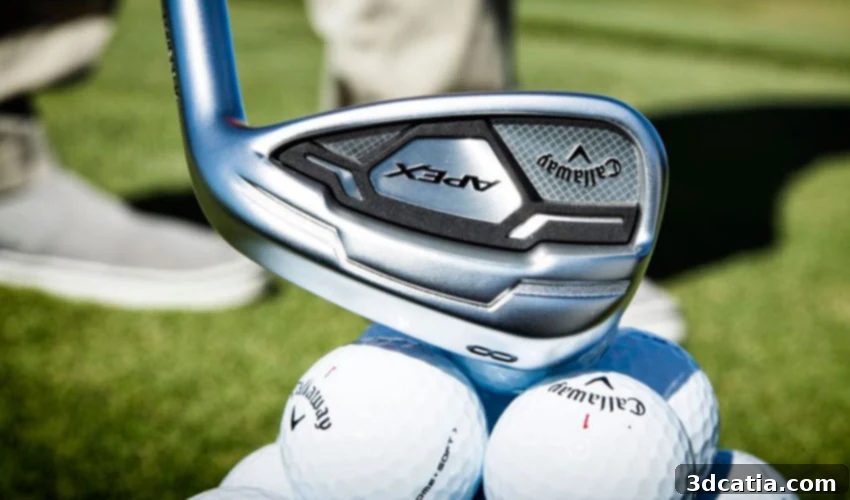
Titomic and Callaway Golf Forge Alliance: Revolutionizing Golf Clubs with Advanced Metal 3D Printing Technology
In a significant development poised to transform the sports equipment landscape, Titomic, a pioneering Australian additive manufacturing company, has officially announced a strategic partnership with Callaway Golf, one of the world’s most renowned and largest manufacturers of golf clubs. This collaboration marks a pivotal moment, as Titomic brings its unparalleled expertise in advanced metal additive manufacturing to the United States. The primary objective of this alliance is to leverage cutting-edge 3D printing technologies to design, develop, and produce golf clubs that are not only more innovative but also demonstrably superior in performance, ultimately setting new benchmarks for success on the green.
Additive manufacturing, commonly known as 3D printing, has increasingly established itself as a cornerstone of innovation across various sports sectors. Its inherent capabilities foster a new paradigm of creativity, enabling the development of equipment that is both highly efficient and, in many cases, more cost-effective to produce over time. The personalized nature of 3D printing allows for tailor-made solutions, granting athletes the immense benefit of equipment precisely adapted to their unique physiological needs, playing styles, and performance aspirations. From customized footwear to specialized protective gear, AM is reshaping how athletes interact with their tools, pushing the boundaries of what’s possible in competitive sports.
Golf’s Embrace of 3D Printing: A New Era of Custom Club Design
The sport of golf, with its relentless pursuit of precision, power, and personalized feel, is no exception to this technological revolution. The advent of 3D printing has empowered golf club manufacturers to reimagine traditional design and production methods. This technology facilitates the creation of exceptionally lightweight equipment with intricate geometries previously unattainable through conventional manufacturing processes. Furthermore, these sophisticated designs can now be conceptualized, prototyped, and brought to production in record time, significantly accelerating the innovation cycle. The ability to iterate quickly and test various designs with unparalleled speed offers a distinct competitive advantage in a market driven by marginal gains.
A prime example of this transformative impact can be seen in French startup Grismont. This luxury brand has carved out a unique niche by offering custom-made golf club heads, a testament to the power of 3D printing in delivering highly personalized, premium products. For a brand positioned in the luxury market, the ability to create bespoke components that perfectly match a client’s aesthetic and performance requirements is a strong selling point, differentiating them from mass-produced alternatives. These custom heads allow for precise weight distribution, optimized aerodynamics, and unique aesthetic features that cater to the discerning golfer, elevating their game and their style.
The intricate and customized 3D printed heads of Grismont clubs exemplify the precision and design freedom unlocked by additive manufacturing in golf.
Titomic Kinetic Fusion: Pioneering Metal Additive Manufacturing for Golf
The current collaboration sees American golf giant Callaway Golf actively seeking the innovative capabilities of Titomic to engineer superior golf clubs. At the core of Titomic’s groundbreaking offering is the Titomic Kinetic Fusion (TKF) 3D metal printing process. This proprietary technology, meticulously developed in close collaboration with the Commonwealth Scientific and Industrial Research Organisation (CSIRO), represents a significant leap forward in metal additive manufacturing. Specifically optimized for the 3D printing of titanium components, the TKF process utilizes a revolutionary cold gas spray technique. This method allows for the application of titanium particles onto a base structure at supersonic speeds, fusing them together to create robust, dense, and load-bearing parts without melting the metal. This ‘cold’ process significantly reduces material stress and distortion, leading to components with superior mechanical properties and structural integrity.
Titanium, renowned for its exceptional strength-to-weight ratio, corrosion resistance, and biocompatibility, is an ideal material for high-performance golf clubs. The ability to precisely control the internal structure and weight distribution of titanium components using TKF opens up unprecedented design possibilities for Callaway. While the exact products Titomic will be manufacturing for Callaway Golf have not yet been publicly disclosed, this strategic partnership is poised to significantly accelerate the evolution of additive manufacturing within the golf sector. It will serve as a crucial test case, providing valuable insights into whether advanced 3D technologies can fundamentally disrupt and redefine this competitive market, moving beyond niche applications to mainstream production.
The potential impact extends beyond just new club designs. The speed and flexibility offered by additive manufacturing could lead to shorter product development cycles, enabling Callaway to bring new innovations to market faster than ever before. Furthermore, the capacity for on-demand production and customization could revolutionize inventory management and supply chain logistics within the golf industry. This is not entirely uncharted territory; pioneering efforts such as Krone Golf’s initiative to create a 3D printed golf club last year demonstrated the feasibility and potential of such applications, laying the groundwork for larger-scale ventures like the Titomic-Callaway collaboration.
Strategic Vision: Insights from Titomic’s Leadership
Jeff Lang, CEO and CTO of Titomic, articulated the company’s enthusiasm and strategic vision behind this alliance. “We are very pleased to announce this collaborative agreement with the world’s largest golf club manufacturer,” stated Lang. “This agreement establishes a strategic alliance with the intention of incorporating our Titomic Kinetic Fusion additive manufacturing process into the manufacturing of golfing accessories and will be carried out at our new state-of-the-art Melbourne facility which houses the world’s largest 3D metal printer.” This statement underscores not only the significance of partnering with an industry leader like Callaway but also highlights Titomic’s commitment to leveraging its cutting-edge technology and substantial production capabilities.
The mention of the “world’s largest 3D metal printer” is particularly noteworthy. It signals Titomic’s capacity for large-scale industrial production, a critical factor for a partnership with a global manufacturer like Callaway. This facility in Melbourne represents a significant investment in advanced manufacturing infrastructure, allowing Titomic to not only prototype but also produce substantial quantities of complex metal components. This scale of operation positions Titomic as a key player in driving the industrial adoption of metal additive manufacturing, demonstrating that 3D printing has matured beyond small-batch, high-cost applications to become a viable solution for demanding industrial requirements.
Titomic’s colossal 3D printer, capable of producing parts up to 9 x 3 x 1.5 meters, showcases its unmatched industrial-scale metal additive manufacturing prowess.
Redefining Industrial Scale: Titomic’s Vision for Additive Manufacturing
Indeed, the Titomic 3D printer boasts an impressive build volume, capable of creating parts measuring up to 9 x 3 x 1.5 meters. This gargantuan capacity is significantly more generous than that offered by many other leading industrial systems, including GE Additive’s ATLAS machine, which itself is considered a large-format printer. This expansive build envelope positions Titomic at the forefront of large-scale metal additive manufacturing, enabling the production of much larger components or multiple smaller parts in a single build cycle. Such scale is crucial for industries requiring substantial structures, offering new possibilities for aerospace, defense, marine, and, crucially, sports equipment manufacturing.
The Australian manufacturer’s overarching objective is to fundamentally disrupt and expand the entire metal additive manufacturing sector. By offering unparalleled scale and speed through its Kinetic Fusion technology, Titomic aims to unlock a broader spectrum of opportunities for manufacturers across various industries. This includes not only enabling the creation of previously impossible designs but also accelerating prototyping, reducing material waste, and streamlining supply chains. The partnership with Callaway Golf serves as a powerful demonstration of how industrial-scale 3D metal printing can be practically applied to deliver tangible competitive advantages in high-performance product categories, heralding a future where complex, custom-engineered components become standard across numerous consumer and industrial goods.
This alliance between Titomic and Callaway Golf signifies a landmark moment for both additive manufacturing and the sporting goods industry. It solidifies the position of 3D printing as a mature, industrial-grade technology capable of delivering tangible performance enhancements and strategic advantages. As these technologies continue to evolve, the future of personalized, high-performance golf clubs – and indeed, sports equipment across the board – looks set for an era of unprecedented innovation, driven by the precision and versatility of advanced manufacturing.
For more detailed information on Titomic’s groundbreaking technology and strategic initiatives, please visit their official website.