

Pioneering Space: BEAMIT’s NASA-Qualified 3D Printed Parts Propel International Space Station Missions
In a landmark advancement for both additive manufacturing and space exploration, BEAMIT, a renowned Italian service bureau at the forefront of Metal Additive Manufacturing solutions, has officially announced its pivotal role in supplying NASA-qualified AlSi7Mg 3D printed components for the International Space Station (ISS). This significant collaboration underscores BEAMIT’s technical prowess and strategic importance within the aerospace sector. More precisely, the company’s high-performance parts will contribute to the ongoing success of the Cygnus program, a vital initiative dedicated to resupplying the ISS and pushing the boundaries of human presence in outer space. This development not only highlights NASA’s unwavering commitment to embracing advanced manufacturing techniques, particularly metal additive manufacturing, but also reinforces the technology’s critical role in ensuring the safety, efficiency, and sustainability of future space endeavors.
The Cygnus Program: A Lifeline for the International Space Station
The Cygnus program, managed by Northrop Grumman and developed in partnership with NASA, serves as an indispensable lifeline for the International Space Station. Since its inception in 2013, the program has consistently enabled the crucial refueling and resupply of the ISS through uncrewed Cygnus spacecraft. These robust cargo vehicles regularly ferry essential supplies, scientific equipment, and spare parts to the orbiting laboratory, sustaining its operations and supporting the vital work of astronauts aboard. The reliable delivery of these provisions has been instrumental in facilitating the successful completion of countless scientific experiments within the unique microgravity environment of the space station. These experiments span a wide array of disciplines, from biology and physics to materials science and human health, significantly broadening humanity’s understanding of our universe and the impact of space on living organisms.
Beyond routine resupply, the Cygnus missions are strategically paving the way for the ambitious revival of deep space exploration. The insights gained and technologies tested through ISS operations, heavily supported by such cargo missions, are directly contributing to the development of future long-duration missions to the Moon and Mars. A fascinating aspect of these missions involves pioneering research into the application of 3D printing in space itself. Scientists and engineers are actively investigating the potential use of in-situ resources, such as rock and soil found on the surface of planetary bodies like the Moon, to construct essential infrastructure. This includes innovative concepts for creating shelters and habitats directly in extraterrestrial environments, which could dramatically reduce the cost and complexity of establishing permanent human outposts.
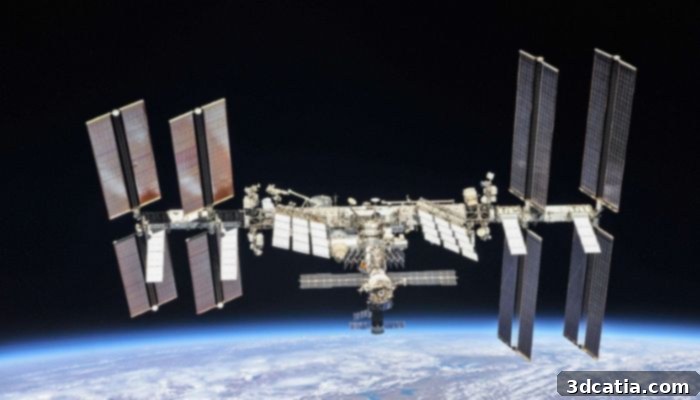
Photo Credits: Epa/Nasa
BEAMIT’s Cutting-Edge Contribution: NADCAP-Certified Metal AM Parts
For this critical project, BEAMIT leveraged its extensive expertise in metal additive manufacturing to provide essential 3D printed components. These intricate parts were produced using Laser Powder Bed Fusion (LPBF), a highly precise additive manufacturing technique recognized for its ability to create complex geometries with superior mechanical properties from metal powders. The material chosen for these space-grade components is AlSi7Mg, a high-strength aluminum alloy known for its excellent strength-to-weight ratio, corrosion resistance, and thermal performance – properties that are absolutely crucial for components operating in the extreme conditions of space. Furthermore, BEAMIT’s commitment to quality is evidenced by the NADCAP certification of these AlSi7Mg components, a globally recognized accreditation for aerospace and defense manufacturing processes. This certification guarantees that the parts meet the most stringent quality and reliability standards required for critical aerospace applications.
Remarkably, the 3D printed parts supplied by BEAMIT not only meet but also significantly exceed NASA’s minimum material requirements, particularly in terms of fatigue data. Fatigue resistance is a paramount concern for spacecraft components, which must endure repeated stresses from launch vibrations, thermal cycling, and continuous operation in orbit. By surpassing these rigorous fatigue benchmarks, BEAMIT has demonstrated a profound mastery of additive manufacturing processes and material science, solidifying the technology’s capability to deliver components with exceptional durability and longevity. This achievement represents a major leap forward for technological advancements in space applications, showcasing the potential of metal AM to unlock new levels of performance and reliability for the aerospace industry.
A Symphony of Expertise: Collaboration for Space Excellence
The success of such a complex and critical endeavor is rarely the result of a single entity. In manufacturing these highly specialized parts for the Cygnus program, BEAMIT engaged in a strategic collaboration with several key industry players: Telema, Blu Electronic, and Thales Alenia Space. This multi-company partnership exemplifies the collaborative spirit essential for pushing the boundaries of aerospace engineering, ensuring the highest levels of quality, innovation, and reliability for the program. Thales Alenia Space, a joint venture between Thales and Leonardo, is a major European satellite manufacturer and a critical contributor to space infrastructure, bringing immense experience in spacecraft design and integration to the table. The synergy among these partners allowed for a comprehensive approach, combining BEAMIT’s additive manufacturing leadership with their partners’ expertise in electronics, systems integration, and space-qualified components.
Mauro Antolotti, President of BEAMIT, eloquently articulated the significance of this partnership: “Our collaboration with Telema, Blu Electronic and Thales Alenia Space represents a milestone in the aerospace industry. BEAMIT’s expertise in additive manufacturing, combined with the contributions of our valued partners and NADCAP-qualified components, will elevate the Cygnus program to new levels of innovation and efficiency.” This statement not only underscores the strategic importance of combined forces but also highlights how integrating advanced manufacturing with traditional aerospace expertise creates a robust framework for overcoming the unique challenges of spaceflight. The collective knowledge and stringent quality controls from all parties ensured that the 3D printed metal components would perform flawlessly under the most extreme conditions.
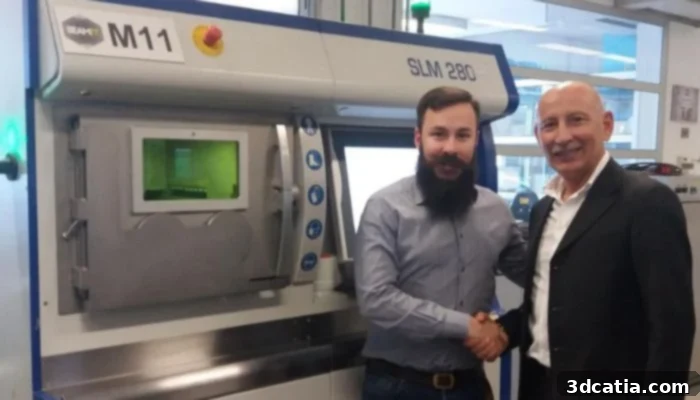
Mauro Antolotti, CEO of BEAMIT (right) and Michele Antolotti, the general manager (photo credits: SLM Solutions)
Exceeding NASA Requirements: Robust, Lighter, and Technologically Advanced
The integration of BEAMIT’s NADCAP-qualified AlSi7Mg components into the Cygnus program is set to yield substantial benefits for the spacecraft. These advanced 3D printed parts contribute to the development of more robust, significantly lighter, and technologically superior spacecraft. Lightweighting is a primary objective in aerospace design, as every kilogram saved translates directly into reduced launch costs and increased payload capacity. Additive manufacturing excels in this regard, enabling optimized designs with complex internal structures that maximize strength while minimizing material usage. Furthermore, the ability to consolidate multiple parts into a single, intricately designed 3D printed component reduces assembly time, decreases the risk of failure points, and simplifies supply chain logistics – all critical advantages for space missions.
Ensuring the utmost reliability for space-bound hardware, all 3D printed components underwent rigorous testing and qualification by NASA itself. This exhaustive qualification process typically involves a battery of tests simulating the incredibly harsh environmental conditions encountered in space exploration. These include extreme temperature fluctuations (from cryogenic cold to scorching heat), vacuum exposure, intense vibration and acoustic testing during launch, radiation exposure, and microgravity effects. Such stringent verification protocols guarantee the unwavering reliability and longevity of the components, ensuring they perform as expected throughout their operational lifespan, even in the unforgiving vacuum and radiation-filled expanse of space.
A Testament to Metal AM’s Evolution and BEAMIT’s Vision
This groundbreaking partnership between BEAMIT and NASA, facilitated by the Cygnus program, serves as a powerful testament to the significant strides made in metal additive manufacturing technology and quality assurance. The rapid evolution of AM processes, coupled with stringent certification standards like NADCAP, has propelled this technology from prototyping tool to a critical manufacturing method for high-stakes applications, particularly within the rapidly expanding field of space. It underscores that 3D printing is no longer a niche technology but a mainstream, industrial-grade solution capable of meeting the most demanding specifications.
Moreover, this achievement firmly solidifies BEAMIT’s commitment and strategic interest in establishing itself as a global leader in advanced manufacturing for the aerospace sector. Through continuous investment in cutting-edge aerospace projects and pioneering technologies, the Italian company is not only contributing to humanity’s ongoing quest for space exploration but also showcasing the vast potential of additive manufacturing to an international audience. BEAMIT’s success with NASA positions it at the forefront of a technological revolution, inspiring further innovation and demonstrating the transformative impact that advanced manufacturing can have on critical industries worldwide.
What are your thoughts on this latest news from BEAMIT and NASA? How do you envision the future of 3D printing in space? Let us know in a comment below or join the conversation on our LinkedIn, Facebook, and Twitter pages! Don’t forget to sign up for our free weekly Newsletter here to get the latest 3D printing news straight to your inbox! You can also find all our insightful videos on our YouTube channel, offering deeper dives into the world of additive manufacturing.
*Cover Photo Credits: Cygnus Aircraft, Thales Alenia Space