
Unveiling the Future: Top 5 Additive Manufacturing Videos Transforming Industries
Welcome to another exciting week where we delve into the dynamic world of additive manufacturing, bringing you a fresh collection of five captivating videos. This week’s compilation showcases the immense versatility and groundbreaking applications of 3D printing technology, offering vibrant insights into how it’s revolutionizing diverse sectors. From the ambitious large-scale construction of 3D printed homes in Georgetown, Texas, to the intricate manufacturing processes enabling lighter aircraft, and the precision of 3D scanning for iconic sports cars, these videos provide a comprehensive look at the cutting edge. We’ll also explore a detailed review of a popular new FDM 3D printer and witness the incredible potential of carbon fiber in action.
Additive manufacturing, often broadly referred to as 3D printing, is no longer a niche technology; it’s rapidly evolving into a foundational pillar for innovation across global industries. These handpicked videos are designed to inform, inspire, and keep you abreast of the latest trends, breakthroughs, and practical applications shaping our future. Whether you’re a seasoned expert, an enthusiastic hobbyist, or simply curious about how technology is changing the world, our weekly video roundup on our YouTube channel is your go-to source for interviews, product reviews, and an abundance of engaging content. So, settle in, explore these remarkable advancements, and stay connected with the vibrant pulse of the 3D printing universe. Let’s explore the future, one layer at a time!
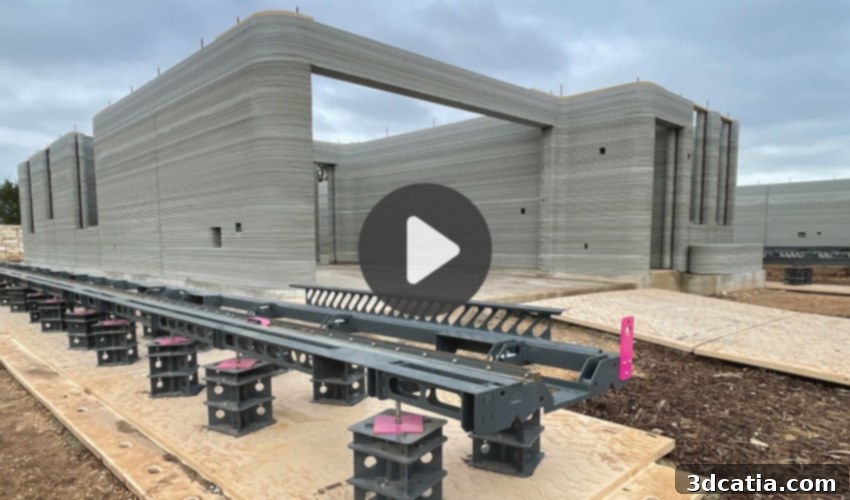
Top 1: 3D Printed Homes in Georgetown – A Glimpse into the Future of Construction
The construction industry, traditionally slow to adopt new technologies, is experiencing a transformative shift with the increasing integration of 3D printing. This year alone, we’ve witnessed a surge of impressive projects demonstrating the profound impact of additive manufacturing on how we build. From public infrastructure to residential developments, 3D printing offers a compelling array of advantages that address some of the most pressing challenges in modern construction, including speed, efficiency, sustainability, and design flexibility.
Globally, pioneering projects are showcasing this potential. Europe, for instance, is home to the continent’s largest 3D printed building in Heidelberg, Germany, a monumental structure that redefines scale in additive construction. Similarly, the SC Capelle soccer club boasts a 3D printed public building, exemplifying community-focused architectural innovation. Even in challenging environments, such as Ukraine, Europe’s first 3D printed school has opened its doors, highlighting the technology’s role in rapid, resilient reconstruction efforts.
Beyond public and commercial structures, the application of 3D printing in residential building construction is rapidly gaining momentum. While many current projects remain in conceptual or model stages, companies like ICON and Lennar are pushing the boundaries, transitioning from prototypes to fully habitable, large-scale communities. In a groundbreaking collaboration with BIG-Bjarke Ingels Group, they have unveiled The Genesis Collection – an innovative house park featuring an astounding 100 3D printed houses in Georgetown, Texas. This ambitious development is not just about quantity; it also integrates sustainability with solar panels on the roof of each home, ensuring a reliable and eco-friendly power supply.
The Genesis Collection represents a significant leap forward, showcasing how 3D printing in the construction industry can deliver tangible, scalable solutions to housing demands. These homes offer advantages ranging from enhanced structural integrity and energy efficiency to unprecedented design freedom, allowing for unique architectural forms that would be challenging or cost-prohibitive with traditional methods. For those eager to experience these revolutionary residences firsthand, virtual tours are now available, providing an immersive glimpse into the future of housing. With prices ranging between $475,000 and $590,000, these homes are not just technologically advanced; they are also competitively priced, further underscoring the potential of 3D printing as a practical and forward-looking solution for modern residential development. This successful implementation clearly demonstrates additive manufacturing’s capacity to address housing shortages and create sustainable, resilient communities on an unprecedented scale.
Top 2: Soaring Ahead – How 3D Printing Transforms Aviation with SHARK.AERO
The aerospace industry, with its stringent requirements for lightweight components, complex geometries, and superior performance, has found a powerful ally in additive manufacturing. This video takes viewers on an exhilarating journey inside the world of Czech aircraft manufacturer SHARK.AERO, showcasing how they are ingeniously leveraging 3D printing to revolutionize aircraft production. Their ambitious goal is to manufacture an impressive 50 3D printed aircraft annually, each designed to weigh a mere 350 kg, pushing the boundaries of what is possible in lightweight aviation.
SHARK.AERO’s strategic adoption of 3D printing technology has yielded significant benefits, most notably in dramatically reducing production time for complex components. The company has managed to save approximately 100 man-hours per component, a testament to the efficiency and speed that additive manufacturing brings to the workflow. This remarkable feat is achieved with the help of the Original Prusa MK4 FDM printer, a reliable and versatile machine that enables the creation of high-quality, functional parts. The use of FDM (Fused Deposition Modeling) allows for cost-effective prototyping and production of parts that would be challenging and time-consuming to produce with traditional methods.
Beyond direct aircraft parts, SHARK.AERO also employs additive manufacturing to create essential work tools, jigs, and molds. This internal application of 3D printing further streamlines their operations, allowing for rapid iteration of tools, quick replacement of worn-out components, and customized solutions tailored to specific manufacturing needs. By embracing 3D printing for both end-use parts and production aids, SHARK.AERO exemplifies a holistic approach to integrating additive manufacturing into their entire operational ecosystem.
The video provides a firsthand look at the fascinating process of crafting an aircraft using these advanced 3D printed components. It highlights how SHARK.AERO ingeniously harnesses the precision, flexibility, and material efficiency of 3D printing to develop cutting-edge aircraft. The advancements showcased here underscore the critical role of additive manufacturing in driving innovation, reducing lead times, enhancing fuel efficiency through lighter designs, and ultimately shaping the future of the aviation industry. This pioneering approach not only demonstrates significant cost and time savings but also opens up new possibilities for aircraft design and performance.
Top 3: Precision Unleashed – 3D Scanning a Porsche 911 for Bespoke Automotive Customization
In the dynamic world of automotive engineering, design, and customization, precision is paramount. This captivating video embarks on a fascinating journey into the realm of digital capture, as the powerful Einstar 3D scanner from Shining3D is introduced and rigorously tested by scanning none other than the iconic Porsche 911 sports car. The primary objective of this intricate process is to acquire highly accurate three-dimensional data, which will then serve as the foundation for creating tailor-made, custom parts for this cherished automobile.
The video meticulously showcases the precision and intricate detail capabilities of the Einstar 3D scanner. Viewers witness the scanner in action as it meticulously captures every curve, contour, and subtle design element of the Porsche 911. This process transforms a physical object into a detailed digital model, opening up a world of possibilities for reverse engineering, design iteration, and personalized automotive solutions. The ability to capture such fine details ensures that any subsequently designed parts will fit perfectly and seamlessly integrate with the vehicle’s existing structure and aesthetics.
This venture into personalized automotive engineering begins with the comprehensive scanning process, where millions of data points are collected to form a precise digital mesh. From this raw data, a sophisticated 3D model is generated, allowing designers and engineers to analyze, modify, and enhance components within a virtual environment. The next crucial step involves leveraging this digital blueprint to fabricate bespoke components. Whether it’s a custom aerodynamic spoiler, a uniquely designed interior console, or performance-enhancing engine parts, 3D printing and CNC machining can then bring these digital designs to life. The entire workflow, from initial scan to final fabrication, is highlighted, demonstrating how modern digital tools enable the creation of bespoke components that perfectly complement and elevate the performance and aesthetics of a cherished car like the Porsche 911.
Beyond customization, 3D scanning plays a crucial role in quality control, rapid prototyping, and even the restoration of classic cars where original parts are no longer available. This technology empowers enthusiasts and professionals alike to push the boundaries of automotive design and engineering, creating truly unique and high-performance vehicles. The Einstar 3D scanner’s performance in capturing the complex geometry of the Porsche 911 sets the stage for an exciting future where personalized and precision-engineered automotive solutions are more accessible than ever before.
Top 4: AnkerMake M5C – A Comprehensive Review of the Latest FDM 3D Printer
The consumer 3D printing market is constantly evolving, with new FDM (Fused Deposition Modeling) printers being launched regularly, promising faster speeds, higher quality, and improved user experiences. AnkerMake, a brand known for its innovative technology solutions, recently launched its AnkerMake M5C FDM printer. Since its release earlier this year, this printer has generated a remarkable amount of excitement and discussion across various online forums, social media, and enthusiast communities. But with all the positive buzz, a critical question arises: is the widespread enthusiasm surrounding this printer truly justified? Does the AnkerMake M5C genuinely live up to its reputation and the expectations it has set?
To thoroughly answer these questions and provide an unbiased perspective, this test video offers a comprehensive review of the AnkerMake M5C. A good printer review is essential for prospective buyers, as it cuts through marketing hype and provides real-world insights into a device’s performance, usability, and value. This particular review covers every critical aspect, starting from the moment the printer arrives at your doorstep: the unboxing experience, which often sets the first impression, followed by the setup process, a crucial step that can determine a printer’s accessibility for users of all skill levels. Ease of assembly and initial calibration are carefully examined, as these factors significantly impact the overall user journey.
Beyond the initial setup, the review delves into rigorous test printing. This involves evaluating print quality across different resolutions, speeds, and material types, assessing details like layer adhesion, surface finish, dimensional accuracy, and the printer’s ability to handle complex geometries such as overhangs and bridges. Furthermore, the video tackles a substantial printing project, pushing the AnkerMake M5C to its limits with a more demanding and time-consuming print. This larger project provides valuable insights into the printer’s long-term reliability, consistency, and its performance under sustained load – critical factors for anyone considering it for serious hobbyist use or even light professional applications.
Viewers can expect to gain all the essential details about the AnkerMake M5C, including its key features, specifications, potential strengths, and any limitations. This informative and insightful video aims to empower consumers with the knowledge needed to make an informed decision, ensuring that the AnkerMake M5C’s real-world performance aligns with its market reputation. Whether you’re a beginner looking for a reliable first printer or an experienced user seeking an upgrade, this review will help you understand if the AnkerMake M5C is the right tool for your 3D printing endeavors.
Top 5: Carbon Fiber in Action – Unlocking Superior Performance with Advanced Materials
In the realm of advanced materials, carbon fiber stands out as a true game-changer, renowned for its exceptional strength-to-weight ratio, stiffness, and durability. This incredibly robust yet lightweight material is transforming product development and manufacturing across a multitude of industries, from the high-performance demands of automotive and aerospace to the rigorous requirements of defense and industrial tooling. Its unique mechanical properties allow engineers and designers to create parts that are lighter, stronger, and more efficient than those made from traditional materials.
This fascinating video specifically showcases carbon fiber in action, demonstrating its versatile applications through the lens of UltiMaker, a leading name in desktop 3D printing. UltiMaker highlights how their customers are leveraging carbon fiber filaments for a wide array of upcoming projects, pushing the boundaries of what is achievable with additive manufacturing. The video vividly illustrates the material’s exceptional properties and its adaptability to diverse functional requirements. For instance, in the automotive sector, carbon fiber 3D printed components can significantly reduce vehicle weight, leading to improved fuel efficiency and enhanced performance. In defense, it enables the creation of lighter, more resilient equipment for soldiers and sophisticated unmanned systems.
The integration of carbon fiber into 3D printing, particularly through processes like FDM with specialized composite filaments, provides engineers with unprecedented freedom to design complex geometries that would be impossible or prohibitively expensive to produce with conventional manufacturing methods. This allows for rapid prototyping of functional parts that mimic the properties of injection-molded components, as well as the production of end-use parts that can withstand demanding operational environments. The ability to print with carbon fiber composites empowers industries to innovate faster, optimize designs for performance, and create customized solutions with superior mechanical properties.
Prepare to be inspired by the boundless possibilities that carbon fiber offers for innovation and advancement across various sectors. The video serves as a compelling testament to the material’s potential to drive efficiency, enhance performance, and unlock new frontiers in product design and manufacturing. As additive manufacturing technologies continue to evolve, the combination of advanced printers and high-performance materials like carbon fiber will undoubtedly lead to even more revolutionary applications in the years to come, further solidifying its role as a cornerstone of modern engineering and design.
We hope you enjoyed this week’s exploration into the cutting-edge applications of additive manufacturing. Which of these Top 5 videos captivated you the most? Were you particularly fascinated by the large-scale 3D printed community in Georgetown, or perhaps the intricate engineering in aviation? We’d love to hear your thoughts! Would you consider living in a 3D printed home, or do you have a favorite application of 3D printing that wasn’t featured this week?
Share your insights and opinions in a comment below or join the conversation on our LinkedIn, Facebook, and Twitter pages! Don’t miss out on the latest advancements and news shaping the future of 3D printing. Be sure to sign up for our free weekly Newsletter here to receive the freshest updates straight to your inbox. You can also find all our compelling videos, including interviews, reviews, and exciting case studies, conveniently located on our YouTube channel. Stay curious, stay informed, and keep exploring the incredible potential of additive manufacturing!
*Cover photo credit: Community Impact