
Navigating the Evolving 3D Printing Job Market: Trends, Demands, and Future Outlook
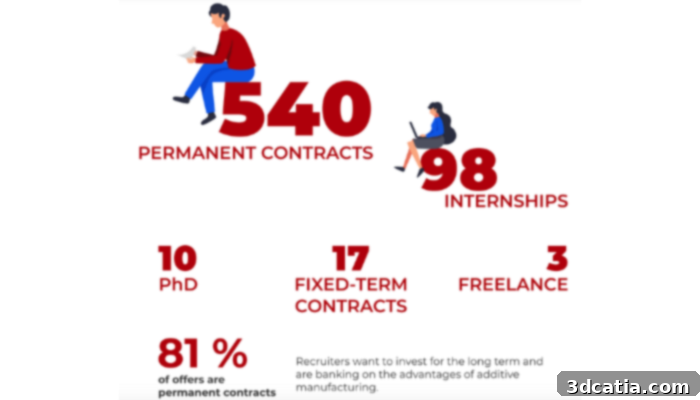
Every year, 3Dnatives undertakes a comprehensive review of the 3D printing job market, meticulously analyzing trends to anticipate future developments. Our insights are drawn from a vast array of job vacancies published across our international Job Board, encompassing listings in French, English, Spanish, Italian, and German. The year 2023 saw a significant volume of over 650 such vacancies, with a striking 81% of these being for permanent contracts. This strong emphasis on permanent roles underscores a prevailing long-term recruitment strategy within the additive manufacturing industry. Companies are clearly focused on strengthening their core teams and investing in a forward-looking approach, demonstrating confidence in the sustained growth of the sector. The demand for specific profiles remains consistent: the market actively seeks highly skilled technicians, operators, and engineers possessing specialized knowledge and expertise. A substantial 62% of all published vacancies specifically called for these types of qualifications, highlighting the industry’s technical core. Furthermore, the 3D printing software sector has definitively cemented its crucial position in the job market, experiencing a steady increase in job offerings over the past three years, signaling a critical expansion in digital solutions for additive manufacturing.
While the long-term outlook remains robust, our analysis reveals a slight tempering in the number of job offers published in 2023 compared to the preceding year. We observed 668 vacancies in 2023, a decrease from the approximately 900 recorded in 2022. This dip can largely be attributed to a period of heightened economic and political uncertainty globally. Many companies adopted a more cautious stance, implementing strategic redundancy plans, scaling back new recruitment initiatives, and prioritizing the consolidation of existing operations and gains. Consequently, the sheer volume of job openings did not match the expansive growth seen immediately following the COVID-19 pandemic. Nevertheless, the market’s underlying buoyancy persists, largely propelled by substantial investments from large corporations and an increasing number of end-users who are actively integrating additive manufacturing into their operations and establishing dedicated AM clusters. This strategic adoption by major players signals a shift from purely R&D applications to industrial-scale implementation, ensuring sustained demand for skilled professionals.
Types of contracts sought after
Key Employment Trends: Contract Stability and Strategic Recruitment
The prominence of permanent contracts, accounting for 81% of all job offers, is a significant indicator of the 3D printing industry’s maturity and stability. This trend reflects a strategic commitment from companies to cultivate long-term talent and build robust, experienced teams. For employers, offering permanent positions facilitates knowledge transfer, fosters innovation through sustained expertise, and reduces the costs associated with frequent recruitment and training. For employees, it provides crucial job security, clear career progression paths, and opportunities for professional development within a rapidly evolving field. While contract and temporary roles exist, they typically cater to project-specific needs or specialized consulting, highlighting that the core operational and developmental functions within additive manufacturing are increasingly seen as long-term commitments. This emphasis on stability suggests that companies are moving beyond experimental phases and are now integrating additive manufacturing as a fundamental part of their production and innovation strategies.
What Are the Most Sought-After Professions in 3D Printing?
Consistent with previous years, roles in production, design, and development remain at the forefront of demand within the additive manufacturing sector. These positions are inherently technical, requiring a deep understanding of both hardware and software aspects of 3D printing. They encompass a diverse range of responsibilities, from the hands-on operation of advanced machinery to the intricate conceptualization of new designs and processes. Examples include highly skilled 3D printer operators who manage complex print jobs, ensure material integrity, and perform essential post-processing tasks. Production managers are crucial for overseeing the entire additive manufacturing workflow, optimizing efficiency, and maintaining quality standards. Machine designers, on the other hand, focus on the innovation and improvement of 3D printing hardware itself, pushing the boundaries of what these technologies can achieve. The “Maintenance and Support” branch also constitutes a vital segment of the job market, accounting for a significant 14% of published job offers. These roles are critical for ensuring the continuous operation and longevity of expensive additive manufacturing equipment, involving preventative maintenance, troubleshooting, and repairs.
A notable shift observed in 2023, compared to 2022, was a significant increase in the demand for sales profiles. These roles represented 13% of all vacancies, up from 9% in the previous year. This surge indicates a maturing market where companies are increasingly focused on expanding their reach and driving broader adoption of additive manufacturing solutions. The need for knowledgeable sales professionals who can articulate the complex benefits of 3D printing technologies to potential clients is growing. These individuals often require a hybrid skillset, combining strong interpersonal and negotiation abilities with a fundamental understanding of engineering principles and additive manufacturing processes to effectively communicate value propositions and provide consultative sales. As the industry moves from early adoption to mainstream integration, the importance of effective sales and business development becomes paramount for market penetration and growth.
Recruiting Sectors: Where is the Growth Happening?
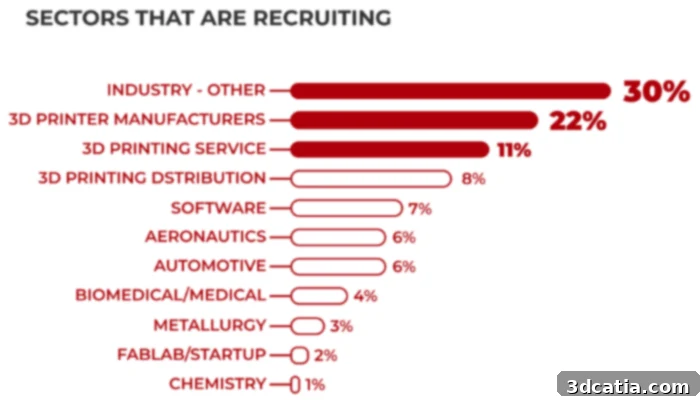
Once again, the core additive manufacturing players were the primary recruiters in 2023, showcasing their central role in driving industry employment. This category encompasses 3D equipment manufacturers, who design and produce the printers themselves; distributors, who facilitate the reach of these technologies to diverse markets; and printing services, which offer on-demand production for businesses and individuals. This figure climbed even higher than in 2022, reaching 41% compared to 38%, underscoring the robust expansion within the foundational segments of the AM ecosystem. These companies are at the forefront of innovation, material development, and service provision, making them consistent sources of employment across technical, operational, and customer-facing roles.
Beyond the direct AM industry, manufacturing in the broadest sense continues to recruit massively, providing compelling evidence that additive manufacturing is no longer just a prototyping tool but a transformative production method making significant inroads into traditional industrial sites. Companies across various industrial sectors are recognizing the strategic advantages of AM, from reducing lead times and waste to enabling complex geometries and on-demand production. A prime example is the rail giant Wabtec, which inaugurated a dedicated additive manufacturing center in Tours, France, in November 2023. This strategic investment aims to accelerate the production of critical metal and plastic parts for its onboard doors and high-speed trains (TGVs), demonstrating how established industries are integrating AM to enhance efficiency, innovation, and supply chain resilience. This trend signifies a broader industrial adoption, creating demand for AM specialists within traditional manufacturing companies.
Sectors that recruited the most in 2023
The Ascendancy of Software in Additive Manufacturing
Finally, a critical observation is the increasingly aggressive recruitment policies of software publishers. These companies are actively seeking to expand their teams to develop and offer more sophisticated and effective modeling, control, and printing solutions for the additive manufacturing industry. The growth in this sector is driven by the recognition that advanced software is indispensable for unlocking the full potential of 3D printing. Today, a multitude of powerful tools are available to facilitate design for additive manufacturing (DfAM), moving beyond basic design. This includes not only sophisticated CAD software tailored for lattice structures and topology optimization but also comprehensive platforms for production planning, build preparation, automation of print processes, and rigorous quality control. The development of simulation tools to predict part performance, machine learning algorithms for process optimization, and robust data management systems are all contributing to the intense demand for software engineers, developers, and data scientists with expertise in AM. This market sector is poised for continued rapid growth and will undoubtedly be a key area to monitor closely in the coming years, as software innovation continues to redefine the capabilities and accessibility of additive manufacturing.
Looking Ahead: The Future of 3D Printing Careers
In summary, despite a moderate dip in job supply in 2023, the 3D printing job market remains remarkably consistent with the core trends observed over the last five years. The industry continues to emphasize permanent positions, demand for highly technical skills, and recognize the growing importance of software solutions. The resilience of the market, driven by large-scale industrial adoption and technological advancements, paints a positive picture for long-term career prospects. The critical question for the immediate future is whether companies will maintain their conservative recruitment policies in the face of ongoing global economic shifts, or if they will broaden their search for talent and proactively seek out a wider array of candidates as confidence returns and new applications emerge. Factors such as new material breakthroughs, increased automation within AM processes, and the expansion of educational programs dedicated to additive manufacturing will undoubtedly influence these recruitment strategies. What is clear, however, is the sustained strategic importance of additive manufacturing as a key enabler of innovation and production across various industries. If you are an industry player actively seeking skilled profiles in the dynamic field of additive manufacturing, we encourage you to post your job offers HERE, free of charge, to connect with top talent.
Download the Full Infographic HERE for Deeper Insights
What are your thoughts on the current state and future trajectory of the additive manufacturing job market? What specific trends have you personally observed regarding job offers and career opportunities in 3D printing within your region or specialization? We invite you to share your insights and comments below or engage with our community on our LinkedIn, Facebook, and Twitter pages! Don’t forget to sign up for our free weekly newsletter here to receive the latest 3D printing news directly in your inbox! You can also explore all our informative videos and engaging content on our dedicated YouTube channel.
*All Image Credits: 3Dnatives