
Unveiling the Future: Your Weekly Dive into Groundbreaking 3D Printing Innovations
Welcome back to our special weekly roundup, where we illuminate the most captivating and impactful developments across the dynamic landscape of 3D printing. Every Sunday, we dedicate ourselves to bringing you the cutting-edge stories and exciting advancements that are shaping industries and transforming daily life. This week, we embark on a fascinating journey, starting with an in-depth exploration of bioprinting’s monumental potential within the medical sector. From there, we’ll shift gears to the high-fashion world, as we unveil Stratasys’ revolutionary J850 TechStyle printer, designed to empower designers with unprecedented creative freedom. Our adventure continues with a look at Vaude’s innovative, recyclable backpack, featuring a meticulously 3D printed suspension system that redefines comfort and sustainability. We then delve into the crucial world of software, guiding you through the considerations for choosing the optimal 3D modeling tools for various applications. Finally, we conclude this week’s “Top 5” with a compelling video demonstrating the intricate process of creating a realistic skeleton model using 3D printing, destined for hospitals and universities worldwide. Prepare to be inspired by the sheer ingenuity and rapid evolution of additive manufacturing. As you explore these incredible innovations, don’t forget to share which video resonated with you the most!
Top 1: The Transformative Future of Bioprinting in Medicine
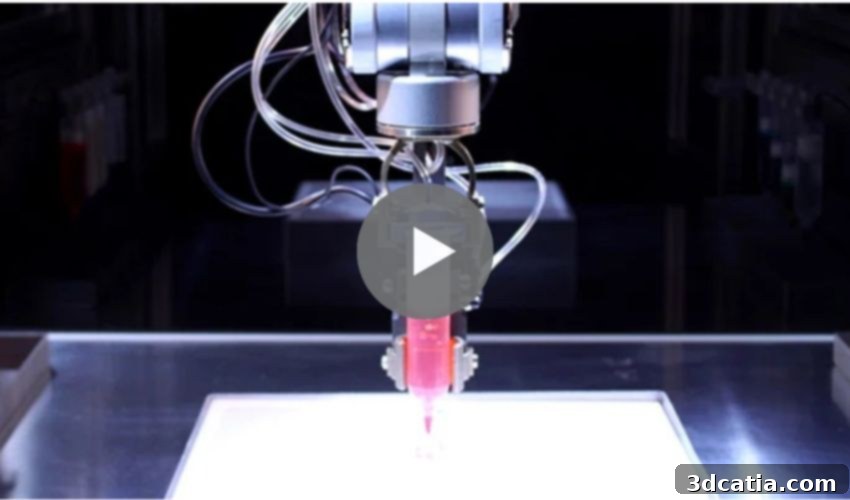
Additive manufacturing has undeniably cemented its position as a groundbreaking force within the medical sector, offering solutions that were once confined to the realm of science fiction. As technology relentlessly advances and our understanding of biological processes deepens, medical scientists are continually discovering novel and profound applications for bioprinting. This revolutionary field is on the cusp of delivering truly life-changing innovations, with researchers diligently working on projects that promise to redefine healthcare as we know it.
Bioprinting, the process of creating functional living tissues and organs using 3D printing techniques, holds immense promise. Currently, it’s being explored for a multitude of applications, including the creation of intricate tissue models for drug discovery and disease research, personalized implants that perfectly match a patient’s anatomy, and even the potential for regenerating damaged tissues. The ability to precisely deposit living cells, growth factors, and biocompatible materials layer by layer allows for the construction of complex biological structures that mimic natural tissues. This precision is critical for ensuring the functionality and viability of bioprinted constructs.
Looking ahead, the aspirations for bioprinting are even grander. Scientists envision a future where patient-specific organs could be bioprinted on demand, drastically reducing reliance on organ donation and eliminating transplant rejection. Imagine a world where a patient’s own cells are used to print a new heart, liver, or kidney, offering a complete cure for organ failure. While significant challenges remain, such as vascularization of larger constructs and long-term viability, the progress being made is nothing short of extraordinary. This video provides a captivating glimpse into these ongoing efforts and the profound impact bioprinting is poised to have on medicine, from regenerative therapies to advanced surgical training models. It’s clear that additive manufacturing is not just assisting medicine; it’s actively reshaping its very foundation.
Top 2: Additive Manufacturing Meets High Fashion with Stratasys J850 TechStyle
From its inception, the Israeli-American pioneering company Stratasys has consistently revolutionized the 3D printing market, offering a diverse portfolio of additive manufacturing machines tailored for various industrial sectors. With the recent unveiling of their newest 3D printer, the J850 TechStyle, Stratasys has taken a bold and strategic step into an entirely novel territory for additive manufacturing: the high-end fashion industry. This groundbreaking move highlights the increasing versatility and sophisticated capabilities of 3D printing technology.
Specifically engineered for the demanding world of fashion and haute couture, the J850 TechStyle is designed to empower designers with unprecedented creative freedom. This innovative machine allows for direct-to-fabric printing, enabling the creation of intricate textures, vibrant patterns, and complex geometries directly onto various garments and textile materials. This capability opens up a myriad of new design perspectives, allowing for rapid prototyping, personalization on an industrial scale, and the realization of designs that would be impossible or prohibitively expensive with traditional manufacturing methods. Designers can now experiment with an array of materials, colors, and durometers, achieving unique tactile qualities and visual effects that were previously unimaginable.
To powerfully demonstrate the extraordinary capabilities of its new solution, Stratasys collaborated with several distinguished fashion specialists. Through this synergy, they collectively designed the breathtaking SSYS 2Y22 REFLECTION collection. This collection, comprising seven exquisite pieces, stands as a testament to the J850 TechStyle’s potential to bridge technology and artistry. It showcases how 3D printing can be seamlessly integrated into the fashion design process, allowing for custom embellishments, integrated structural elements, and innovative textile designs. The SSYS 2Y22 REFLECTION collection, along with the J850 TechStyle printer itself, was presented to critical acclaim at the prestigious Milan Design Week, solidifying additive manufacturing’s exciting new role at the forefront of fashion innovation. This marks a pivotal moment where advanced technology is not just supporting, but actively driving aesthetic and functional innovation in textiles and apparel.
Top 3: The Sustainable Innovation: Vaude’s Novum 3D Backpack
For numerous years now, additive manufacturing has steadily permeated our daily lives, moving beyond industrial applications to create an increasing array of consumer objects. Whether it’s exquisitely designed vases, personalized eyewear frames, or even ergonomically tailored footwear, 3D printing is becoming an integral part of the products we use every day. This widespread adoption is largely due to the technology’s ability to produce complex geometries, offer rapid customization, and enable the use of advanced materials with specific properties.
Last February, the renowned German outdoor gear company Vaude further showcased this trend by unveiling its latest and most exciting 3D printing application: a revolutionary 3D printed backpack. Christened the Novum 3D, this innovative backpack was meticulously designed and manufactured from Thermoplastic Polyurethane (TPU), a material celebrated for its exceptional blend of comfort, aesthetic appeal, and, crucially, superior durability. TPU offers impressive flexibility, resistance to abrasion, and a lightweight feel, making it an ideal choice for high-performance outdoor equipment.
What truly sets the Novum 3D apart is its pioneering approach to sustainability and design. The backpack incorporates a fully 3D printed suspension system, which is not only engineered for optimal comfort and load distribution but is also entirely recyclable. This commitment to environmental responsibility extends throughout its production, as the Novum 3D is assembled in Germany, promoting local manufacturing and reducing the carbon footprint associated with global supply chains. By embracing a circular economy model, Vaude demonstrates how advanced manufacturing techniques can be harmoniously integrated with ecological principles. The ability to recycle the entire backpack aligns perfectly with modern environmental demands, presenting a compelling alternative to traditional manufacturing processes that often generate significant waste. This backpack is a powerful example of how 3D printing is enabling companies to innovate not just in product design, but also in sustainable production and material usage, pushing the boundaries of what is possible for eco-conscious consumers.
Top 4: Navigating the Landscape: The Best Software for 3D Modeling
In the intricate world of additive manufacturing, the choice of 3D modeling software is as critical as the printer itself. The vast array of applications for 3D printing means that “the best” software is highly subjective, depending entirely on the specific needs of the project. For instance, which 3D software is most optimally suited for the additive printing of complex parts for automotive engineering? Or, conversely, which program excels in the delicate and precise modeling required for intricate jewelry designs? The sheer breadth of 3D printable parts – from industrial components to artistic creations – makes the task of identifying the single “best” software for the entire 3D modeling process a significant challenge. Each software package comes with its own strengths, weaknesses, and learning curve, tailored to different design philosophies and industry requirements.
Effective 3D modeling software is the foundation of any successful 3D printing endeavor. It dictates the precision, detail, and printability of the final object. Designers must consider factors such as the complexity of the desired model, the materials to be used, the intended application, and the designer’s own skill level. Some software excels in parametric design, ideal for engineering and functional parts, while others are geared towards organic sculpting, perfect for artistic figures or anatomical models. Furthermore, features like mesh repair, support generation, and slicing capabilities directly impact the printing process, making software selection a strategic decision.
Against this backdrop of diverse requirements, the innovative Photocentric Additive software has emerged as a compelling solution, developed through a synergistic collaboration between Photocentric, a leader in resin 3D printing, and CoreTechnologie, a specialist in 3D data exchange and processing. This partnership leverages their combined expertise to create a software suite specifically optimized for additive manufacturing. Photocentric Additive aims to streamline the workflow from design to print, offering advanced tools for model preparation, optimization, and generation of efficient print data. It addresses common challenges such as file compatibility, material profile management, and print job estimation, providing a robust platform for both experienced professionals and newcomers. To truly understand its capabilities and how it addresses the complexities of modern 3D printing projects, delving into the provided video will offer a detailed insight into its functionality and user experience. Selecting the right software is not merely about functionality; it’s about finding the tool that best translates your creative vision into a tangible, high-quality 3D print.
Top 5: Precision in Education: The 3D Printed Skeleton Model
As we’ve highlighted throughout this article, the applications of 3D printing within the medical sector are continuously expanding, revealing a boundless potential to revolutionize healthcare, education, and research. Whether it’s the development of custom prosthetics that perfectly fit a patient’s unique anatomy, highly accurate dental applications that improve treatment outcomes, or the visionary pursuit of 3D printed organs for transplantation, the possibilities of additive manufacturing truly seem to have no limits. This transformative technology offers unparalleled precision, customization, and cost-effectiveness compared to traditional methods.
One particularly impactful application is the creation of highly detailed anatomical models. In this final video, you will witness a fascinating step-by-step demonstration of how a sophisticated 3D printed model of a human skeleton is meticulously produced. These models are not just static replicas; they are invaluable educational tools designed for extensive use in universities, medical schools, and hospitals around the globe. Traditional anatomical models can be expensive, fragile, and often lack the level of customization required for specific teaching or surgical planning scenarios. 3D printing overcomes these limitations by allowing for the production of anatomically precise models that can be tailored to specific conditions or instructional needs.
The process typically begins with high-resolution imaging data, such as CT or MRI scans, which are then converted into a digital 3D model. This digital model is then optimized for printing, potentially incorporating specific pathologies or injuries for specialized training. The benefits of these 3D printed skeleton models are manifold: they provide medical students with hands-on learning experiences, allowing them to study complex anatomical structures in a tangible and interactive way. For surgeons, these models can serve as realistic practice tools for planning intricate operations, reducing risks and improving patient outcomes. Moreover, they are excellent aids for patient education, helping individuals better understand their conditions and proposed treatments. This video not only showcases the technical prowess involved but also underscores the profound educational and practical value that 3D printing brings to medical training and practice, proving once again that additive manufacturing is a powerful catalyst for innovation in healthcare.
What are your thoughts on the incredible advancements in bioprinting for medicine, or any of the other revolutionary applications of 3D printing we’ve explored this week? We’d love to hear your insights and opinions! Share your comments below or engage with us on our Linkedin, Facebook, and Twitter pages. For those eager to stay at the forefront of additive manufacturing news, don’t miss out – sign up for our free weekly Newsletter here, delivering the very latest 3D printing news directly to your inbox! You can also explore all our compelling video content and more by visiting our comprehensive YouTube channel. Stay curious, stay informed, and keep embracing the future of 3D printing!