
Revolutionizing Dentistry: The Power of 3D Printing in Dental Practices and Labs
Additive manufacturing has profoundly transformed numerous sectors and industries, consistently delivering significant advantages in areas such as productivity, cost efficiency, customization capabilities, and reduced lead times. Within the highly specialized field of dentistry, this technology is carving out innovative solutions perfectly tailored to the unique needs of each patient. Indeed, dental 3D printing represents a flourishing industry poised for remarkable expansion. Not long ago, the consulting firm QY Research projected that the dental 3D printing market would reach an impressive $930 million by the close of 2025. This forecast signifies an anticipated annual growth rate of 17%, a trajectory largely fueled by the relentless development and refinement of 3D printing technologies and their associated materials. The scope of dental 3D printing is vast, encompassing a diverse array of processes like stereolithography and direct metal laser sintering, and utilizing a wide spectrum of materials including biocompatible resins, specialized plastics, and various metals. This versatility allows for the precise creation of essential dental applications such as surgical guides, custom crowns, clear aligner trays, and lifelike dentures, each meticulously designed to fit individual patients with unparalleled accuracy.
Given this rapid evolution, it becomes crucial for dental professionals to understand which 3D printing technologies are best suited for specific applications and how they integrate into existing workflows. Equally important are the questions surrounding the dental community’s response to the rise of 3D printing: How are dentists and dental technicians adapting to this technological shift? What steps are they taking for training and preparing for a digitally driven future? This article delves into these critical aspects, exploring the technologies, their practical applications, and the transformative impact on dental care delivery.
The Digital Transformation of Dental Workflows
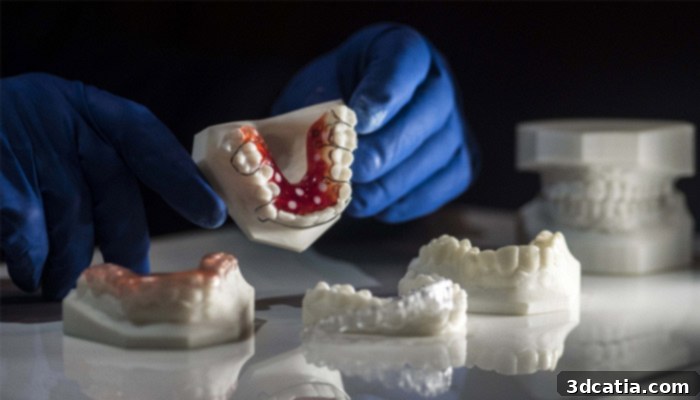
Traditionally, the dental sector has operated through a distinct division of labor, involving two primary families of actors: dental practices and dental prosthesis laboratories. These entities have historically collaborated closely in the production of custom medical devices, ranging from gutters and crowns to bridges. The conventional procedure involves the dentist taking a physical impression of the patient’s teeth, typically using a putty-like material. This impression is then meticulously packaged and dispatched to an external dental laboratory. The laboratory, in turn, uses this impression to create a physical model, often from plaster, which serves as the basis for manufacturing the final device. This multi-step process is inherently time-consuming, frequently taking several days due to the transit time between the dental practice and the laboratory. Furthermore, the patient is required to schedule a follow-up appointment, often without the absolute guarantee that the fabricated device will perfectly fit their needs on the first try, sometimes necessitating further adjustments or even remakes. The advent of 3D technologies, however, is fundamentally disrupting this established procedure, offering a path towards entirely dematerialized and significantly more efficient work processes, promising enhanced precision and a streamlined patient experience.
Exploring Dental 3D Printing Technologies and Their Materials
When discussing additive manufacturing in dentistry, it’s essential to recognize that a variety of 3D printing technologies are employed, each with distinct advantages and ideal applications. The choice of technology – whether fused deposition modeling (FDM), photopolymerization (SLA/DLP), or laser sintering – is primarily dictated by the specific dental device being produced and its required characteristics. As Olivier Bellaton, Director and Founder of Biosummer3D, aptly points out, “Each process comes with its own advantages and disadvantages.”
Fused Deposition Modeling (FDM)
FDM technology, for instance, is highly valued for its cost-effectiveness in producing dental models. Bellaton notes that FDM can manufacture pieces “at a cost of a couple of pennies and no post-processing after printing.” This makes it an attractive option for certain applications. However, FDM typically falls short in terms of speed, accuracy, and the biocompatibility required for direct patient contact devices. Consequently, FDM technology is predominantly utilized for creating orthodontic dental models that serve as molds for thermoform gutters, whether for teeth alignment, bleaching procedures, or retention purposes. A significant development in FDM dental solutions is the emerging use of PEEK (Polyether Ether Ketone). IEMAI3D, a 3D printer manufacturer, highlights the substantial benefits of PEEK for partial prostheses: “There are many advantages to making partial prostheses with PEEK. It is a strong and lightweight material that will improve patient comfort. The frame of the prosthesis is produced without metal and is completely neutral in terms of taste.” This offers a comfortable, metal-free alternative for patients.
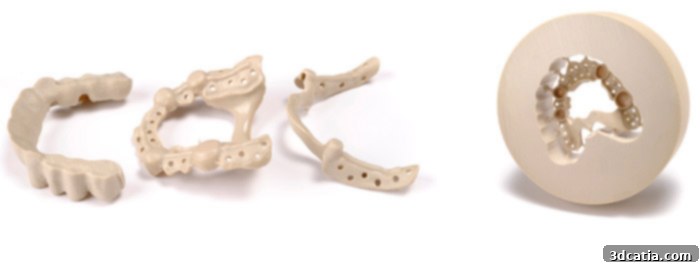
Photo Credits: Juvora
Photopolymerization (SLA and DLP)
Another prominent and arguably the most widely adopted additive manufacturing process in the dental sector is photopolymerization. This category includes both stereolithography (SLA) and Digital Light Processing (DLP). These technologies stand out due to their ability to achieve significantly higher resolution and, crucially, to process biocompatible liquid resins. Anton Lopez, Channel Sales Manager France at EnvisionTEC, emphasizes the transformative potential: “Combined with CE/FDA approved materials, photopolymerization and especially DLP, gives more accurate printing which allows more accurate devices to be created. The finishing is much less complex, which reduces manufacturing time. Also, it is very easy to change materials and print for different applications. This is very beneficial for the dental industry because professionals can treat their patients more quickly.” The superior precision offered by photopolymerization expands its application range considerably. Beyond surgical guides and temporary crowns, these technologies are used for producing custom impression trays, orthodontic models, bite splints, castable elements like dental stellites (frameworks for partial dentures), and gingiva masks for implantology, enabling a broad spectrum of high-quality, patient-specific solutions.
Metal Additive Manufacturing
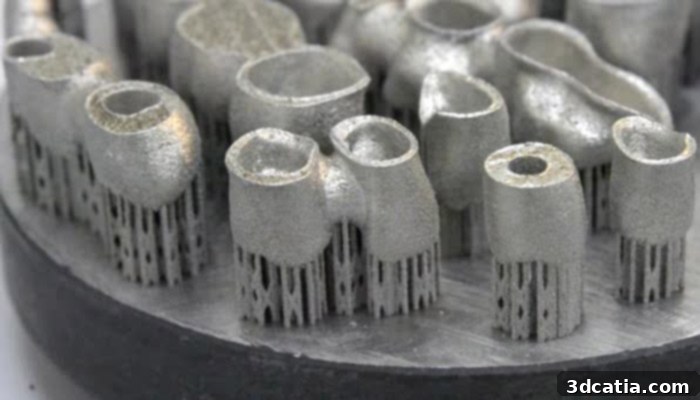
Finally, metal additive manufacturing also plays a vital role in modern dentistry, particularly for applications requiring exceptional strength and durability. This process is primarily employed for producing robust dental implants, precise stellites, and nickel-chromium frameworks for prostheses. However, as Oliver Bellaton notes, “This technology requires sustained production to absorb investments of up to several hundred thousand euros with skills coming from the industrial world rather than the dental sector.” Metal 3D printers are considerably more expensive than their resin-based counterparts, and the resulting parts often necessitate extensive post-processing, which can impact overall productivity for some dental laboratories. While a crown made by traditional machining might take 15 minutes of direct work, a 3D printed metal crown can require up to 5 hours of printing time. Despite the longer print times, additive manufacturing offers a compelling advantage in terms of cost per unit, with a 3D printed metal crown potentially costing as little as 75 cents compared to over 7 euros for a machined one. This cost efficiency, coupled with the ability to create complex geometries and customized structures, makes metal 3D printing invaluable for specialized high-performance dental components.
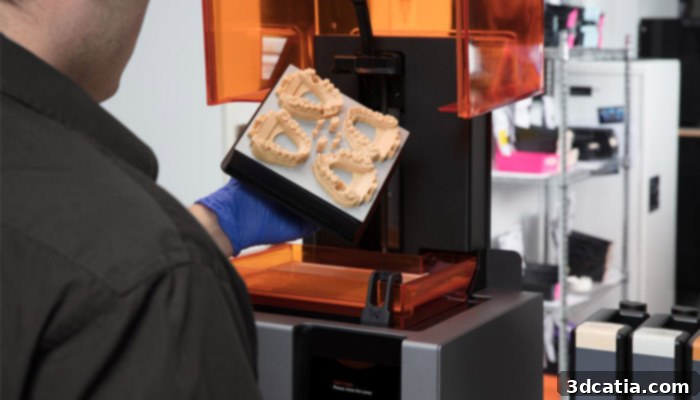
Photo Credits: Formlabs
A Dematerialized Manufacturing Process: The Digital Dental Workflow
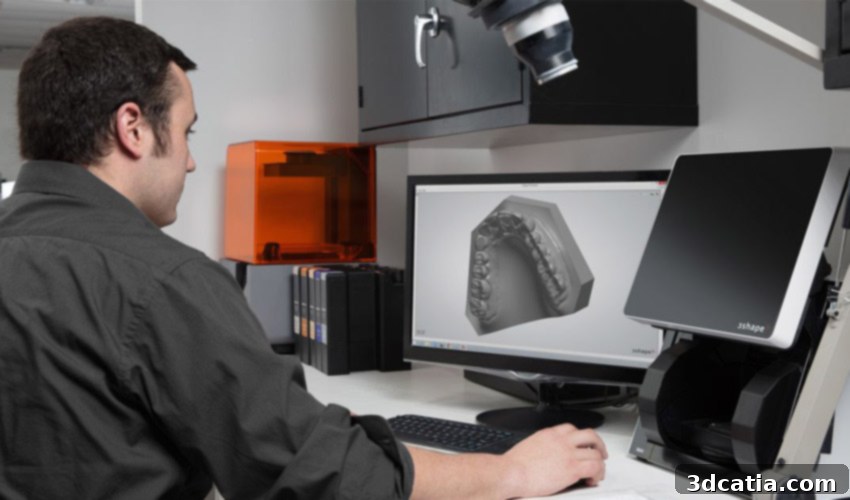
As highlighted earlier, the integration of 3D technologies is designed to deliver superior precision and significantly reduce manufacturing times in dentistry. But what does this new, dematerialized workflow actually entail for the creation of 3D printed dental devices? Oliver Bellaton provides a comprehensive overview of these innovative steps: “The physical impression will be replaced by a 3D digital impression taken by the dentist with an intra-oral scanner. This cutting-edge device, essentially a sophisticated camera, reconstructs the surface of the teeth and gums in precise 3D and real-time. This high-fidelity 3D file can then be instantly and securely transmitted to the dental laboratory via a dedicated web platform. Once received, the laboratory meticulously reviews the digital impression and proceeds to model the morphology of the crown using advanced CAD (Computer-Aided Design) software. This design process takes into account crucial factors such as the precise limits of the gum line, potential interferences with other digitized teeth, and even incorporates the aesthetic shape of the patient’s smile, which can be captured with a face scanner for holistic planning. In instances where there is any doubt or a need for clarification, a quick, interactive exchange via split-screen between the laboratory technician and the dentist allows for immediate validation of the crown’s design. Once the design is finalized and approved, the 3D file of the crown is then sent directly to a 3D printer for precise manufacturing.”
Bellaton further envisions a future where “the dentist could have the 3D printer directly in the office for simple manufacturing. All digital flow configurations are possible.” This transformative process dramatically slashes production times, potentially reducing it to just a few hours. In many cases, this means “the patient could only be brought in to the practice once” – a monumental improvement in patient convenience and clinical efficiency. The tangible benefits are manifold: significantly reduced logistical flows, accelerated production schedules, and a highly personalized system that delivers dental devices far more accurately adapted to the patient’s unique morphology than ever before. This digital revolution not only enhances the quality of care but also streamlines operations, making dental practices more agile and responsive.
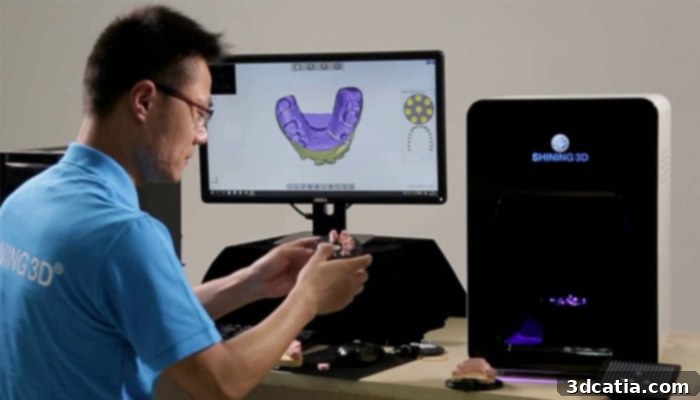
Photo Credits: Shining 3D
The shift to this digital workflow necessitates a significant investment in new equipment and training for dental professionals. Dentists and dental technicians will need to equip their practices and laboratories with advanced 3D scanners and 3D printers, alongside sophisticated CAD software. This requirement can present a considerable obstacle for many professionals today. As Nicolas Klaus, Dental Product & Business Development at Formlabs, explains, “The essential pillars of these new working methods are 3D scanners, CAD software and 3D printing. Generally, there is a point of resistance in the software on which training is not obvious.” Overcoming this initial learning curve and investment barrier is crucial for widespread adoption and realizing the full potential of digital dentistry.
The Promising Future of Dental 3D Printing
While 3D technologies undeniably offer significant advantages for the dental sector, their widespread adoption can still be a source of apprehension for some practitioners. This hesitation often stems from the requirement for a new work logic, the need for extensive training in sophisticated software, scanners, and printers, and the inherent demand for a certain level of confidence in these innovative, yet unfamiliar, processes. Despite these initial hurdles, the momentum towards digital dentistry is undeniable. For instance, in France, over 50% of dental laboratories have already invested in 3D scanners and advanced machine tools, with 20% also integrating 3D printers into their operations. These early adopters have reported an impressive 70% increase in turnover, a clear testament to the tangible financial gains and operational efficiencies that 3D printing brings to dental professionals. Anton from EnvisionTEC reinforces this positive trend, stating, “Most practitioners are very receptive and open to new digital technologies. It is simply a matter of asking clinicians and dental industry professionals to understand and trust the new digital technology and its benefits for themselves, their company and their patients. And of course, education and training play an important role. This is why many manufacturing companies are investing in this field to better understand the technology and its clinical applications.”
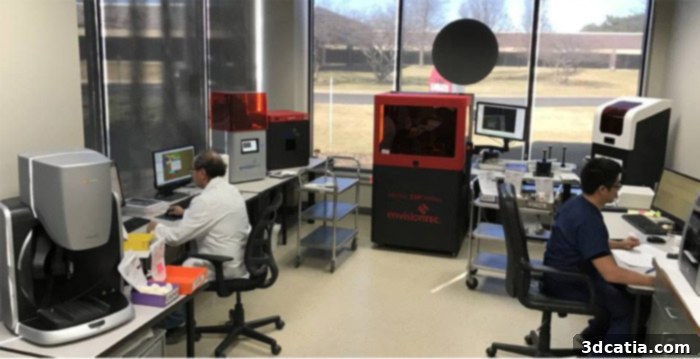
Photo Credits: EnvisionTEC
The future outlook for the dental 3D printing industry is therefore overwhelmingly encouraging. A growing number of enthusiastic professionals are recognizing the technology as a powerful tool to significantly enhance their efficiency, improve the precision of their interventions, and ultimately elevate patient safety and satisfaction. The market projections further underscore this optimism: SmarTech Publishing’s 2018 report forecast an astounding 35% annual growth in 3D dental printing, predicting the market to reach an impressive $9.5 billion by 2027. This comprehensive report meticulously factors in sales of hardware, materials, and the final 3D printed parts, painting a clear picture of a robust and rapidly expanding sector. As technologies continue to advance and training becomes more accessible, 3D printing is set to become an indispensable component of modern dental care, promising a more precise, efficient, and patient-centric approach to dentistry worldwide.
Are you excited for the future of 3D printing in the dental field? Share your thoughts and experiences in the comments below or join the conversation on our Facebook and Twitter pages! Don’t miss out on the latest advancements – sign up for our free weekly Newsletter to receive all the news in 3D printing straight to your inbox!