
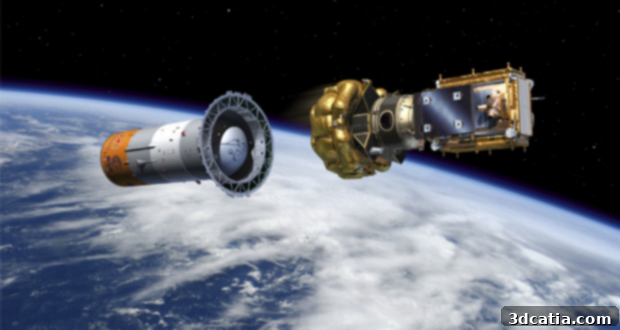
Thales Alenia Space Leads the Way: Pioneering 3D Printed Parts for Advanced Satellites and Spacecraft
The aerospace industry is undergoing a transformative shift, with additive manufacturing, commonly known as 3D printing, emerging as a pivotal technology for spacecraft development. Thales Alenia Space stands at the forefront of this revolution, aggressively integrating 3D printing into its manufacturing processes to produce an ever-growing array of components for satellites and other orbital platforms. This forward-thinking approach is enabling the company to create more than 400 meticulously crafted metal and plastic 3D printed parts destined for the challenging environment of space, pushing the boundaries of what’s possible in satellite design and functionality.
With a distinguished legacy spanning over four decades, Thales Alenia Space has cemented its reputation as a leading specialist in sophisticated space systems. This powerhouse enterprise is the product of a strategic joint venture between two industrial giants, Thales and Leonardo, combining their extensive expertise to deliver cutting-edge solutions for global space endeavors. The company’s core competencies encompass the design, development, and rigorous testing of critical systems for a diverse range of applications, including advanced navigation, high-capacity telecommunications, scientific exploration missions, and Earth observation. Given their deep involvement in these complex fields, it was an inevitable progression for Thales Alenia Space to recognize and embrace the immense potential of additive manufacturing.
The journey into orbital additive manufacturing for Thales Alenia Space officially began in April 2015. At that time, the company embarked on an innovative project to design and produce an aluminum antenna support structure using 3D printing technology. This pioneering component was subsequently and successfully deployed into orbit aboard the TurkmenAlem MonacoSat satellite, marking a significant milestone in space technology. The success of this initial endeavor proved the viability and reliability of 3D printed parts in the harsh conditions of space. Since this landmark achievement, Thales Alenia Space has consistently incorporated similar 3D printed antenna components into every subsequent satellite launched into space. The primary advantage of these additive-manufactured parts is their significantly reduced weight compared to their traditionally manufactured counterparts, a crucial factor in minimizing launch costs and maximizing payload efficiency for space missions.
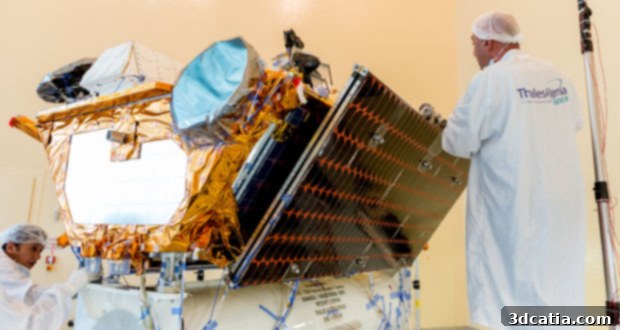
The Iridium Next satellite includes 3D printed pieces// Photo: Thales Alenia Space
The commitment of Thales Alenia Space to additive manufacturing is evident in the impressive number of components they have successfully placed in orbit. To date, the company has deployed 79 metal parts, along with 350 intricately designed tube holders manufactured from chemical polymers for propulsion systems. The metal components, essential for various satellite platforms, have been fabricated using the highly precise Laser Beam Melting (LBM) technique. LBM is an advanced additive manufacturing process that involves selectively melting thin layers of metallic powder with a high-powered laser beam in a controlled, inert atmosphere. This layer-by-layer fusion builds up complex geometries with exceptional material properties, making it ideal for the demanding requirements of space applications. For the production of some of these critical parts, Thales Alenia Space has strategically collaborated with ‘Polyshape,’ leveraging their specialized expertise. The company has predominantly utilized the Concept Laser 3D printer, specifically the X-Line 1000R model, known for its large build volume and robust capabilities for industrial metal additive manufacturing. Out of the 79 metal pieces printed and launched, a remarkable 47 of them feature unique designs, collectively serving 13 distinct and vital functions across their satellite fleet. This highlights the unparalleled design freedom and versatility that 3D printing offers, allowing for highly optimized and specialized components tailored to specific mission needs.
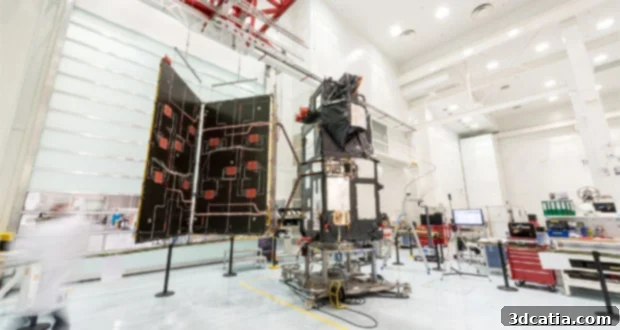
The Sentinel-3 also includes 3D printed pieces// Photo: Thales Alenia Space
The adoption of additive manufacturing brings a multitude of profound advantages to Thales Alenia Space’s production capabilities. One of the most significant benefits is the ability to consolidate multiple components into a single, monolithic part. This eliminates the need for complex assembly processes involving numerous different pieces, fasteners, and welding operations for a single structure. By producing parts in one piece, the company achieves substantial savings in both manufacturing time and associated labor costs. Furthermore, this consolidation significantly reduces the overall weight of the component, which is paramount for space applications where every gram impacts launch expenses. Beyond cost and weight savings, this innovative method of manufacturing unlocks unprecedented design freedom, enabling the creation of intricate and highly complex structures that would be impossible or prohibitively expensive to produce with traditional techniques. This includes the integration of internal lattice structures for optimal strength-to-weight ratios, or complex internal channels for efficient thermal management. Simultaneously, additive manufacturing can maintain or even increase production speed for certain specialized parts, especially in prototyping and small-batch production, by streamlining the supply chain and reducing reliance on specialized tooling. The broader aerospace sector has also recognized these benefits, with numerous experts and companies, such as Etihad Airways, turning to additive manufacturing to design and optimize various aircraft components, from cabin interiors to engine parts, showcasing its widespread applicability beyond just space.
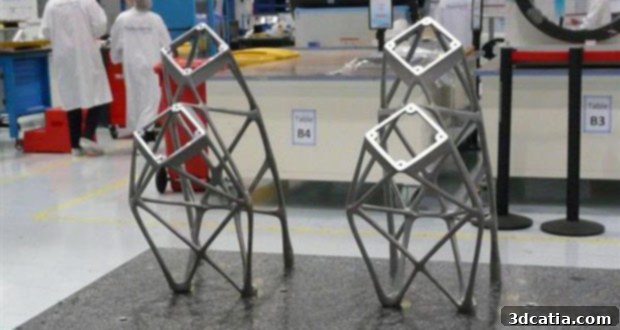
Metal parts created with the help of additive manufacturing
The proven success of numerous satellites incorporating 3D printed components has not only validated the technology but has also significantly encouraged Thales Alenia Space to further deepen its investment in and commitment to this transformative manufacturing process. The company is actively pursuing new avenues to leverage additive manufacturing, aiming to introduce even greater innovations into their product development and production workflows. Florence Montredon, the insightful Head of Development for Additive Manufacturing Technologies at Thales Alenia Space, articulates the company’s future vision: “Our development efforts are now focusing on integrating several functions in a single part, such as mechanical, thermal, and radio-frequency functions.” This ambitious goal represents the next frontier in 3D printing for space, moving beyond simple component replacement to true multi-functional integration. She emphasizes that “The challenge lies as much in the design process as in the production technique per se.” This highlights the complexity of creating parts that simultaneously serve structural integrity, manage heat dissipation, and perform critical radio communications, all within a single, optimized additive manufactured piece. Achieving this level of integration promises to revolutionize satellite design, leading to more compact, lighter, and more capable spacecraft, ultimately enhancing mission performance and cost-effectiveness for future space exploration and connectivity.
The implications of Thales Alenia Space’s pioneering work extend far beyond individual satellite components. Their advancements demonstrate a clear pathway towards fully optimized spacecraft architectures where additive manufacturing is not just a tool, but a fundamental design principle. This shift allows for unprecedented customization, rapid prototyping cycles, and the ability to iterate designs quickly based on mission-specific requirements. The ongoing research and development in this area are critical for reducing lead times, improving supply chain resilience, and ultimately fostering greater innovation within the space industry. As materials science and 3D printing technologies continue to evolve, the possibilities for even more advanced, high-performance, and cost-efficient space systems will only expand, securing Thales Alenia Space’s position as a leader in this exciting domain.
For comprehensive further information regarding Thales Alenia Space’s achievements and commitment to additive manufacturing, you can access their official announcement directly here.
What are your thoughts on the future trajectory of additive manufacturing within the demanding aerospace sector? We invite you to share your insights and predictions in a comment below, or join the conversation on our Facebook and Twitter pages!