
Pioneering Mars: AI Spacefactory’s 3D Printed MARSHA Habitat Paves the Way for Human Life on the Red Planet
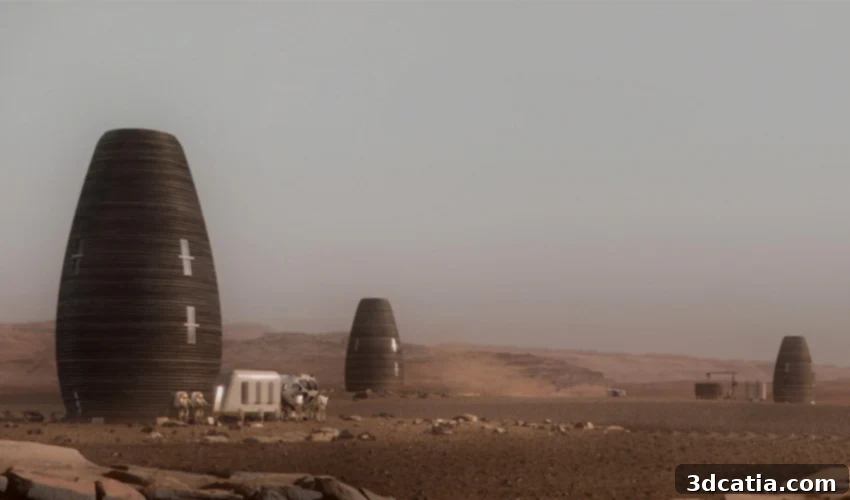
The dream of human colonization on Mars is steadily moving closer to reality, thanks to groundbreaking innovations in space architecture and advanced manufacturing. Recently, NASA announced the victors of its ambitious “3D-Printed Habitat Challenge,” a competition designed to spur the creation of sustainable off-world living spaces. Among the most lauded participants was AI Spacefactory, a New York-based architectural and technology company, whose revolutionary project, MARSHA (Mars Habitat), garnered significant attention and an impressive award of nearly $21,000. This visionary project showcased a fully functional 3D printed house designed for habitation on Mars, offering a compelling glimpse into our future among the stars.
Launched in 2014, NASA’s “3D-Printed Habitat Challenge” was a strategic initiative to accelerate the development of innovative, self-sufficient shelters capable of being constructed using indigenous materials found on other celestial bodies. The core objective was to foster solutions that would enable humanity to establish a long-term presence beyond Earth, emphasizing sustainability, resource independence, and resilience. This competition has been instrumental in pushing the boundaries of what’s possible in extraterrestrial construction, laying crucial groundwork for future endeavors such as the ambitious lunar village project, which many anticipate becoming a tangible possibility by 2030. Such challenges are vital for fostering the technological breakthroughs needed to overcome the immense logistical and environmental hurdles of space settlement, driving forward the collective human endeavor to inhabit new worlds.
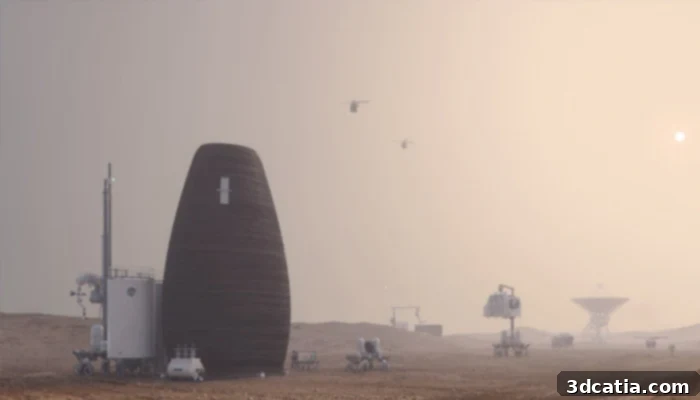
MARSHA’s robust design will be created to withstand the inclement weather and extreme conditions on Mars.
The Revolutionary Development of MARSHA: A Self-Sufficient Habitat for Mars
AI Spacefactory’s MARSHA project is predicated on a bold vision: to construct buildings on Mars primarily using materials sourced directly from the Martian surface. This strategy, known as In-Situ Resource Utilization (ISRU), is absolutely critical for sustainable space exploration and colonization. By leveraging advanced 3D printing technologies, the AI Spacefactory team has formulated an innovative composite material. This groundbreaking blend consists of a bioplastic (specifically, a polylactic acid or PLA-gold polymer) which is designed to be processed from plants potentially grown on Mars, combined with Martian regolith (soil). This revolutionary approach dramatically reduces the need to transport heavy construction materials from Earth, a logistics nightmare and an astronomical expense. Instead, it promotes a far more sustainable and autonomous development model for future Martian settlements, moving humanity closer to true interplanetary independence. The concept of utilizing local resources not only minimizes mission costs and risks but also empowers future Martian inhabitants to create and expand their infrastructure with greater self-sufficiency.
One of the most striking and critical features of the MARSHA 3D printed house is its unique architectural design: a tall, cylindrical structure. This form is not merely aesthetic; it is engineered to optimize both internal space utilization and structural integrity, crucial factors in the hostile Martian environment. The cylindrical shape intrinsically offers superior resistance to internal atmospheric pressure, a significant advantage given the need to maintain a habitable environment against the near-vacuum of Mars’s external atmosphere. Furthermore, it efficiently distributes structural stress, enhancing the habitat’s resilience against the planet’s powerful dust storms and seismic activity. To counter the extreme temperature fluctuations on Mars, which can swing from over 20°C (68°F) at the equator in summer to -153°C (-243°F) at the poles in winter, MARSHA incorporates an ingenious double-layer system. This innovative design separates the internal living area from the exterior shell, creating a thermal buffer that effectively isolates inhabitants from the planet’s natural contraction and expansion caused by drastic temperature changes, while also offering enhanced radiation shielding – another vital protection for future Martian colonists.
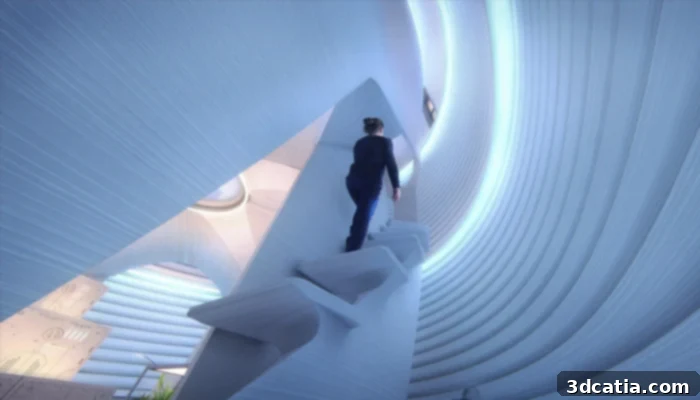
A glimpse into the innovative interior of one of the houses printed in 3D, designed for future Mars inhabitants.
The interior of the MARSHA habitat is meticulously designed to foster a unique and uplifting atmosphere that encourages mobility, psychological well-being, and a sense of normalcy despite the alien surroundings. Unlike traditional single-level structures, MARSHA’s design specifies multiple levels within the cylindrical form, each bathed in diffused natural light. This multi-dimensional layout, combined with strategic lighting, adds depth and visual interest to the structure, combating the potential monotony of long-duration space missions. The goal is to infuse daily life with greater energy and dynamism, redefining the very idea of inhabiting Mars. AI Spacefactory’s philosophy champions the development of “human-centered habitats,” prioritizing the psychological and physical needs of astronauts, even though the environmental requirements on Mars are fundamentally different from Earth. MARSHA’s brilliance lies in its ability to seamlessly integrate familiar human characteristics – comfort, aesthetics, and functionality – into a structure built for an entirely alien environment, ensuring that future Martian settlers not only survive but thrive.
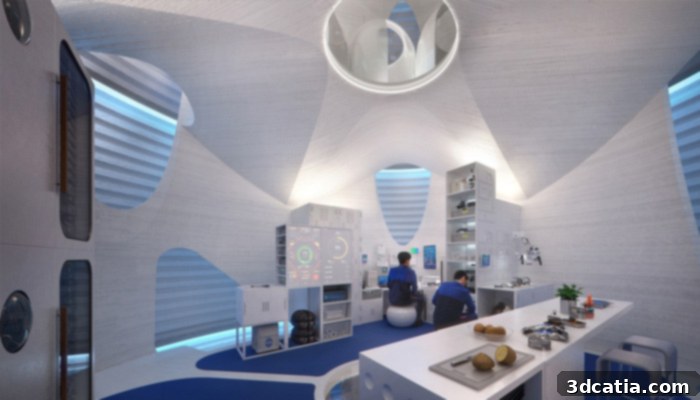
A functional and inviting kitchen within one of the MARSHA prototype houses, essential for long-duration missions.
The internal layout of the MARSHA structure is thoughtfully planned to support the diverse needs of its inhabitants. It will encompass a generous space of 34 square meters, efficiently partitioned to include essential facilities like a dedicated laboratory and a fully equipped kitchen. Beyond these fundamental areas, the habitat cleverly integrates different levels to accommodate a variety of functions crucial for long-term survival and well-being. These include sanitation centers, a hydroponic garden designed to cultivate fresh produce and enhance atmospheric quality, and a comprehensive recreation and physical exercise center. The inclusion of such amenities is vital not just for physiological health but also for the psychological resilience of the crew, mitigating the stresses of isolation and confinement. This holistic design ensures that MARSHA is not merely a shelter but a true home and a functional workspace, equipped to support scientific research, daily living, and crew morale on the Red Planet.
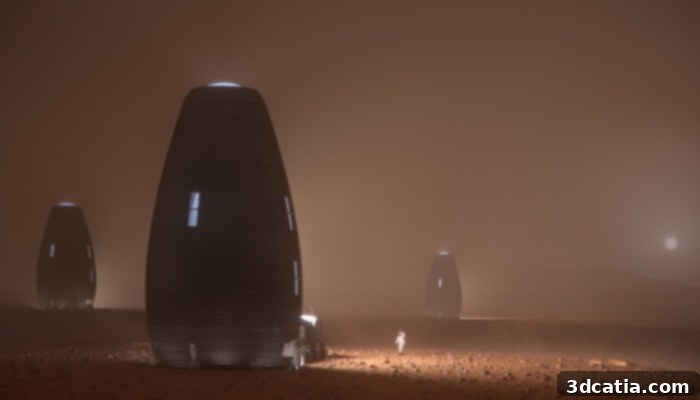
While the idea of establishing a permanent human presence on Mars remains a profound dream, projects like MARSHA demonstrate that it is an increasingly achievable goal. There is no doubt that 3D printing technology will emerge as one of humanity’s greatest allies in the conquest of outer space. Its ability to rapidly construct complex structures with minimal human intervention, utilizing local resources, is unparalleled. This technology is not just about building houses; it’s about enabling a new era of space exploration and allowing us to fulfill one of humanity’s grandest aspirations: to transcend our home planet and inhabit other worlds. The success of initiatives like NASA’s challenge and AI Spacefactory’s MARSHA brings this future vividly into focus, inspiring further innovation and investment in the technologies that will pave our way to becoming an interplanetary species.
For those eager to delve deeper into this exciting development, do not miss the compelling presentation of MARSHA in the video below. If you desire even more comprehensive information and detailed insights into AI Spacefactory’s pioneering work, you are encouraged to visit their official project website here.
What are your thoughts on AI Spacefactory’s innovative 3D printed house designed for living on Mars? Do you believe such technologies are the key to unlocking humanity’s future in space? Share your opinions and insights with us in a comment below, or connect with our community on our Facebook and Twitter pages! And for all the latest news and breakthroughs in the dynamic world of 3D printing, remember to sign up for our free weekly Newsletter, delivered straight to your inbox!