
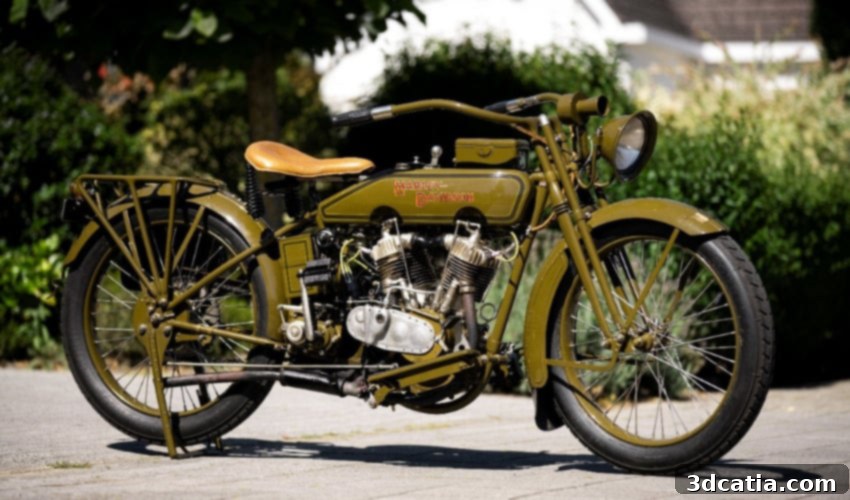
Vintage Harley Davidson Restoration: 3D Printing a Century-Old Distributor Cap with Artec 3D and Reverse Engineering
In the intricate world of classic vehicle restoration, finding original or even suitable replacement parts for machines over a century old can often feel like an insurmountable challenge. This was precisely the dilemma faced by Carl van de Rijzen, the founder of Visual First (VF), a Dutch company established in 2007 with a strong focus on reverse engineering solutions. Visual First embarked on the ambitious project of renovating a magnificent 1919 Harley Davidson motorcycle, a true relic of automotive history. During this meticulous restoration process, a critical mechanical component, specifically the distributor cap, was found to be in an irreparable state. The age of the part meant that original production had ceased long ago, leaving Carl in a predicament familiar to many classic vehicle enthusiasts: how do you replace a part that simply no longer exists?
The solution emerged through a fortunate collaboration with Edwin Rappard, the Director of 4C Creative CAD CAM Consultants and a distinguished Artec 3D ambassador. Carl discovered the transformative power of 3D digitization combined with advanced additive manufacturing. This innovative approach offered a clear path forward: the damaged distributor cap could be precisely scanned using an Artec 3D scanner, its digital twin meticulously refined, and then physically recreated through 3D printing. This modern technological intervention promised to breathe new life into a vintage machine, allowing the iconic Harley Davidson to roar back to life, ready to hit the road once more.
The Critical Role of 3D Technologies in Spare Part Production
When it comes to the complex and often urgent need for producing spare parts, especially for legacy systems or vintage machinery, 3D technologies have undeniably emerged as a profoundly viable and often superior solution. The ability to create a new, functional part from a digital file, regardless of the original component’s condition, its initial manufacturing date, or even the availability of original blueprints, marks a paradigm shift in industrial maintenance and restoration. This digital file is most frequently obtained through the process of 3D scanning, which forms a cornerstone of reverse engineering. Reverse engineering, in this context, involves creating a precise copy of an existing object for which no design plans, specifications, or manufacturing methods are readily available. This methodology is particularly prevalent and highly valued in the automotive sector, where it is often employed to repair or recreate specific, hard-to-find components for classic collector cars and motorcycles, ensuring their continued operation and preservation.
In the specific case involving Visual First and 4C, Carl van de Rijzen entrusted his irreplaceable, damaged distributor cap to Edwin Rappard. Edwin’s expertise involved scanning the part with high precision, meticulously preparing a detailed 3D digital file from the scan data, and subsequently sending this file back to Carl. This seamless workflow highlights the efficiency and collaborative potential of modern 3D technologies, bridging geographical distances and overcoming material sourcing challenges. The ability to digitally capture the geometry of an aged part opens up endless possibilities for repair, reproduction, and even enhancement.
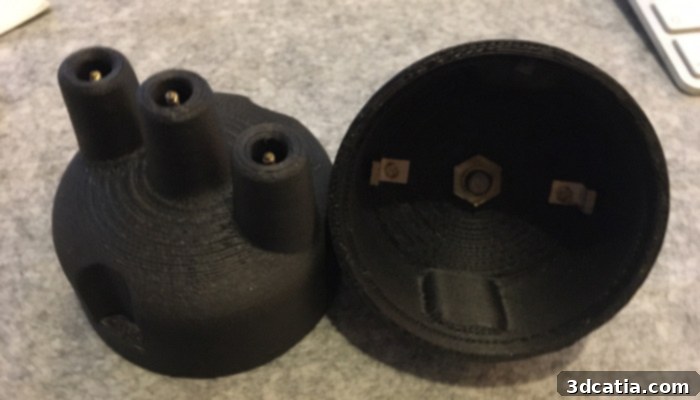
The distributor cap printed in 3D in PA. (photo credits: Artec 3D)
Overcoming Obsolescence: Replacing a Century-Old Part Using Artec 3D Scanning
The primary challenge Carl faced was how to replace a critical component that had been manufactured a staggering 100 years prior, with its production long since discontinued. This was more than just a logistical headache; it was a significant impediment to the Harley’s restoration. Even if a rare, century-old distributor cap could be sourced from a niche dealer, the costs would be exorbitant, and there would be no guarantee of its reliability or operational lifespan. Despite its diminutive size, the distributor cap is a central and indispensable component, absolutely vital for the engine’s ignition and successful starting. Without a functional distributor cap, the vintage Harley Davidson would remain a beautiful but inert display piece.
Determined to overcome these formidable obstacles and bring the motorcycle back to its former glory, Carl reached out to 4C Creative CAD CAM Consultants, specifically enlisting the expertise of Edwin Rappard. Edwin proposed a cutting-edge solution: utilizing a highly specialized 3D scanner, the Artec Space Spider, to accurately model the damaged part. The choice of the Space Spider was deliberate and strategic. This particular scanner is renowned for its exceptional precision and ability to capture intricate details, making it perfectly suited for small objects or complex geometries, sharp edges, and fine ribs often found in industrial components. Given its widespread use and proven capabilities within the industrial and automotive sectors, the Artec Space Spider was the ideal tool for Edwin’s task.
Carl van de Rijzen vividly recounted the simplicity and effectiveness of the process: “He scanned it. He just solved the problem, and it was over. He sent it back to me. And tada! The bike is 100 years old, and now we have the parts to make it work.” This powerful quote encapsulates the profound impact of this technology – turning what seemed like an insurmountable obstacle into a straightforward, elegant solution. The ability to quickly and accurately digitize a physical object, regardless of its age or complexity, is a game-changer for restoration projects, industrial repair, and countless other applications where obtaining original blueprints or manufacturing data is impossible.
According to Edwin, the 3D scanning phase itself was remarkably swift and efficient. A key factor contributing to this ease was the nature of the distributor cap: its dark, non-shiny surface minimized reflectivity, which can often complicate scanning by causing glare or requiring additional preparation. Furthermore, an intriguing aspect of the project was that the igniter head was incomplete during the initial scan. However, this challenge was expertly addressed using the advanced capabilities of the Artec Studio software. The software’s intelligent symmetry mode allowed Edwin to seamlessly add the missing section by replicating and mirroring an existing part of the object. “The part being symmetrical, I used a copy of the scan that I mirrored to ‘paste’ it into the missing space,” Edwin explained. “So I arrived at the end result: a brand new piece!” This clever application of software features highlights how modern 3D scanning workflows are not just about capturing data, but also about intelligent post-processing to achieve perfect digital replicas, even from imperfect originals.
From Digital Scan to Physical Production: Crafting the New Distributor Cap
With the damaged distributor cap successfully transformed into a precise 3D digital model, the next crucial step was to translate this virtual design into a tangible, functional part. Carl van de Rijzen collaborated with the renowned additive manufacturing specialist, Stratasys, a global leader in 3D printing solutions. The goal was to determine the most suitable material for producing a robust and reliable replacement part that could withstand the demands of a vintage motorcycle engine. After careful consideration and expert consultation, the final material choice fell upon polyamide (PA), commonly known as Nylon. This polymer was selected for its exceptional balance of properties, including high strength, excellent durability, good heat resistance, and inherent flexibility – characteristics that are paramount for a component like a distributor cap operating within an engine environment.
The 3D printing process brought the digital design to life, creating a new distributor cap that was geometrically identical to the original but free from a century of wear and tear. Following the additive manufacturing phase, an essential post-treatment step was undertaken. This involved specific finishing processes, primarily to give the new polyamide part a smooth, slightly shiny appearance that matched the aesthetic and functional requirements of the original component. Once this crucial post-treatment was complete, the newly printed distributor cap was ready to be installed. The moment of truth arrived as the new part was integrated into the Harley’s engine. With the turn of a key, the engine sprang to life, proving that the combination of advanced 3D scanning and printing had not only replaced an obsolete part but had effectively made the 1919 Harley Davidson fully operational and road-ready once again. This successful outcome underscored the immense potential of these technologies in preserving historical machinery.
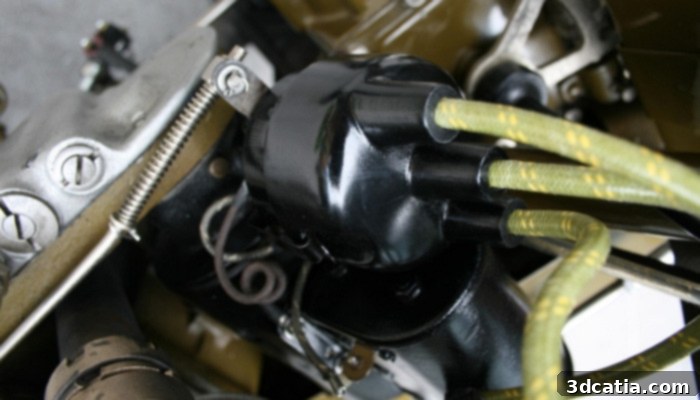
The Harley now has a printed and functional distributor cap (photo credits: Artec 3D)
Beyond the Harley: The Broad Potential of Reverse Engineering and Additive Manufacturing
The successful restoration of the 1919 Harley Davidson using 3D scanning and printing is far more than just a captivating anecdote for motorcycle enthusiasts. It stands as a powerful testament to the transformative potential of reverse engineering and additive manufacturing across a multitude of industries. Visual First, 4C Creative CAD CAM Consultants, and Stratasys all concur that this innovative methodology offers unparalleled possibilities well beyond the automotive sector. This approach is highly relevant for industries dealing with legacy equipment, custom machinery, or components with long lead times for traditional manufacturing. From industrial maintenance and aerospace to medical device manufacturing and cultural heritage preservation, the ability to rapidly reproduce exact replicas of complex or obsolete parts represents a significant leap forward in efficiency, cost-effectiveness, and operational continuity.
For everyone involved in this specific motorcycle project, the experience transcended a mere technical task; it was described as a truly fun, innovative, and deeply rewarding endeavor. The immense satisfaction came not just from overcoming a technical hurdle, but from making the owner incredibly happy with the “rebirth” of his cherished vintage vehicle. Edwin Rappard perfectly encapsulated this sentiment: “The perfect example of using new technology to fix old technology! We really had fun. It’s a privilege to work on such an old Harley, and using Artec to do it is even more fun. What more?” This quote highlights the intersection of passion, technology, and preservation, illustrating how advanced tools can serve to bridge the gap between historical craftsmanship and future functionality.
This project exemplifies how modern 3D technologies are not just about creating new things, but also about preserving and revitalizing the old. It provides a blueprint for how industries can leverage these tools to address challenges of obsolescence, reduce downtime, and foster innovation. The collaboration between specialized companies like Visual First, technology providers like Artec 3D, and manufacturing partners like Stratasys creates a powerful ecosystem capable of tackling complex engineering problems with unprecedented speed and precision. This approach allows for the custom creation of parts that meet original specifications, often with improved materials, ensuring the longevity and continued performance of valuable assets. You can find more information about this inspiring project and others on Visual First’s dedicated page HERE.
What are your thoughts on the application of the Artec 3D scanner and additive manufacturing in the renovation of this iconic Harley Davidson? Do you see similar potential in other sectors? Let us know your insights in a comment below or join the conversation on our Facebook, Twitter andLinkedIn pages! For the latest updates and breaking news in the world of 3D printing, remember to sign up for our free weeklyNewsletter here, delivered straight to your inbox!