
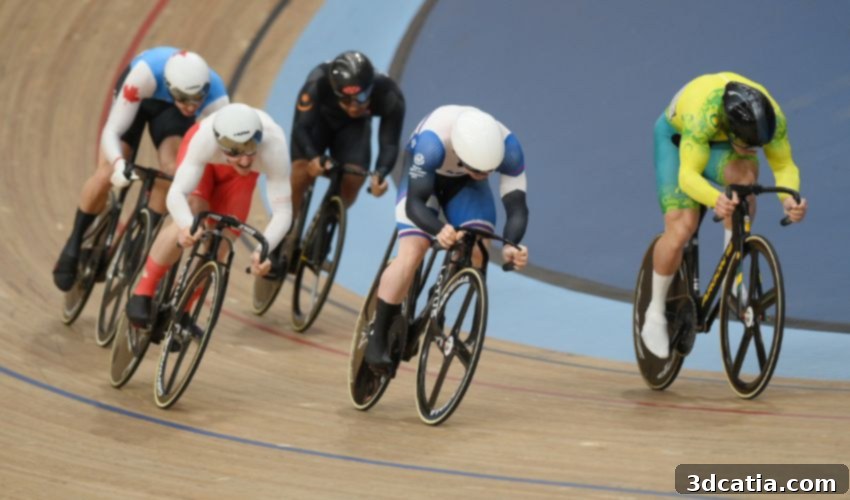
Additive Manufacturing Propels British Cycling: Renishaw’s 3D Printing Innovations Deliver Peak Performance
The world of elite sports is constantly seeking a competitive edge, and once again, advanced manufacturing technologies are proving to be a game-changer. Additive Manufacturing (AM), commonly known as 3D printing, has demonstrated its profound impact, particularly within the demanding sports sector. A prime example of this innovation is the collaboration between Renishaw, a global leader in metal 3D printing solutions, and the esteemed Great British Cycling Team (GBCT). Their partnership culminated in the development of a state-of-the-art track bike, specifically engineered to dominate the Birmingham 2022 Commonwealth Games, which took place from July 29th to August 7th. This groundbreaking project leveraged Renishaw’s expertise in laser powder bed fusion technology and the superior properties of titanium to craft intricate, yet incredibly lightweight components. Furthermore, additive manufacturing played a critical role in facilitating faster and more effective rapid prototyping, enabling the optimization of the bike’s aerodynamics to an unprecedented level.
This significant contribution to the GBCT’s success at the Commonwealth Games is not an isolated incident but rather the latest chapter in a fruitful and ongoing partnership. Renishaw and British Cycling have been close collaborators since 2019, consistently pushing the boundaries of what’s possible in cycling performance. Their prior triumphs include the production of innovative parts for the track bike that helped secure an impressive seven medals at the Tokyo Olympics. During that period, additive manufacturing proved invaluable for designing highly customized parts, offering unparalleled precision and speed. A notable achievement in Tokyo was Renishaw’s creation of bespoke handlebars, meticulously tailored to the unique biomechanics and preferences of each individual rider. This level of personalization is virtually impossible with conventional manufacturing techniques. Beyond initial customization, the agility afforded by 3D printing allowed the team to implement crucial, last-minute modifications before races—a strategic advantage that traditional methods simply could not provide. This ability to adapt and refine designs on the fly ensures that riders always have the most optimized equipment available for competition.
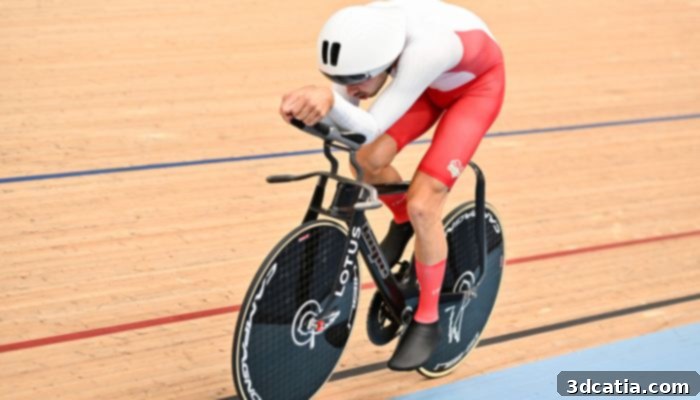
Charlie Tanfield from England on the bike (photo credits: Renishaw)
Revolutionizing Track Cycling: The Development of a New Bike with Metal Additive Manufacturing
The continued pursuit of excellence led British Cycling to once again seek Renishaw’s expertise for the development of their latest track bike. The team fully recognized the inherent benefits of metal additive manufacturing, particularly its capacity to produce lightweight yet incredibly complex components. For this specific project, the material of choice was titanium, a metal renowned for its exceptional strength-to-weight ratio and fatigue resistance. Renishaw’s proprietary laser powder bed fusion solutions were instrumental in fabricating a range of critical parts for the bike. This ambitious undertaking was a collaborative effort, with Renishaw working closely alongside industry leaders like Lotus Engineering and Hope Technology. The collective goal was clear: to maximize the bike’s performance, ensuring every advantage in the fiercely competitive race for medals.
The decision to employ metal 3D printing went beyond its ability to create optimally designed parts; its profound benefits in rapid prototyping were equally crucial. In track cycling, where milliseconds can determine victory or defeat, aerodynamics are paramount. Traditionally, high-performance bikes rely heavily on carbon fiber, a material lauded for its lightness and strength. However, manufacturing final carbon fiber parts often necessitates injection molding. The creation of each mold is not only a significant financial investment but also leads to protracted turnaround times. Such delays are far from ideal when the iterative testing of parts for optimal aerodynamic performance is a continuous requirement. Metal AM fundamentally transformed this process, empowering British Cycling to test numerous design iterations and analyze results with unprecedented speed. This agility in design and testing cycles allows for far more comprehensive optimization, ensuring that the final product represents the pinnacle of engineering efficiency.
The Power of Precision: Titanium and Laser Powder Bed Fusion in Cycling
Delving deeper into the technology, the choice of titanium and laser powder bed fusion (LPBF) was strategic. Titanium offers an unrivaled combination of high strength, low density, and excellent corrosion resistance, making it an ideal material for performance-critical cycling components. Its biocompatibility also makes it suitable for parts that riders frequently interact with. LPBF, a sophisticated form of metal additive manufacturing, involves using a high-power laser to selectively melt and fuse metallic powders layer by layer, building a component from the ground up based on a 3D digital design. This process allows for the creation of incredibly complex geometries, including internal lattice structures that dramatically reduce weight without compromising strength or stiffness. For track bikes, this translates to parts that are lighter, more rigid, and inherently more aerodynamic. The precision of LPBF also ensures minimal material waste compared to traditional subtractive manufacturing methods, contributing to more sustainable production practices.
Unlocking Aerodynamic Superiority Through Iterative Design and Prototyping
In track cycling, every fraction of a second counts, making aerodynamic efficiency paramount. The collaboration focused heavily on this aspect, with Renishaw’s AM capabilities proving indispensable. The traditional design process often involves costly and time-consuming tooling, which severely limits the number of design iterations possible within a development cycle. By contrast, AM enabled British Cycling and its partners to rapidly produce multiple prototypes of components like frame joints, forks, and handlebars. Each prototype could then be rigorously tested, often in wind tunnels, to analyze its aerodynamic performance. The data gathered informed subsequent design modifications, allowing for a highly iterative and optimized development loop. This agile approach significantly shortened the time from concept to a competition-ready part, providing the GBCT with an unprecedented advantage in fine-tuning their equipment for maximum speed and efficiency. The ability to quickly manufacture and test a physical part rather than relying solely on simulations accelerates the discovery of optimal designs.
Customization: Tailoring Equipment for Individual Rider Excellence
One of the most transformative aspects of Renishaw’s involvement was the capacity for personalized equipment. While the original content briefly mentioned custom handlebars, the implications are far-reaching. Every elite cyclist has a unique physiology, riding style, and aerodynamic posture. With traditional manufacturing, creating bespoke components for each rider is often prohibitively expensive and time-consuming. However, Renishaw’s metal 3D printing made it feasible to design and produce handlebars, and potentially other contact points, that were perfectly molded to each athlete’s hands and arms. This customization enhances comfort, improves power transfer, reduces drag by optimizing the rider’s position, and minimizes the risk of fatigue or injury. The result is a bike that becomes an extension of the rider, maximizing their potential on the track. This “marginal gains” philosophy, where small improvements across numerous areas accumulate into significant overall performance enhancements, is central to elite sports, and AM is a powerful enabler of this strategy.
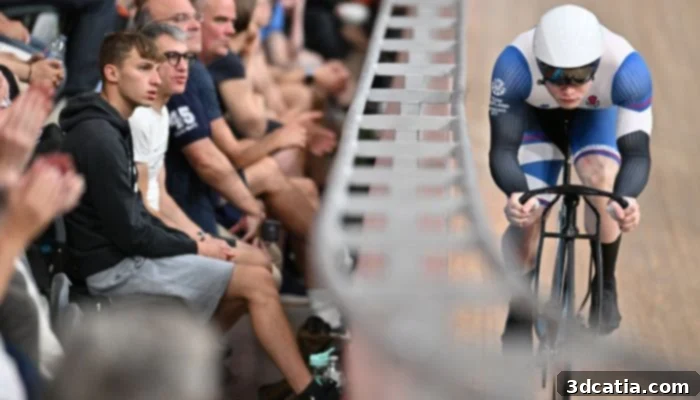
Scotland’s Jack Carlin in the Qualifiers (photo credits: Renishaw)
Success at Birmingham 2022 and the Future of AM in Sports
The culmination of this innovative collaboration was showcased at the Birmingham 2022 Commonwealth Games, where British cyclists competed with equipment that embodied cutting-edge engineering. Ben Collins, Senior Additive Manufacturing Application Engineer at Renishaw, aptly summarized the significance of their work: “The Commonwealth Games was a brilliant opportunity to display the innovation of British engineering as well as British talent on our home turf. The riders needed the best equipment to perform at such high levels. By providing tailored AM parts to the cycling team, we’ve delivered the performance the team requires while also highlighting the potential of AM in producing high quality strong, lightweight, and complex components.” This sentiment underscores not only the immediate success on the track but also the broader implications for additive manufacturing across various sporting disciplines. The ability to rapidly innovate, customize, and optimize equipment with advanced materials like titanium positions AM as an indispensable tool for elite athletic performance.
The partnership between Renishaw and British Cycling serves as a powerful testament to the transformative potential of additive manufacturing in sports. As the technology continues to evolve, we can anticipate even greater advancements in bicycle design, material science, and personalized athletic equipment. From cycling to motorsports, winter sports, and beyond, 3D printing is enabling athletes to push human limits by providing them with tools that are perfectly optimized for their unique needs and the demands of their sport. The continuous quest for marginal gains will ensure that collaborations like this become the norm, rather than the exception, in the world of high-performance athletics. The legacy of this project extends beyond medals, inspiring future engineers and athletes to embrace innovation in their pursuit of excellence. You can find out more on Renishaw’s website HERE.
What are your thoughts on Renishaw’s groundbreaking work with the Great British Cycling Team to engineer and optimize their track bikes? We’d love to hear your perspective! Let us know your opinions in a comment below or join the conversation on our LinkedIn, Facebook, and Twitter pages! Don’t forget to sign up for our free weekly Newsletter here, bringing the latest 3D printing news straight to your inbox! You can also find all our compelling videos on our YouTube channel, showcasing even more incredible applications of additive manufacturing.