
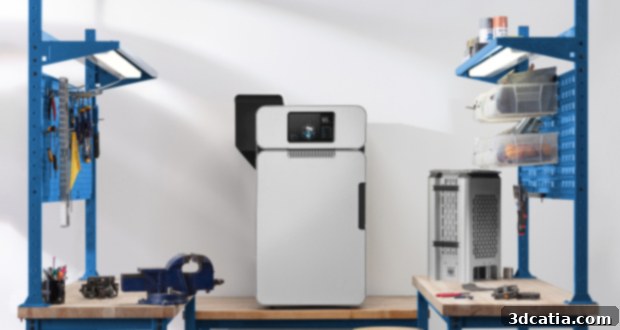
Formlabs Revolutionizes Industrial 3D Printing with Affordable Fuse 1 SLS Printer and Form Cell Automation System
In a monumental announcement at the Formlabs Digital Factory conference, the Boston-based 3D printing powerhouse, Formlabs, officially unveiled two groundbreaking innovations poised to reshape the additive manufacturing landscape. The company introduced the highly anticipated Fuse 1, their inaugural Selective Laser Sintering (SLS) 3D printer, alongside Form Cell, an innovative automated system designed to manage and optimize fleets of Form 2 Stereolithography (SLA) 3D printers. These launches signify a pivotal moment for Formlabs, expanding their reach from desktop SLA into the realm of industrial-grade SLS technology and automated production, while maintaining their commitment to accessibility and affordability.
Formlabs has long been celebrated for democratizing professional 3D printing with their acclaimed SLA machines, including the original Form 1, the enhanced Form 1+, and the hugely successful Form 2. Building on this legacy, the company is now venturing into the SLS market, a segment traditionally dominated by high-cost industrial systems. SLS technology is revered for its ability to produce strong, functional parts without the need for support structures, making it ideal for complex geometries and end-use applications. However, the exorbitant price tag, often reaching several hundred thousand dollars, has historically limited its adoption to large corporations and specialized service bureaus. Formlabs aims to disrupt this paradigm by introducing the Fuse 1 at an unprecedented starting price of just $9,999, making it an astounding 20 times more affordable than many existing industrial SLS solutions. Pre-orders are already available on the Formlabs website, with initial deliveries projected for mid-2018, promising to unlock new possibilities for designers, engineers, and manufacturers worldwide.
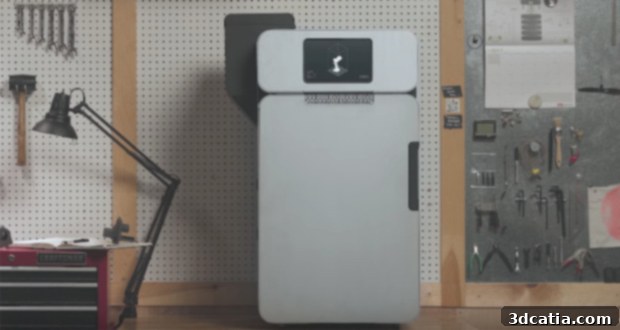
The Formlabs Fuse 1, bringing industrial SLS technology to a $9,999 price point.
Democratizing Industrial-Grade SLS with the Fuse 1
Max Lobovsky, CEO of Formlabs, underscored the company’s foundational philosophy in his statement: “When we launched the world’s first desktop stereolithography 3D printer in 2012, Formlabs created new possibilities for designers and engineers to create physical products by giving them access to professional 3D printing technology that had historically been unavailable.” He continued, “With Fuse 1, we are taking the same approach to making powerful SLS technology available to a huge range of customers. And with Form Cell, we are making an efficient, scalable production solution by leveraging the Form 2, an SLA print engine that’s already stood the test of printing more than 10 million parts.” This vision reflects Formlabs’ consistent drive to democratize advanced manufacturing tools, making sophisticated technologies accessible to a broader audience, from small businesses and design studios to large enterprises looking for distributed manufacturing solutions.
The Fuse 1 is engineered to produce complex, functional parts with exceptional mechanical properties using industrial-grade Nylon (PA 12 and PA 11) materials. Its generous print volume of 165 x 165 x 320 mm allows for the creation of sizable components or batches of smaller parts within a single build. A key advantage of SLS technology, which the Fuse 1 fully leverages, is the elimination of the need for printing supports. This feature not only streamlines post-processing but also enables greater design freedom, allowing for intricate internal geometries and interlocking parts that would be challenging or impossible with other additive manufacturing processes. Furthermore, Formlabs has confirmed that approximately 50% of the unused powder within the build chamber will be reusable, significantly reducing material waste and operational costs – a critical factor for sustainable and cost-effective production. The ability to reuse powder contributes to a lower total cost of ownership, making high-quality additive manufacturing more economically viable for a wider range of applications.
The impressive capabilities of the Fuse 1 have already captured the attention of major industry players. Numerous companies, including giants like GE, Lockheed Martin, Tesla, and Google, have had the opportunity to beta test Formlabs’ new machine and system. Their involvement underscores the industrial relevance and potential impact of the Fuse 1, particularly for high-stakes applications in aerospace, automotive, and advanced technology sectors. These early adopters often require robust, high-performance parts for prototyping, tooling, and even end-use components, making SLS an ideal choice. Formlabs’ ability to gain such high-profile beta testers validates the Fuse 1’s readiness for demanding professional environments and its potential to deliver consistent, quality results.

Anticipated deliveries for the Fuse 1 are expected to commence by the end of 2017 or early 2018.
David Beardsley, a manager at Google ATAP (Advanced Technology and Projects), shared his insights on the transformative potential of the Fuse 1. “SLS technology enables designers and engineers to accelerate their prototyping process by combining realistic material properties with the minimization of 3D printing design constraints,” Beardsley stated. He elaborated, “With the Fuse 1, a combination of high precision parts, reduced cycle time and robust materials allow teams to easily iterate throughout the design process and accelerate from whiteboard to final parts.” This testimonial highlights the critical role the Fuse 1 can play in rapid product development cycles, offering the speed and flexibility needed to bring innovative ideas to market faster. The ability to produce durable, functional prototypes quickly is invaluable for companies like Google, which operate at the cutting edge of technological innovation.
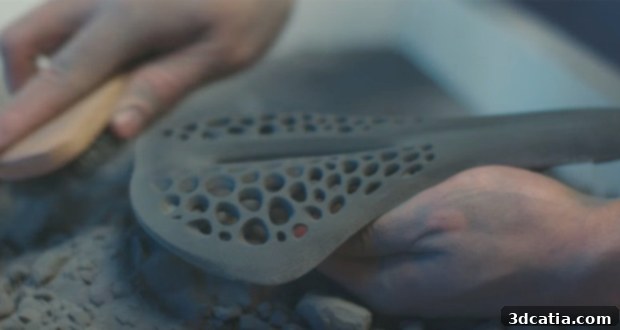
Powered by SLS technology, the Formlabs Fuse 1 will produce high-quality PA11 and PA12 nylon parts.
Form Cell: Enabling Scalable, Automated SLA Production
Beyond the Fuse 1, Formlabs also introduced Form Cell, an advanced automation system designed to create a “digital factory” environment for its existing Form 2 SLA printers. Form Cell integrates a robotic arm to operate multiple Form 2 machines concurrently, transforming what was once a manual, individual printing process into a streamlined, production-scale operation. This innovative system significantly reduces manual labor and intervention by automating critical steps such as print initiation, resin loading, and part removal. Through remote monitoring capabilities, operators can oversee the entire production process from a centralized location, receiving real-time updates and notifications. The system’s ability to detect and flag errors proactively ensures consistent output quality and minimizes downtime, thereby enhancing overall efficiency and throughput. Form Cell represents Formlabs’ vision for future manufacturing, where automation and smart systems enable lights-out production and significantly lower the per-part cost for SLA parts, extending the Form 2’s utility beyond prototyping into true scalable manufacturing.
The combination of the Fuse 1 and Form Cell underscores Formlabs’ dual strategy: to push into new industrial technologies like SLS while simultaneously enhancing the scalability and efficiency of their existing, highly popular SLA ecosystem. By offering an affordable SLS solution, Formlabs is opening up new applications for strong, functional parts that were previously out of reach for many businesses. Concurrently, Form Cell elevates the Form 2 from a powerful desktop tool to a component of an automated production line, addressing the growing demand for customized mass production and rapid, on-demand manufacturing. These innovations empower engineers and designers to move from concept to final product faster and more efficiently, driving innovation across various industries.
The impact of these announcements extends beyond just new hardware. They signal a shift in the broader 3D printing market, challenging the traditional divide between expensive industrial systems and more accessible desktop machines. Formlabs is effectively bridging this gap, making advanced additive manufacturing capabilities available to a much wider user base. This democratization of technology has the potential to foster greater innovation, reduce manufacturing lead times, and enable new business models that leverage the flexibility and cost-effectiveness of localized, digital production. As industries continue to embrace digital transformation, Formlabs’ commitment to making powerful tools more accessible positions them as a key enabler of the next generation of manufacturing.
For a deeper dive into Formlabs’ innovative spirit and to see these new technologies in action, check out the video below:
What are your thoughts on the revolutionary Formlabs Fuse 1 SLS 3D printer and the Form Cell automation system? Do you believe these innovations will significantly impact the future of additive manufacturing and industrial production? We invite you to share your insights in a comment below or join the discussion on our Facebook and Twitter pages. Stay ahead of the curve and receive all the latest news and developments in the dynamic world of 3D printing directly in your inbox by signing up for our free weekly newsletter!